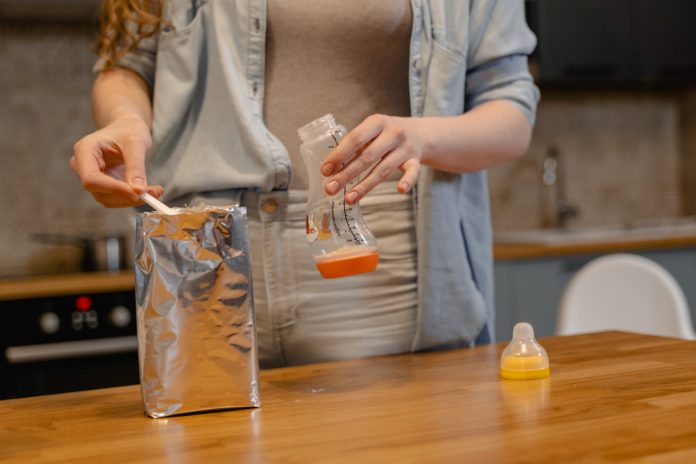
We can all agree that “fed is best” when it comes to our infants, regardless of where you land on the breastfed vs. bottle-fed scale. As a mother of four whose approach has run the gamut of feeding my newborns — pumping exclusively, bottle feeding with formula, exclusively breastfeeding, and supplementing with formula — I have concluded that fed truly is best. While I was fortunate that I could extensively breastfeed three out of four of my children, for many families, this is simply not an option. There are a dozen reasons why an infant is fed formula, and all of them are valid. Our families are all unique, and our needs can be vastly different from another.
Unfortunately, the terrifying question for many families with newborns in our country amidst the current formula shortage is “Will I be able to feed my baby at all?” On the heels of a pandemic, our country is now facing a horrendous situation with over 40 percent of formulas now out of stock across the country, according to this article from the NY Times. That is coming dangerously close to half of all formulas, which may yet occur before this is over.
This shortage does not solely affect newborns. Children who rely on formula as their primary source of nutrition, such as medically fragile children and those with disabilities, are facing this issue as well. Some of these children are well beyond infancy, and some may need formula for the entirety of their lives.
How Did We Get Here?
Several factors have played a role in this dangerous shortage, from supply chain delays due to the pandemic in 2020, to one of the largest manufacturing plants in Michigan reportedly being contaminated and shut down since February, to the fact that there are only five manufacturers of infant formula in the country. ByHeart is the newest manufacturer of infant formula that has received approval after a grueling five-year process. They are their first in 15 years.
On Thursday, May 19, the head of the FDA met with Congress in a bipartisan hearing on how this shortage happened and why it took so long for the Abbott manufacturing plant in Michigan to be closed and investigated for contamination. Dr. Robert Califf reported that the Abbot plant is expected to reopen in the next two weeks, but that it would be another two months before the formula would be available in stores. In the meantime, the shortage is expected to get worse.
To mitigate this terrifying shortage, other countries, like Germany, began sending the U.S. shipments of their own infant formula this past weekend. Similac, a brand I have personal experience using, is importing formula from its FDA-approved plant in Ireland as well as increasing production at its Columbus plant.
Social Media and “Tips”

With this grim outlook, many mothers and caregivers are turning to alternatives. My own Facebook feed has been flooded with “tips”, including an alleged formula recipe. While these “tips” may feel helpful, they could be harmful, especially when it comes to making your own formula. Science has come a long way since the 1940s, and while that may have been acceptable over 80 years ago, medical professionals are urging parents not to attempt a DIY formula. Check out this article and this article about the dangers of homemade formula.

Another tip I have stumbled across is using other country’s Amazon sites, specifically Canada, to order infant formula. Curious, I did some of my own investigating. I switched my Amazon account from the U.S. to Canada, following the direction of the tip. I searched for Similac, a popular formula brand. A list of various Similac and — I am assuming — Canadian formulas popped up. As I am a Prime member, I clicked the “Prime” button at the top only to have most formulas disappear. I then clicked on one of the only Similac products left, 360 Total Care. It came in a 850-gram container, which equates to roughly 30 oz. Since most cans in the U.S. are sold in 12 oz (about 340.19 g) containers, this is roughly equivalent to 2.5 cans.
It was also in-stock. This could be legit, I thought to myself, but I quickly realized I was wrong. The cost for this one can was $69.90 CAD, and despite being a Prime member, the shipping cost another $39 CAD, for a total of $108.90 CAD – $86.38 US. For one can, albeit a large can, of Similac 360 Total Care. This was on May 13, and the approximate delivery date was May 25. That’s almost a full two weeks, which if I had a hungry infant now, would be expensive and not very helpful.
Looking back at the first list without the Prime option, I recognized Similac’s NeoSure formula. This is the brand’s high-calorie formula typically recommended for premature infants, which my daughter had been on almost 15 years ago. She had been born 10 weeks early and spent 40 days in the NICU. Recalling this period in my oldest child’s life, I clicked on the link. In bold letters, I saw OUT OF STOCK. Not even Canada has a supply of this high-calorie formula, which many families of premature infants rely on. I cannot fathom how truly awful this must be for these families.
In short, I found this “tip” to not be realistic.
One tip that appears to be legitimate after some research is this formula exchange website. You are prompted to choose between two options, whether you have formula or if you need formula. A disclaimer at the bottom states that by clicking either option, you are agreeing to receive emails from another party. I cannot say for certain whether this website is reliable, but is worth taking a look at if you are interested.
Another tip that I have seen on my feed is to contact the brand of formula that you use directly. You tell them the state in which you live, and they will ensure they send extra formula to your state. The comments section was a mixed bag; some said they waited on hold for over two hours, and some reported no issues. Similac’s website has a Find a Retailer option for each of their products, although they suggest you contact the store ahead of time. Click here for news and updates on their products.
Despite all the misinformation circulating among Facebook and other social media platforms, I have seen some wonderful support as well. I belong to several parenting support groups, and multiple times a day I see posts about someone having a certain kind of formula that they cannot use and offering it to someone who needs it. I have seen posts from members who have taken a photo of the formula aisle at area stores or posting what formulas they have seen at which locations. Most often, the formula that is being offered to those who need it is given free of charge, although I have seen a small percentage of members trying to profit from it as well — thankfully, this is the minority. This does, however, raise concerns of potential price gouging soon.
Brand Name Formula, Store Brand Formula, and WIC
Most infants can use a brand name formula and its generic, store brand counterpart without difficulty. If you are concerned about your little one’s gastrointestinal comfort, you can make the switch by mixing the two brands of formula, gradually adding in the new formula each day. If your infant shows signs of discomfort, you can always revert to an earlier mix for another day or two. Here’s a sample schedule (always check with your pediatrician first!):
| Day |
Previously Used Formula |
New Formula |
| 1-2 |
75% |
25% |
| 2-3 |
50% |
50% |
| 3-4 |
25% |
75% |
| 4-5 |
|
100% |
This can also be useful if switching a breastfed infant to formula, as I did for my daughter 15 years ago.
Store brands are just as nutritious as brand name formulas but can be half the cost. Have a Costco membership? Try their store brand formula. Prefer Sam’s Club? Check this out. Want to check out Walmart, Target, or a different store? Click here! If you’re interested in formula assistance, keep reading!
WIC is an income-based nutritional assistance program for Women, Infants, and Children up to age five. They aid families with infant formula, with a varying number of canisters per month depending on if the infant uses formula to supplement breastmilk or is exclusively formula fed. My family qualified for their program when my oldest daughter was born. Infants who need a specific formula get a prescription written by their pediatrician, which allows the families to use WIC to buy in-store. Benefits are loaded onto a card which is used at the register like SNAP or a debit card. Back when we had WIC for myself and my daughter, paper coupons were printed in the office!
WIC periodically changes the infant formula offered. Fifteen years ago, it was Similac. Recently, it offered Gerber-brand formula. As of October 1, 2021, it changed to Enfamil. Click here for the corresponding Gerber-brand to Enfamil-brand.
Typically, you can count on going through 13-14 cans of formula per month, until your child reaches around six months. Generally, this is the time cereal and other mild foods can be safely introduced. Very Well Family suggests a budget of $70-$250 per month for formula fed infants. Programs like WIC may be able to help ease the financial burden.
While using WIC can offset the cost of infant formula, it may not cover the entire amount of formula needed. If possible, supplement with the corresponding store brand formula. While WIC is limited to certain brands and sizes of formula, all infant formula can be bought with SNAP benefits.
Click here or here to check income eligibility for Ohio’s SNAP benefits.
Click here for the CDC’s guidelines for how much and how often you should feed your infant.
Click here for a list of WIC offices in Ohio.
Click here to see if your family may qualify for WIC, here for the 2021/22 Income Guidelines, and here for the 2022/23 Income Guidelines, beginning July 1.
Click here for the WIC application.
Already have WIC? Click here for the Prescribed Formula and Food Request Form.
Ohio and Michigan now offer waivers for alternate container sizes, different brands without a doctor’s note, and exchange recalled formula bought with WIC benefits.
The North American Society for Pediatric Gastroenterology, Hepatology & Nutrition (NASPGHAN) has a wealth of resources for the infant formula shortage 2022, as well as this list of recalled formula and comparable replacements.
Click here for Healthy Children’s resource page for the formula shortage and what to do if you can’t find any.
Bottom Line – Fed is Best!
If you are facing formula insecurity, reach out! Between the resources listed here, social media support groups, pediatricians, and average, everyday citizens, you and your family will be just fine. It may take more legwork than we are accustomed to, a little more resourcefulness, and perhaps some extra planning to ensure you do not run out unexpectedly, but if there is one thing I have seen rise out of this stressful situation, is that we are all in this together. Even if it is as small as sharing what formulas have been seen in which store via Facebook or offering formulas, you can no longer use free of charge to a family in need, it all adds up.
We can all agree that fed is best. Now is not the time to debate which method is better..
Imagine how frightening this shortage is for millions of families; those with premature infants, full-term and healthy infants, or medically fragile children and adolescents. Keep a watchful eye when out grocery shopping for your family. You may not personally have infants in your home, but chances are someone you know and love does. Be mindful of misinformation or outdated information that may be more harmful than helpful. We all need to care for each other now more than ever, especially those who are most vulnerable, our newborns, our infants, our special needs and/or medically fragile children, and above all, our mothers and caregivers.
Interested in learning more about infant feeding? Read “Breastfeeding vs. Formula” and “Donating Breastmilk, Saving Lives.”





 Tatyana has family and friends still living there. Like so many people in Ukraine, Craig and Tatyana couldn’t believe the Russians would actually invade a country where Russians had so many relatives, friends and such a deep cultural kinship.
 Help where it’s needed most