Home Blog Page 194

A Former Lifeguard Reveals 5 Secrets You Should Know

Summer is almost upon us, which means pools and beaches will be soon be opening. While your kids are having fun splashing in the surf, it is important to keep in mind water safety.

When I was 16 years old, I got my first real job as a lifeguard for the public town pool. Now that I’m a mom, I understand how necessary it is for me to watch my children and not rely on the lifeguard.

According to the National Center for Health Statistics (NCHS), an average of 3,868 deaths per year occur due to unintentional drowning in the United States. Children ages 1–4 years old were most likely to drown in a swimming pool. Individuals from 5-19 years old were most likely to drown in natural water such as an ocean or lake.

Based on my experience as a lifeguard, here are a few reasons I watch my children when they swim: 

It Was My First Job

Translation: I had no experience. Sure, I got the proper certifications, but I had never had a job, and I never was responsible for ensuring the safety of others. I don’t think I really understood how serious it was to be entrusted with this. I thought being a lifeguard sounded like fun. I was getting paid to sit in the sun and socialize with my friends—that’s how teenagers tend to view it.

It Was Low Paying

Granted, this was a while ago, and the pay can vary depending on where you work, but my first lifeguard job paid $4.25 per hour (it wasn’t a lot back then either — today’s dollar equivalent is $8.86). According to PayScale the average rate for a lifeguard now is $9.48, which might not be considered a lot of money to a teenager. Even though I was a responsible person, there are teens who view this low pay as a reason to not pay attention.

It’s Hard to See/Hear Everything

On hot, crowded days, there are hundreds of people in the pool. Kids are screaming to get their friends’ attention, parents are yelling at their kids to get out of the pool and the other lifeguard is hollering yet again to the child running, “you need to walk, not run.” It’s hard to hear over all this commotion. If your child yells “help,” then I might not be able to hear it. Or, if they are struggling to swim, I might not be able to see it. With so many people in the pool all moving in different directions, it’s hard to keep track of everyone.

I’m Not a Disciplinarian

The rules for no running or no diving in shallow water exist because it’s unsafe. I had a hard time enforcing these rules since I didn’t know how to discipline other people’s children (they don’t teach that during the lifeguard certification class). This creates an unsafe situation not only for your own children, but for other people as well if parents don’t help to enforce these rules. 

People Crack Under Pressure

One time while I was a lifeguard, a person had a seizure and was drowning. I was not near the person when it happened, but the lifeguard that should have rescued this person froze in fear and did nothing. Luckily another nearby lifeguard stepped in and rescued the person.

As a Parent You Should: 

  1. Always watch your child in the pool or other bodies of water, even if they know how to swim. Knowing how to swim doesn’t mean you can’t drown.
  1. Help enforce the pool rules like no running and no diving in shallow areas. Kids can easily slip on the wet cement when they run. And if you dive in shallow areas, you can hit your head which could cause paralysis.
  1. Make sure your child understands the pool gradually gets deeper. I once saw a child almost drown because they didn’t understand this concept and walked to a point where they could no longer stand.
  1. Understand that arm floaties can come off your child. Don’t rely on this to keep your child’s head above water.
  1. Understand that kids can drown in a puddle of water and it only takes seconds.

The CDC found most drownings are preventable. Drownings usually occur in areas without lifeguards. Even if there is a lifeguard, as a parent it is important to have your guard up as well.

Originally published on Signature Moms.

 Cheryl Maguire holds a Master of Counseling Psychology degree. She is married and is the mother of twins and a daughter. Her writing has been published in The New York Times, National Geographic, Washington Post, Parents Magazine, AARP, Healthline, Your Teen Magazine and many other publications. She is a professional member of ASJA. You can find her at Twitter @CherylMaguire05

SELF-ESTEAM Empowers Girls to Succeed

Caption One: Members participated in an Egg Drop Workshop with University of Toledo's National Society of Black Engineers.

Science and technology education has become increasingly important in classrooms and after-school programs to prepare students for the future. But not all students receive equal opportunities or exposure to these growing fields of study. SELF-ESTEAM was founded in 2019 to change that.

“Our mission is to instill underrepresented young women of color with fundamental skills which foster independence through workshops, programs, service and mentorship for personal and professional success,”  said Monique Montgomery, public relations director for SELF-ESTEAM.

Montgomery noted the many problems that plague youth in the metro Toledo area, including human sex trafficking, drug abuse, teen pregnancy and poverty. 

“SELF-ESTEAM was founded to address these issues by offering a program that gives underrepresented girls the opportunity to build their confidence and their community,” she said. “There are very few programs in Lucas County that are dedicated to the betterment of inner city youth. There are even fewer interdisciplinary programs that provide access to educational materials centered around Science, Technology, Engineering, Art, and Mathematics. We created a program with the purpose of catapulting more underrepresented women into STEAM-related careers.” 

The program is available to girls ages 12 to 18, and offers a balance of community service-related events along with workshops and educational opportunities.

Members created DIY animated holograms using peppergram and their cell phones.

“SELF-ESTEAM will assist in the transformation of teens who come from poverty and marginalization into healthy and nourished adults,” Montgomery stated. “Though our members may not come from financially secure environments, they have the potential to become experts to better their own lives. Although they lack decent education, social investments, access to technology, health services and creative outlets, with the right guidance, we believe our members can become change-agents in their own lives, community, country and world.”

Recently, the nonprofit organization partnered with Winterfield Venture Academy to offer the program to girls in grades 6-8.

“Winterfield Venture Academy has proven to be a successful partnership for SELF-ESTEAM,” said Montgomery. “The staff has been very hands-on and vocal in expressing their need for a program in their school. The students were able to engage in authentic but challenging educational experiences that will hopefully enhance the quality of their lives in the future. We take pride in knowing that the students of Winterfield show up voluntarily to our program and fully commit to each workshop outside of regular school hours.”

The University of Toledo’s National Society of Black Engineers has also assisted the organization by aiding the staff with the implementation of the STEAM curriculum. In addition, they have partnered with members through the Egg Drop Mentorship Program.

This year, members of the organization have participated in the Friendly Center’s PB and J drive, created meals for families at the Ronald McDonald House, and helped to fill backpacks with school supplies for Lucas County Children’s Services.

 “In the fall, SELF-ESTEAM plans to host its Community Engagement and Enrollment Day (CEED Day), where we inform families of our program with hopes of recruiting new members. The purpose of CEED Day is to engage with the community, partners, and the students and families. During the event, we will have S.T.E.M. demonstrations, entertainment, and giveaways,” Montgomery said.

“We have a great program and vision that we wish to carry out, but funding is needed. We are currently seeking opportunities, sponsorships and donations to help fund our program.”

For more information on the program, visit SELF-ESTEAM’s website and follow them on Facebook page and Instagram @selfesteamtol.

Toledo Mud Hens encourage kids to Play Ball June 10-12

image

In an age of video games, TikTok and YouTube, it can be harder than ever to encourage kids to engage in outdoor activities. The Toledo Mud Hens, in partnership with Major League Baseball and the City of Toledo, are hoping to help.

The team will host its annual Play Ball Weekend at Fifth Third Field beginning Friday, June 10. The three day event features a series of activities aimed at building a stronger connection between youth sports and the city as a whole.

The Play Ball Initiative is a program designed to encourage young people to participate in their community’s baseball and softball activities, whether that be taking part in Little League or just enjoying more casual forms of playing the game. 

This year’s Play Ball Weekend with the Mud Hens will include the following events:


Friday, June 10: Field of Dreams Special Needs Clinic

Aimed at children ages five and up with special needs, the event will see three simultaneous games being played on the Fifth Third grass. Admission will include a souvenir Mud Hens baseball and two admission tickets to that evening’s game. $30 per camper (one adult chaperone is required to attend with each camper).


Saturday, June 11: Play Ball Event

Kids who have no experience with the game are welcome to this free event to learn the game’s fundamentals. Five skill stations will be set up to learn about throwing, batting and more. Open to any child ages 4-12, though preregistration is required.


Sunday, June 12: Toledo Mud Hens Kids Day

Families are encouraged to come out to the Mud Hens game and meet some of the players of MLW— the world’s most popular wiffle ball league. A pregame popup will be held in Hensville Park before the game, then attendees will be able to meet MLW personalities during the game. Afterward, the MLW’s Pacific Predators will face the Western Wildcats in right field as kids run the bases.For more information on Play Ball Weekend, visit the Toledo Mud Hens website

A Girl’s Guide to Puberty: Columbia University Professor Addresses Stigma

In Tanzania in 2004, Columbia University professor Dr. Marni Sommer was looking into the issue of menstruation and puberty for girls as a part of her doctoral dissertation research. She expected to find large gaps of knowledge and resources for these young girls in lower-income countries and areas, and decided to write a book that was composed of facts and tips, as well as first-hand accounts from older girls about their own puberties. After the great success this received, she turned her gaze onto the youth of America.

“My team at the Mailman School at Columbia University [and I] … had become increasingly concerned that even girls in the U.S. were not getting enough information and support about their changing bodies,” Dr. Sommer says. “The participatory research that we did with American girls, including collecting first period stories from twenty-five states across the country, led to our new book, ‘A Girl’s Guide to Puberty and Periods’!”


Fresh off the press, though also available digitally, this book aims to provide girls in low-resource areas of the country with the knowledge they need. Sommer and colleagues decided to self-publish to maintain the low price-point. They have also reached out to over 200 youth-focused non-profits who can use the book in their programs, and are also in the process of getting in contact with libraries and school-systems to get it placed on as many shelves as possible.

To the Drawing Board

In the style of a graphic novel, its pages covered in awesome drawings by Emily Scheffler of girls from various backgrounds, races, and cultures, “A Girl’s Guide to Puberty and Periods” is bound to help many girls identify with and showcase how different each puberty experience can be. Though the places and settings of the story can be quite different — it could be a dad, mom, or grandma helping out — themes of fear, embarrassment, and shame frequently popped up in the personal anecdotes. This not only shocked Dr. Sommer, but it also helped drive home the fact that this book was needed.

“The first period stories were all collected from the participatory research we did across the country, an approach that I’ve used since my doctoral research when I collected first period stories from adolescent girls in Tanzania,” she says. “In this way, the book becomes a book by girls for girls, as the stories are so central to the learning. It’s always been important to me that we have adolescent girls include, at the end of a personal story, their advice for younger girls who have yet to reach puberty. In that way it’s like an older sister advising a younger sister, and it is much more meaningful.”

Spotting the Issue

Puberty can be tough. The stigma surrounding it, particularly when in regards to female puberty, makes discussion of the ins-and-outs of periods, PMS, and feminine hygiene uncomfortable at best, scary at worst. 

“As my own friends begin to have kids reaching puberty, I have found it so interesting that they are across the board quite uncomfortable needing to ‘have the conversation,’ as it were, with their kids,” says Dr. Sommer. “Or their kids are eager to find anyone but their parents to talk to. I think the discomfort may be about the symbolic meaning that people — the girls themselves, parents or caregivers — give to puberty as a sign or symbol of young adulthood, of leaving childhood behind, even though many kids enter puberty long before we would perceive them as adults.”

Tiffany Pottkotter, a ProMedica Psychiatric Nurse Practitioner from Findlay who has had over fifty articles published and has engaged in fifty-six public appearances, also understands that there is a major problem in the stigma that surrounds girl’s puberty.

Photo Credits to ProMedica

“I wish I knew why [there is a stigma],” says Pottkotter. “I think it’s because, at that age and through that cognitive lens — nine or ten-years-old — it seems like such a weird concept for them. But if we really start to normalize it and look around, obviously everybody goes through it, just at different times. In my own conversations talking with my kid’s friend’s moms, they’ll be like, ‘No, I don’t want to freak her out,’ or, ‘No, I don’t want to scare her”. And I thought, man… if that’s the message we’re sending to the girls — that this is a scary thing — then that’s definitely the wrong approach. My approach with my daughter was, ‘Hey, this is a very natural and beautiful thing your body is going to go through. Let’s be prepared, let’s make a little kit.’”

Pottkotter pushes adults to realize this stage of everyone’s life, like Sommer’s new book suggests, is “not ‘one size fits all’. The best approach is open and honest communication with your child, and to really just normalize these events so it’s not this big mystery nobody has talked about. We should culturally be talking about these things.”

“A Girl’s Guide to Puberty and Periods” can be purchased from most major retailers, such as Amazon and Barnes & Noble.

Kids Astrology: Gemini (May 21-June 20)

Happy birthday to your Gemini child, who is likely even more full of energy this month than they usually are. Their brain is quite active, taking in all of their surroundings. It is important for them to be cautious when it comes to gossip and how they express things. One exercise I’ve done for years with a good friend, who works with children and parents, involves a parachute. It doesn’t have to have the straps or anything on it, just a round parachute. Open it up and stand around in a circle, pulling the parachute out so it’s tight. Then walk a few steps and create a ripple by lifting the parachute up and letting the air under it and pushing it down. You can see the ripple move across the fabric, and the kids will feel it. Explain to your kids that this is how life works: what we do to others is what they feel, so everything we say and do has an effect. This will teach little Geminis the importance of avoiding gossip. Since Gemini children are natural teachers, they will very likely share this lesson with other kids.

My next suggestion is to have your child look up the definition of bullying and write a story about it. Have them tell you a story about bullying they’ve seen, and ask their teacher if they could try the parachute lesson in class. Your child will be excited to do a good deed. 

How to Score Music and Family Fun This Summer: Toledo Opera Events

Opera, opera everywhere — even for the kids! This spring and summer offer a plethora of options for introducing the family to opera, or getting your opera fix in a different location.

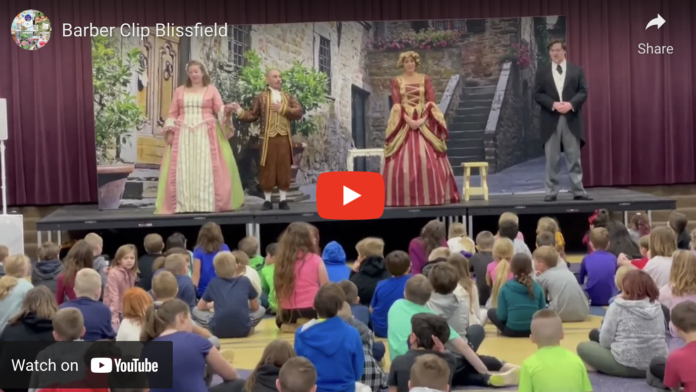
The opera’s flagship educational program, Opera On Wheels, is completing its 2021-2022 schedule on May 27, running in-school, K-8 presentations of The Stylist of Seville, an adaptation of the beloved comic opera The Barber of Seville. 

The 2021-2022 performances of The Stylist of Seville from Opera on Wheels. Performances run through May 27.

“Each year our resident artists (including Grace Wipfli, Katherine Kincaid, Fran Daniel Laucerica and Andrew Payne in 2021-2022), along with pianist Mercy Olson, adapt an opera for children,” explained Rachael Cammarn, communications and patron services coordinator with the Opera. The opera is 40-50 minutes in length, and the Opera also develops a study guide for the schools to use. “We perform for about 20,000 students during each program year,” Cammarn said. 

Established in the early 1990s, Opera on Wheels tours to over 60 schools in Northwest Ohio and Southeast Michigan each fall and spring. In Toledo, Buckeye Broadband sponsors the tour to all Toledo Public Schools elementary schools, and Marathon Petroleum Corporation sponsors the tour to Hancock County schools.

And coming this fall? “Next year’s production, with our new resident artists, will be The Pirates of Penzance,” said Cammarn.

The 2021-2022 performances of The Stylist of Seville from Opera on Wheels. Performances run through May 27.

Bringing Blue to the community

Toledo Opera’s performance of Blue, originally scheduled for February, will be presented August 26 and 28. Blue was introduced shortly before the pandemic, and named best new opera by the Music Critics Association of North America. It’s a riveting story of an African American couple in Harlem who are raising their young son. As the boy grows into a young man, his father, a police officer, prepares him for today’s realities.

According to Alyssa Greenberg, PhD, the Opera’s community engagement director, Blue will be the feature of Student Night at the Opera for a special dress rehearsal Aug. 24 at the Valentine Theatre. Middle and high school students (grades 6-12) are invited to this performance, sponsored by the Lucas County Commissioners. In addition, Blue will be the subject of other special events this summer:

August 11, 9am to 4pm: Blue Day at Mott Branch Library, WGTE On The Road. The stars and creatives behind the upcoming opera will perform musical selections and read storybooks aloud.

August 19, 7pm: Preserving the African American Legacy in Law Enforcement. The Toledo Police Museum, 2201 Kenwood Blvd., will be the setting for presentations, the Black and Blue exhibition and an opera performance in support of the upcoming opera Blue. Presented by the African American Police League, the Toledo Police Museum and the Toledo Opera.

Opera inside and out

During May, the Toledo Opera is presenting a series of free pop-up live performances at outdoor community hubs throughout Toledo. The Opera’s resident artists perform iconic vocal selections from the classic opera repertoire, along with music theater and other American standards. Remaining performances include:

Toledo Botanical Garden, Metroparks Toledo, Old Jazz Stage, near Conference Center

  • May 18 and 25 beginning at 6pm
  • Select Wednesdays in August

Toledo Farmers’ Market

  • May 21 beginning at 10
  • Select Saturdays in August

Visit the Toledo Opera for more information and updated schedules of family events for this summer and fall.