
Home Blog

Helping Your Kids Use AI the Right Way

It’s a typical school night; dinner dishes have been cleared and you’re packing lunches for tomorrow. After a long day, your bed is calling you. Suddenly, your kid comes rushing in, frantically digging through their school bag and tells you, “I have homework!” A feeling of dread washes over you as this simple phrase threatens to ruin the rest of your night. You see them pull out a packet of algebra questions. Do you remember enough algebra to help them if they need it? Relief replaces dread as you see them start marking down answers. You repress the need to ask them why they waited until it was so late. Crisis averted.

You go back to slathering peanut butter on bread when you notice that your kid has their phone unlocked next to them on the table. They pick it up, snap a photo of one of their math problems, and then go back to scribbling down an answer. You quickly realize that they’re using AI — the phenomena that they keep pushing at the office and that appears on the news almost every night — to give them the answers to their math problems. Isn’t that cheating? Should you scold them? It is saving your night. Should you block AI from their phone or just talk to them about it? What should you say?

AI, what’s the right approach

These are the questions many parents are asking themselves as AI continues to permeate through our and our children’s everyday lives. Generative AI tools, often called chatbots, are certainly going to be around for a while, so it’s important for parents to set intentional boundaries and to talk to their children about how to use them responsibly.

Dr. Chris Hamady, director of technology for Anthony Wayne Local Schools warns that “…relying solely on automated tools can weaken students’ critical thinking, problem-solving, and original writing abilities.” These abilities are learned through productive struggle. When a student puts in the effort to work through a difficult problem without outside help and eventually finds the correct answer on their own, deep neural pathways are built. Getting the answer from AI skips that entire process. Those neural pathways aren’t formed, and they don’t gain the confidence that is learned through mastery. Additionally, chatbots often present fallacies as fact. AI can usually be trusted with math problems, but when it comes to theoretical topics or things where opinions can vary, AI can provide inaccurate information. The real problem is that the chatbots present this information with absolute confidence, allowing a child’s developing mind to struggle discerning fact from fiction.

It’s not all doom and gloom

“AI tools offer many opportunities to support learning, such as tutoring that can be tailored to each student’s learning style and pace, breaking down complex concepts step-by-step, or providing quiz-like review sessions of class material,” said Hamady.

When used responsibly, chatbots can function as an always available personalized tutor. It can be used to re-explain complex topics from school or check their answers for accuracy. As a parent, you can use AI to assist you in helping your student. Can’t remember how to solve an equation or where a comma should go? Pop it into a chatbot for a quick reminder.

Early exposure to AI, used responsibly, also teaches digital literacy. And when used wisely, AI can increase critical thinking. Both skills that can help them in their adult careers. For neurodivergent students or those with learning difficulties, AI can offer customized assistance, quick summaries of topics and even brainstorming prompts to help get the creative juices flowing.

A final word of advice, Dr. Hamady suggests, “Just like with any technology resource, parents should carefully monitor their child’s use. They should always engage with their child to track learning, ensure the integrity of the generated information, and maintain academic honesty.” AI can be a powerful assistant, but it should not be a replacement for human curiosity, face-to-face discussion, or real world learning. Just as physical tools can be dangerous, chatbots pose their own danger to the minds of children. Luckily, it’s never too late to sit down with them and have an open discussion about the proper use of AI.

3 Actions you can take today to protect your children from the risks of AI

• Keep devices in shared spaces: Limit the use of AI to shared spaces, such as the kitchen table or family room so you can monitor how your children use it.

• Set ground rules: Teach and show your students how to use AI responsibly by brainstorming ideas, breaking down complex topics or checking their answers, but never for copying and pasting generated work. Helping Your Kids Use AI the Right Way Parenting in the age of AI By Nathan Jacobs

• Verify facts with local resources: Encourage kids to fact check information supplied by chatbots using trusted research tools, such as the digital databases provided by the Toledo Lucas County Public Library.

Sharing Conversations With Teens

Getting teens to open up and share can feel as hard as climbing Mt. Everest without a Sherpa to guide you. And like climbing a mountain, it is important to prepare ahead of the journey. “To build a good environment for communication, it’s important to first focus on building a good relationships with your teens,” Jill Haar, MA, LPCC-S at Harbor, a leading local mental health provider, explained, adding, “Healthy relationships are built on qualities like trustworthiness, fairness, respect, honesty, accountability and shared control and freedom.”

“For parents and guardians, I encourage them to think about the saying ‘Practice what you preach, and model what you teach.’ Be consistent in your relationships with others, be honest, express interest in their interests, and give options and choices when you can. When teens see consistency, they learn to trust and communicate more freely,” Haar said.

Why so secretive?

“The most common response I hear from teens about why they keep things secret from their parents is because they don’t want to get in trouble,” Haar said. “It usually comes down to fearing the disappointment or anger of the parent or caregiver. They’re typically able to easily see that they should have done better and are fearful of being shamed and losing both trust and privileges.”

What can parents and caregivers do to reassure their teen? Haar suggests:

• Remind them that you love them, that you want them to be safe, and that you want what is best for them.

• Manage your own frustration and anger when they do something wrong and you decide to impose consequences.

• Remember that your teen is not yet an adult. They will make mistakes. How you respond teaches them what to expect as adults

Timing is everything

Are there good times and not-so- good times to initiate conversations with teens? Definitely. “Would you, as an adult, be able to focus on a serious conversation the moment you walked in the door after a long day at work? Carrying the groceries? When you’re trying to watch a video? Trying to make dinner? It isn’t that you don’t want to focus on that conversation, it’s just that there are other things competing for your attention.” Haar offers the following suggestions for conversation starters:

• Model how to set aside time to focus

• Give a heads up that you have something you’d like to discuss with them

Set aside some time for conversation

Put aside the phone, turn off the television and directly focus on your teen and the topic of conversation. Use phrases like “In five minutes…”, “When you’ve finished…”

Open-ended questions

“Approach questioning with the rule ‘Investigate, don’t interrogate.’ If you notice your teen’s behavior has changed, focus on the change itself, not what you think is causing it. Structure your question to focus on what you’ve observed and ask for more information,” Haar said.

“For example, if you notice your teen’s sleeping habits have changed, don’t approach it with ‘Why are you not sleeping?’ Instead, say ‘I noticed you were still awake early this morning. Are you having trouble sleeping or is something else happening?’”

Pick a good location

The dinner table is a great place for the family to have casual conversations about their day. But if the conversation warrants more privacy, consider where that should happen. “I encourage parents and caregivers to try to limit the audience as much as possible. Serious conversations should be as private as possible. That may mean having that conversation in the car, or in their room, or on a walk around the neighborhood. What matters most is that the teen is given a reasonable choice about where and when the conversation takes place. Offer options for them and give them a chance to choose their best fit.”

Establishing a healthy channel of communication with your teen will help them in the present, while giving them the tools they need to succeed in the future. “Good communication leads to clarity and confidence,” Haar explains. “Poor communication leads to confusion and frustration. Only with good communication can we confidently understand the world around us and help the world understand us.”

Gaining Access to Mental Health Services

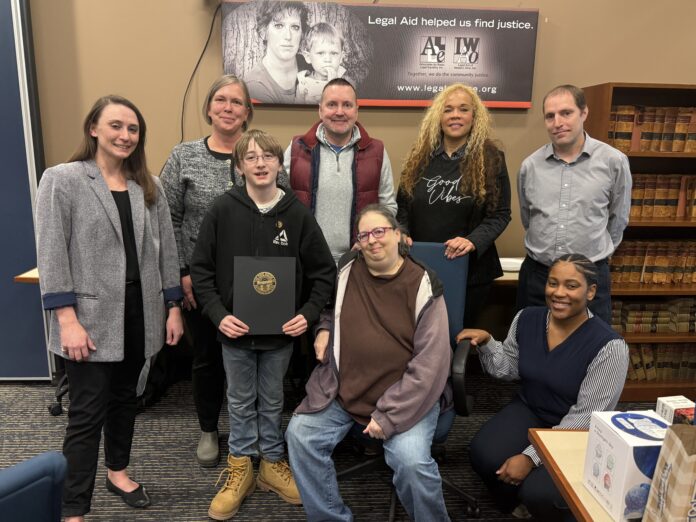
Celebrating success – it takes a team to support Gregory Stalker (with award, center) on his school and home progress. Pictured (back, left to right) Breanna Stephan, ABLE Law Staff Attorney, Jennifer Behnfeldt, ABLE Law Child Advocate, Eric Knaggs, therapist, Ohio Rep. Erika White (Dist. 41) and Brian Murphy, Lucas County Board of Developmental Disabilities; front (left to right) Gregory Stalker, his mother Jamie Nasta and Taylor Greene, OhioRISE Care Coordinator.
Donn Wobser, Service and Support Coordinator,
Lucas County Board of Developmental Disabilities

You’ve planned for and now have begun the school year with your kids, there were myriad questions and concerns you’ve had to deal with. Have you bought all the supplies your child is going to need? How about the clothes? Have you met all the preliminary requirements for classrooms, teachers and all of the other in-school items?

Along with everything else, it is important to consider the mental health support your child might need throughout the new school year.

Rich with resources

The National Center for Education Statistics says that approximately 7.5 million elementary and secondary school students (ages 3 through 21) received special education services under the Individuals with Disabilities Education Act (IDEA) during the 2022-2023 school year. That represents around 15 percent of all public-school students. Here in Ohio, more than 250,000 elementary and secondary school students receive special education services (about 16 percent of the public-school population).

How does a family go about finding the services they need?

“Toledo is very rich with resources,” explained Kate Schwartz, executive director of the Autism Society of Northwest Ohio (ASNO). “And parents have a choice. It’s important for them to realize that they’re not alone, that there’s a ‘daisy chain’ of people before and after them” who have had similar experiences.

The Toledo area offers a range of organizations that provide specialized services for children, from diagnostics, intervention and assessment to programs and counseling catered to a child’s age and situation. The Lucas County Board of Developmental Disabilities works closely with families to support the child’s development and coordinate associated programming.

“We encourage parents to consider all types of programs” that will help support their kids, said Donn Wobser, service and support coordinator. The organization conducts early intervention programs for kids aged 3 to 6, along with assisting families to coordinate programs throughout life. “We do a lot of linking families to programs in the area, and assist with matching families to the right agencies,” he said. The organization also sponsors and supports events and activities for families throughout the year.

Supporting programming and families

The Board of Developmental Disabilities’ staff works closely with local schools – and parents – to evaluate disability services and search out the best programs to meet children’s needs. “It can be very overwhelming for parents, who are often accustomed to hearing ‘no’ from providers,” Wobser said. “We can help families advocate for the specific programs they need for their children.” They organize programs and services through many of the region’s schools, as well as with organizations such as Unison Health, the Zepf Center, Harbor and Ohio Guidestone.

They are also closely affiliated with OhioRISE (Resilience through Integrated System and Excellence), a statewide managed care program for youth with complex behavioral health and multisystem needs. The Board of Developmental Disabilities in Toledo works with OhioRISE to help families get referrals for mental health services through Ohio’s Medicaid program. “It’s another way to find an agency that meets a child’s specific needs,” Wobser said.

Sharing life experiences

ASNO provides families with references to a variety of services that are available to meet their needs and help them as they’re making their decisions about what services they choose. “We offer our lived experiences of navigating the local health care systems, and provide families a list of referrals,” Schwartz said. “We were built on word of mouth and parent to parent.”

By participating in public events and promoting other events around the community, ASNO learns about what’s working and what’s not. And large events, like the annual Acoustics for Autism, offer the organization lots of referrals for programming.

Schwartz, who is a parent of two children on the autism spectrum, shares her own story and recommendations with other parents. “I sat through IEP and social security meetings, and I know what that feels like,” she said. “It sucks and it’s going to hurt and it’s okay to be sad. But you can’t unpack your bags there. We share our experiences and give them referrals so they can make their own choices.”

Swanton’s DeEtte’s Dream Diner

This is a good time of year for a short drive. For a worthwhile adventure, take Airport Highway west into Swanton, Ohio. DeEtte’s Dream Diner sits a bit off the beaten path. Pulling up, the building doesn’t look like much from the outside. My son reminded me not to judge a book by its cover. “Maybe it’s cool in there,” he said. And he was right! Past the colorful metal rooster greeting visitors (along with a season-appropriate plastic skeleton dressed like a farmer), the door opens into an extremely warm environment. Country music plays in the background, paired with a small wooden plaque that says “Hello, Sunshine!”

Lots of personality

It is an intimate room with just nine tables. What DeEtte’s lacks in square footage, it makes up for in personality. Calling any roadside diner an “oasis” might be a stretch, but owner DeEtte Nijakowski has created a space that comes pretty close.

DeEtte herself came over to talk with us, sharing the story behind the name. For years, she told herself that if the modest building ever went up for sale, she would buy it. In the summer of 2021, that opportunity arrived, and she took the leap to turn the address into her literal dream diner. The diner is open every day from 8am-2pm, a window of time DeEtte considers to be the ultimate sweet spot for serving comfort food.

Warm greetings and good food

DeEtte said the location is perfect for locals. She and her waitstaff show immense care for the regulars, many of whom walk in, take a seat and have their meals prepared without needing to look at a menu. Yet the greeting extended to first-timers feels identical. When our server took our order, we were treated like old friends. The food matches the warm reception, arriving to us hot and fast. DeEtte’s is perhaps best known for its specialty pancakes, which stretch to the size of a 12-inch pizza. When asked how such an item came to be, DeEtte smiled and credited the 1989 John Candy film, “Uncle Buck.” Do you remember “Uncle Buck?” I sure do! A vintage movie memory of oversized birthday pancakes on the griddle.


Beyond the giant pancakes, the kitchen covers every diner essential. Another local favorite carries a moniker as “The Mess,” a plate of hash browns with two eggs topped with sausage gravy (a kid- sized portion is called “Lil Mess”). For those arriving closer to the lunch hour, the menu features thick-cut burgers and sandwiches, all priced reasonably for family budgets.

DeEtte’s Dream Diner succeeds because it embraces exactly what it is: a humble, heartfelt local spot run by people who genuinely love feeding their neighbors. My son’s intuition was spot-on. What may seem unassuming from the road turns out to be a warm and welcoming experience. As for those pizza-sized pancakes? Plan a visit. You have to see them to believe them.

The Short Course

Kid Friendly: Yes
Noise Level: Low
Changing Station: No
High Chairs: Yes
Kids Menu: Yes

DeEtte’s Dream Diner
417 S. Main St., Swanton
419-402-4190
DeEtte’s Dream Diner on Facebook
Hours: Open daily, 8am – 2pm

Katie’s Kookies: A local baker’s story

“Wouldn’t it be so cool if we could open our own shop?” That was the thought percolating in Katie Louis’s head as she and her sister-in-law sent each other videos of people baking and decorating cookies. Louis had watched so many cookie baking videos that she felt inspired to try her hand at it. So she signed up for a class, kept watching videos to educate herself and began making cookies for holidays and events with her family and friends.

“It started to turn into a bigger thing,” said Louis, who founded Katie’s Kookies. As a mom of two, she specializes in homemade, hand-decorated sugar cookies— thick, soft, big and flavored with her homemade vanilla.

“The passion I put into the cookies really makes my business stand out,” Louis said. She pays a lot of attention to detail. If someone wants personalized cookies for a birthday party or baby shower, she’ll often want to look at the invitations to get as much information about the theme as possible, and match her cookies to that.

Women supporting women in business

Louis has worked in the mortgage industry for most of her adult career. She moved from Metro Detroit to Ohio about five years ago, and two years ago she was inspired to start Katie’s Kookies.

“I discovered a community of women supporting other women in business here,” she said. Louis has even traded cookies for services with business women in the area. “It’s not a competition, it’s women supporting women,” Louis said.

Louis’ husband, CJ, is a huge supporter of her business. There are nights when she needs to stay up late baking, and that can be overwhelming. Her husband will sometimes roll up his sleeves and pitch in, or sometimes just sit with her and keep a conversation going during those late nights while she works on her cookies.

Louis has a daughter, who’s a high school sophomore, and a four-year-old son. “It’s a big age gap but it’s so much fun,” Louis said. “They are the best of friends. I love seeing their relationship together.”

For fellow parents who are considering starting their own business, Louis encourages them to just go for it. “Believe in yourself and see where it takes you. Even if it’s a business that starts off really small, that’s okay! Be proud of your work. Don’t doubt that what you’re doing is amazing and it’s being done specifically by you. You never know what will happen, and what can turn it into something far bigger than you ever expected.”

248-824-5548, [email protected], Or “Katie’s Kookies” on Facebook.

Get to know Katie Louis

Fiction or nonfiction? That’s a hard choice. I’m torn–I can go both ways!

Fun hobbies: If I see something I like, I try it. I paint, sew, crochet, bake, scrapbook, dabble in leatherworking.

Favorite hidden gem in the Toledo Area? Moe’s in Rossford. That’s my husband’s and my go-to place. It reminds us of a place we went to back in Metro Detroit. We love the people there.

Fun item on the bucket list: To go to Alaska–maybe on a cruise. I want to see a moose in real life! Not too close, but out in the wild. That would be crazy.

Accessible Winter Activities For Every Ability

Toledo winters are magical. From outdoor adventures to cozy indoor activities, there is no shortage of family-friendly activities in Toledo as our city offers accessible activities for individuals with disabilities. Destination Toledo has recently released its Accessibility Guide—an excellent resource for local attractions, written by an Occupational Therapist. Grab a cup of hot cocoa and read on for a round-up of disability-friendly winter activities for families in Toledo.

Accessible Winter Sports

Ability Center of Greater Toledo

5605 Monroe St. Sylvania
419-885-5733
abilitycenter.org

They offer a diverse menu of indoor adaptive sports and recreation through the winter season, including adaptive judo, pickleball, esports and crash football.

Glass City Metropark

1521 Front St. Toledo
419-407-9714
metroparkstoledo.com

This Metropark offers three adaptive sleds that are free and available first- come-first-serve. Personal wheelchairs are allowed on the Ribbon Trail.

Ottawa Park Outdoor Rink

2015 Parkside Dr. Toledo
419-936-2875
ottawaparkrink.com

Enjoy adaptive sledding during the winter months.

Sylvania Tam-O-Shanter

7060 Sylvania Ave. Sylvania
419-885-1167
sylvaniatamoshanter.com

Offers adaptive hockey, sled hockey and specialized skating sessions for individuals with diverse abilities. The Gliding Stars Adaptive Ice Skating program makes ice skating accessible to individuals with disabilities.

Team Toledo Ice House

1258 W. Alexis Rd. Toledo
802-846-5298
teamtoledoicehouse.com

Adaptive Sports Ohio (ASO) provides athletes with diverse abilities the opportunity to participate in sled hockey through the Walleye Sled Hockey Practice.

Accessible Winter Trails

Oak Openings Preserve Metropark

4139 Girdham Rd. Swanton
419-407-9700
metroparkstoledo.com

As the largest park in the regional Toledo Metropark system, Oak Openings offers all-terrain power wheelchairs to navigate across the outdoor landscape. Contact 419-265-2920 with any questions.

Toledo Botanical Garden

5403 Elmer Dr. Toledo
417-407-9718
metroparkstoledo.com

The Toledo Botanical Garden offers a flat 1-mile trail featuring the Doneghy Inclusive Garden with well-marked barrier-free, ADA-compliant paths, sensory textured pathways and textured colored edges for individuals with visual impairments.

Wildwood Preserve Metropark

5100 W. Central Ave., Toledo
419-407-9700
metroparkstoledo.com

This park offers accessible paved trails, accessible routes to the historic Manor House and grounds and handicap-accessible Metz Visitor Center. Individuals can also reserve an all-terrain motorized track chair and adaptive trikes for free to explore park trails. Those interested in reserving adaptive equipment may fill out the online equipment request form. The Manor House is also wheelchair accessible.

Accessible Indoor Winter Activities

Toledo Zoo and Aquarium

2 Hippo Way, Toledo
419-385-5721
toledozoo.org

The zoo offers accessible events such as the Zoo for All Nights at the Lights, which offer sensory-friendly accommodations, access to parts of the broader light exhibits before the Christmas display, and access to sensory bags, including noise-cancelling headphones, a whiteboard and dry erase marker, fidgets, a social story and a misting fan. The Toledo Zoo has ADA-accessible pathways and accessible winter attractions during the cooler months, including:

• Toledo Zoo Aquarium: Flat viewing paths and interactive touch tanks
• ProMedica Museum of Natural History: Offers ramped and elevator access to all indoor exhibits
• Arctic Encounter and Aviary: Offers climate-controlled indoor viewing areas

Toledo Museum of Art

2445 Monroe St. Toledo
419-255-8000
toledomuseum.org

Designated as a Certified Autism Center (CAC), where 80% of the staff has been trained in sensory-inclusive support measures, the museum offers several inclusive features.

• Ramps, wheelchair-accessible restrooms and a wheelchair-accessible entrance is available at the Plough entrance to make a visit to the museum more inviting and comfortable for individuals with disabilities.
• Manual wheelchairs and walkers are available for free. There is also one power wheelchair available on a first-come, first-served basis.
• Sensory kits with fidgets and noise-cancelling headphones are available to museum guests on a first-come, first-served basis.

Imagination Station

1 Discovery Way Toledo
419-244-2674
imaginationstationtoledo.org

Designated as a Certified Autism Center (CAC), this local science center offers several inclusive spaces and features to support individuals with special needs:

• Sensory-friendly museum hours are offered every third Sunday of the month from 10am-12pm
• The KeyBank Discovery Theater hosts sensory-friendly movie screenings on Tuesdays at 4:15pm and Sundays at 12:30pm
• Sensory Support Kits are available to check out, which include noisecancelling headphones, fidgets, earplugs, social stories and weighted lap pads
• Calming Spaces are available near the Little KidSpace entrance
• Restrooms are wheelchair accessible and the lower family restroom features a height-adjustable adult changing table