Home Blog Page 277

With schools everywhere suspended, an education expert answers 4 questions about the upheaval

Jon Pedersen, University of South Carolina

Most of the school systems that shut their doors due to the COVID-19 outbreak initially said these closures would be temporary. But health authorities warn that Americans may need to keep up their social distancing for months. Jon Pedersen, dean of the University of South Carolina College of Education, answers some key questions about how this unprecedented situation might affect the education of millions of children.

Will kids learn anything while schools are closed?

Not all school systems are going to count schoolwork done while schools are closed toward grades. Educators will have to figure out how to motivate kids to do what it takes to keep learning. If dull worksheets don’t excite kids at school, then those worksheets really won’t work at home.

Teachers will have to be more creative and resourceful than ever with what they do while classes are suspended. For example, they can take students on virtual classroom field trips to places like the National Aquarium in Baltimore. Kids can see everything from wild bears in Alaska to classical music concerts through the Virtual School Activities website. They can learn how to conduct science experiments and make collages that look like kooky monsters at Fun Learning for Kids, which has a multitude of activities children will enjoy.

In addition, the New York Public Library has more than 300,000 books you can download for free.

There are also options for children with special needs, such as Educational Technology and Mobile Learning – a great resource for activities for dyslexic learners, autistic learners, apps for the visually impaired and apps for learners with writing difficulties.

Parents will also have a role to play.

Will anyone have to repeat a grade or not graduate as expected?

We don’t know how long this crisis will last.

If it drags on, every state and school will have to decide whether students should move on to the next grade or graduate. Not promoting students or not graduating seniors would obviously have broad implications for all public schools, colleges and universities – including community colleges. There will also be fallout for families and the workforce.

It may be hard in part to see whether students are ready to move forward to the next grade because the federal government has authorized states to let public schools skip otherwise mandatory standardized tests this school year.

When could lost time be made up?

There are options, some more challenging then others. For example, local districts could switch to year-round schooling, extend their current or upcoming academic year beyond the usual minimum of around 180 instructional days, lengthen school days and skip some holidays once things are back to normal.

There are precedents for those arrangements. Numerous schools already operate year-round or with longer school years in places like El Paso, Texas; Romeoville, Illinois; and Bardstown, Kentucky. And countless schools have had to extend the school year by days, weeks or more due to closures brought about by blizzards, hurricanes, floods and other disasters.

But whatever school leaders decide to do, it’s going to come with serious consequences and costs. Adding instructional time at a future date will cost more money.

And it’s not clear how school districts will be able to foot the bill.

Are there any grounds for optimism?

Yes. I believe that the United States has some of the best teachers and professional educators in the world and we will come through this not losing ground.

Although I would not rule out some sort of extended school year for schools, I do believe that the rapid response of states, districts, schools and teachers have reduced the likelihood that extreme measures will be needed.

My colleague, the education professor Gloria Boutte, always starts meetings with a traditional Masai greeting: “How are the children?”

I think this is very appropriate to keep in mind. How are the children? How are they doing? What do we need to do as a community to ensure their success?

Together, we can make sure children succeed.

[Our newsletter explains what’s going on with the coronavirus pandemic. Subscribe now.]The Conversation

Jon Pedersen, Dean of the College of Education, University of South Carolina

This article is republished from The Conversation under a Creative Commons license. Read the original article.

Co-parenting in the coronavirus pandemic: A family law scholar’s advice

Marcia Zug, University of South Carolina

As millions of people around the world practice social distancing and self-quarantine, they are separating themselves from everyone but their immediate family members. However, for divorced or separated parents who share custody of their children, the definition of “immediate family” isn’t obvious.

Already, family lawyers around the country are being inundated with calls from anxious parents worried about returning children to co-parents who are not willing to practice social distancing. They are contemplating keeping their child away from the other parent, in violation of a shared-custody agreement – but wonder how courts will react.

I have been a family law professor for almost 13 years. I have written numerous articles about custody and visitation. Until recently, I never even contemplated how these traditional family law concepts might change in response to a pandemic. Few custody and child-support court orders will have provisions covering how to share parenting in a pandemic – although they may become common in the future.

This is uncharted legal territory. The federal government, many states and even municipal governments around the country have declared states of emergency.

With many family courts closed, divorced or separated parents will have to make up arrangements as they go along. My strong advice is that parents should not try and equate the COVID-19 pandemic with other types of emergencies that may be covered in their custody agreements.

Instead, they should seek to work together – however difficult that may be – to provide for the best interests of their children, and to preserve a sense of fairness and equity, both emotionally and legally, however custody is shared.

Finding common ground

As workplaces shut down or convert employees to working from home, many parents may find opportunities to adjust schedules so the child can be cared for by one parent or the other, rather than bring in the care of sitters, nannies or members of the extended family.

Public health experts say it’s best to limit social circles to reduce the spread of the coronavirus.

Parents should try to be a team in this situation, even if it is difficult. This is not the time to keep a minute accounting of how many overnights the other parent has had or to argue that the current school closures should be treated like summer vacation. Avoid gamesmanship.

Talk through concerns and be open to new arrangements. Reassure the other parent that any current reduction in their parenting time will be made up – eventually – and that in the meantime, they will have increased phone calls, video chats and other forms of non-physical contact.

I do recommend keeping records, including contacting the other parent in writing (by text or email), explaining what your concerns are about the current custody plan, and proposing a reasonable solution. It will be very helpful to encourage the other parent’s thoughts and suggestions on the proposal. Any coronavirus custody arrangement should accommodate the concerns and interests of both parents.

It is stressful for everyone – parents and children alike – to live through this pandemic. Children don’t need the added worry of parental fights. They badly need more stability and reassurance – especially about their contact and connection with those who love them the most.

Judges look out for the kids

It may not be easy to come to agreement. Every relationship – and ex-relationship – is different. Some couples may be used to sorting things out in court. That is less possible now than during normal times.

Most family courts are closed for everything but emergency matters, which almost certainly do not include custody disputes. Of course, after the crisis passes, the courts will reopen.

At that time, I have little doubt that judges will be pleased with parents who have worked together to identify their children’s best interests, and taken steps to protect their health and safety. And I expect judges will be furious at parents who put their own interests before their children’s, and refused to cooperate with a willing and reasonable parent.

This is what you want to avoid.
RapidEye/Getty Images

Disobeying a court order is a big unknown

If agreement is really impossible, the path gets much more precarious. Shared-custody agreements and orders were crafted when the present crisis was unimaginable, but violating them is risky – even if the reason sounds solid. Judges may reduce visitation and custody for parents who interfere with their ex-partner’s custodial rights.

Parents who fear for their children’s health may be willing to take their chances and hope that when this is all over, the family court will agree that their decision was reasonable. It is a big gamble – and regardless of the outcome is likely to involve significant legal expense and time fighting in court.

Mediation may be a way to come to an agreement without going to court.
Marlin Levison/Star Tribune via Getty Images

Seeking help to settle disputes

There are alternatives to conflict and animosity, and waiting for courts to reopen and sort things out.

Many family court mediators remain available to help couples work out pandemic related custody issues. Although the specific circumstances of the coronavirus pandemic are unprecedented, parental disputes about children’s health and safety are common. Mediators are well versed in these issues and can help families reach reasonable agreements.

Mediated agreements – even attempts at agreements – provide a contemporary and largely objective record of the parents’ thoughts, circumstances and concerns. That record may help judges sort out who was being reasonable and accommodating in seeking custody changes, and who was not.

In the effort to stem the spread of the coronavirus, Americans are repeatedly reminded that the decisions they make today will have direct consequences on our individual and collective well-being in the future. This warning is not specifically directed at divorced or separated parents, but it is just as applicable.

The custody choices parents make in the next few weeks affect not only the immediate health and welfare of their children and families, but may also affect their future custody arrangements. Courts rarely look kindly on parents who put their needs before their children’s. In the aftermath of a pandemic, it safe to assume this will be even more true.

The circumstances surrounding many custody disputes have changed drastically in the past week, but as always, the safest bet is cooperation.

[Insight, in your inbox each day. You can get it with The Conversation’s email newsletter.]The Conversation

Marcia Zug, Professor of Family Law, University of South Carolina

This article is republished from The Conversation under a Creative Commons license. Read the original article.

Letter from the Editor: The COVID-19 Pandemic Has Changed Parenting

The world has changed drastically over the last few weeks, and along with it, so has parenting. 

Life is simultaneously busier and slower than ever. We may be limited in what we can do and where we can go, but we are also juggling parenting, teaching, working, cooking and cleaning…all without our normal “me time” outlets. 

Some parents have gone above and beyond, creating detailed daily schedules to keep their kid(s) busy and prevent them from falling behind. Others have refused to take over the role of educator, insisting it isn’t possible and that mental health is more important. Yet other parents are attempting to juggle working from home with teaching their child(ren) and feeling they’re falling short at every turn. 

Whatever path you chose, you’re making the best decision for your family’s sanity, and we’re here to support you along the way and provide resources to make life a tad easier. 

Feeling guilty about plopping the kids in front of the TV? Check out our Top 15 Educational Shows on Netflix for Kids and rest easy knowing the kids are still learning something. 

Unsure of how to talk to your kids about COVID-19? Michigander Heidi Alene Harris, Ph.D. in Early Childhood Education, shares her advice. 

Struggling to feed your kids without school meals? Or do you want to support local restaurants but money is a concern? We list free food resources and local restaurants offering free kids meals and/or free delivery. 

We offer ideas to beat boredom and how you can use this time of forced rest to tackle fun and practical projects, and that’s just the start. 

For regular updates on COVID-19 and resources to help during this time, follow us on Facebook or Instagram at @toledoareaparent and tag us in your quarantine antics with #toledoparents and #toledokids. Join our Facebook group Toledo Parent Support Group to share your own resources and ideas with other Toledo area parents. 

Our community may be virtual during this time, but that does not diminish its strength. Together we can make it through this unprecedented time. 

Virtual hugs,

Erin Schoen Marsh, Editor

Prevent The COVID Crisis From Wiping Out The Primary Election

PRINT OUT A BALLOT APPLICATION, MAIL IT TO THE BOARD OF ELECTIONS, COMPLETE YOUR BALLOT, MAIL IT TO THE BOARD OF ELECTIONS POSTMARKED BY APRIL 27. 

You recall that Ohio’s Primary Election, scheduled for Tuesday, March 17, was called off at the 11th hour when the state’s Health Director issued an Order prohibiting the voting to go on as scheduled.  This was done with the health and safety of Ohioans in mind, though the timing was curious. 

We were told, at the time that the Primary Election was being rescheduled to June 2, 2020. Those were the wishes expressed by Governor DeWine but the Ohio General Assembly, in its wisdom, decided that the Primary Election would take place BY MAIL ONLY, and that ALL BALLOTS MUST BE POSTMARKED BY APRIL 27 OR DELIVERED TO THE BOARD OF ELECTIONS BY APRIL 28.  

Now, however, the election is proceeding with ABSENTEE ONLY ballots.  There will be no polls opening. There will be no Primary Election in June. 

Instead, IN ORDER TO VOTE, YOU MUST:

1. DOWNLOAD/ COMPLETE AN ABSENTEE BALLOT APPLICATION OR CALL THE BOARD OF ELECTIONS AT 419-213-4001 TO REQUEST THAT AN APPLICATION IS MAILED TO YOU 

2. YOU MUST COMPLETE THE APPLICATION IN PEN (the online form does not allow typed answers) 

  • INCLUDE THE “DATE OF THE ELECTION” AS MARCH 17, 2020
  • CHECK THE BOX UNDER SECTION 6 FOR “PRIMARY ELECTION”
  • SIGN AND DATE the form, and then,

3. YOU MUST MAIL THE ABSENTEE BALLOT APPLICATION, OR DELIVER IT, TO THE 

LUCAS COUNTY BOARD OF ELECTIONS
ONE GOVERNMENT CENTER
SUITE #300
TOLEDO, OHIO 43604
(Must be postmarked by April 27 or dropped to the Board of Elections by April 28)

4. FOR ANY QUESTIONS, CALL THE LUCAS COUNTY BOARD OF ELECTIONS AT 419- 213-4001 AND PRESS OPTION 1.

5. WHEN YOU RECEIVE YOUR ABSENTEE BALLOT IN THE US MAIL FROM THE BOARD OF ELECTIONS, COMPLETE IT AND MAIL IT TO BE POSTMARKED NO LATER THAN APRIL 27, 2020.

While exercise is helpful during this unique time, exercising your right to vote for this Primary Election MUST BE DONE ACCORDING TO THE ABOVE REQUIREMENTS OR IT WILL BE LOST.


An open letter from a teacher

This is not what we signed up for. That could easily have been said by any administrator, teacher, parent, or student after hearing about the three week school closing. Whether we signed up for it or not, this school closing is happening. Fortunately what I have experienced as a teacher during this time so far is an incredible amount of support, patience, and camaraderie between everyone affected.

Sure, it is not an ideal situation. I went into teaching because I love helping people and I love working with my students. My favorite part of teaching is getting to see the students everyday. So of course it was a bit heartbreaking to hear that schools were closing for three weeks or possibly longer. But teachers and administrators are in the profession because they enjoy helping students, so these men and women buckled down and got to business. 

Our administrators have spent tireless nights keeping in contact with parents and teachers so everyone knows what is going on. And this is incredibly tough because there are so many changes being made on a daily basis. These administrators are making sure their teachers have the tools and support necessary to work online. They’re working to connect families to internet access, personally delivering books and work material to students’ homes, and staying in the office so they’re in the phone’s reach of parents’ questions and concerns.  

We teachers have been spending countless hours teaching ourselves how to work various online platforms to ensure our kids still get the best instruction we possibly can provide during this time. We answer emails of anxious students, trying to help them through this change. We worry about where they’ll get their next meal. We worry about their safety and if they’re staying out of trouble. Yet despite these worries, we teachers put on a smile to make sure the kids know everything will be ok.

It is times like these when the true job of a teacher and administrator is revealed. It’s not just instructing kids, but truly caring about them, too. 

As my students came to clean out their lockers and pick up their work, one came up to me and said, “I really love school. I’d much rather be here over this break than at home.” 

All I could say to that was, “I completely agree.” 

Join our NEW Facebook group, Toledo Parent Support Group, where the Toledo area community can post local resources for parents during the coronavirus pandemic.

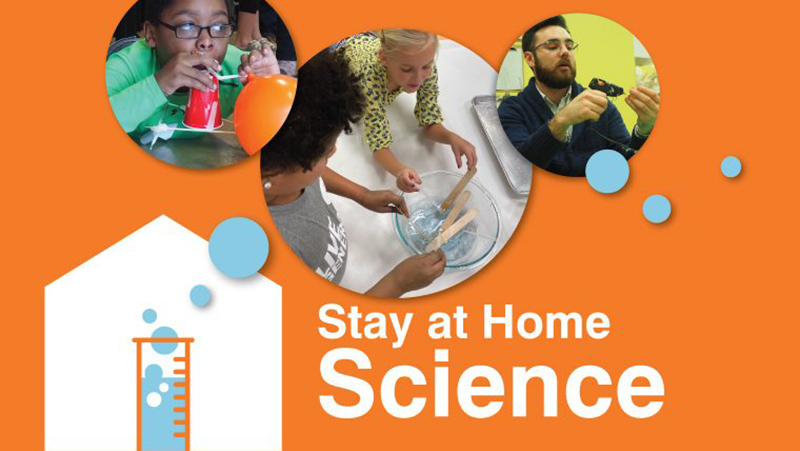
Imagination Station presents some Stay at Home Science

For over a decade, the Imagination Station has enthralled and inspired families around the Glass City area with its enlightening look at science for the curious of all ages. Though the center may be closed due to COVID-19, the thirst for knowledge never ends. So the Imagination Station is encouraging kids of all ages to try some Stay at Home Science.

The new program, hosted on both the Imagination Station website and Facebook page, brings viewers some easy-to-try experiments for young science students with videos hosted by team members of the Station.

The website currently hosts pages dedicated to the creation of aluminum boats, demonstrating how the density of material impacts its ability to float, as well as making oobleck, a viscous, sticky substance that can display the characteristics of both a liquid and a solid.

In addition, the Station’s Facebook page offers links to fun projects hosted on external sites, such as creating a model of the Earth’s layers and building structures out of household materials like uncooked spaghetti.

The Stay at Home Science videos are free for anyone to view, though the Station does accept donations from anyone who can give on their website.