Home Blog Page 274

School Services, Interrupted: What Parents of Students Receiving Speech and Language Treatment in Schools Should Know During COVID-19 Closures

More Than 1 Million U.S. Children Receive School-Based Treatment for Speech and Language Impairments

With speech and language impairment ranking as the second most common disability category under which U.S. schoolchildren receive services via the Individuals With Disabilities Education Act (IDEA), many parents are reporting concern about the impact of COVID-19 related school closures. Parents are worried about their children’s access to speech and language services and their children’s ability to successfully complete schoolwork and maintain skills from home.

Consequently, the American Speech-Language-Hearing Association (ASHA) offers this information to parents of children who have been receiving speech-language pathology services in schools:

Your child is (still) entitled to a free appropriate public education. The U.S. Department of Education (ED) has clarified that school districts must continue to provide a free appropriate public education (FAPE) to all students at this time—including students with disabilities. ED has stated that FAPE may encompass, as appropriate, special education and related services provided through distance instruction (virtually, online, or telephonically). While noting that it may not be possible for services to be provided in the same manner as they are when school buildings are open, ED emphasizes that federal disability law offers flexibility in determining how to meet the individual needs of students with disabilities.

Your child may be able to receive virtual speech and language services during closures. Some school districts had virtual treatment services in place prior to COVID-19, and some have initiated or increased so-called telepractice capability because of the pandemic. 

According to ED, “Many disability-related modifications and services may be effectively provided online. These may include . . . speech or language services through video conferencing.” However, a school’s ability to offer telepractice services depends on state regulations of telepractice for speech and language treatment, local school district policies, technology capabilities of both the school district and family, and a variety of other factors outside the control of parents and speech-language pathologists (SLPs). And although, in some cases, telepractice can offer equal benefits to therapy delivered in person, in other cases, it may not—depending on the individual child, their specific condition(s), and their strengths and weaknesses.

Your child has a right to privacy. Privacy laws for students with speech and language disabilities still apply. A student’s personal health records may not be shared without parental consent under the Health Insurance Portability and Accountability Act (HIPAA), although the government has announced that it will exercise discretion regarding enforcement of penalties for health providers using remote communications technologies that don’t fully comply with HIPAA requirements. 

Another important privacy law is the Family Educational Rights and Privacy Act (FERPA), which protects students’ private educational records. Parents should know that SLPs may need to modify treatment or seek parental approval in certain instances due to these privacy considerations—such as when providing group treatment to students. Although students’ privacy may be reasonably protected when group services are provided in person, when done via telepractice, other adults or members of a household may become aware of the personal information of other students. These are factors that parents and SLPs must consider together.

Children who regress can rebound. Amidst current circumstances, children with speech and language disorders are at a greater risk of regressing educationally than other students. However, students can regain ground; in most cases, a child’s regression will not be permanent.

You are doing your best. SLPs understand that the demands parents are facing are unprecedented. They realize that most parents are not trained as professional therapists or student aides, and that many children with speech and/or language disorders may not adapt to distance learning as easily as other children. They recognize that parents are doing their best as they strive to help their child with schoolwork and therapy, often while dealing with a range of other responsibilities.

Your SLP is doing their best. Just as parents confront this new situation, so do SLPs. Most school-based SLPs were not set up to provide telepractice or implement changes to Individualized Education Programs for a large number of students in this very challenging situation. Nonetheless, SLPs continue to be dedicated and fully invested in your child’s educational, social, and life success. To SLPs, having a good partnership with parents is essential—with all parties focused on serving the child’s best interests.

For more information about speech and language services in schools, visit www.asha.org/public.

About the American Speech-Language-Hearing Association (ASHA)
ASHA is the national professional, scientific, and credentialing association for 211,000 members and affiliates who are audiologists; speech-language pathologists; speech, language, and hearing scientists; audiology and speech-language pathology support personnel; and students. Audiologists specialize in preventing and assessing hearing and balance disorders as well as providing audiologic treatment, including hearing aids. Speech-language pathologists identify, assess, and treat speech and language problems, including swallowing disorders. www.asha.org

Celebrating Ramadan with Social Distancing

This year Ramadan will be extremely different for many Muslims who observe the month of fasting. Ramadan is often filled with lots of family and friend iftars (breaking of fast dinners), prayers at the Mosques, charity-giving and fun activities for children.

Ramadan, which begins on April 24, can still be a memorable moment for children this year, despite quarantines and social-distancing. Here are some fun ways children and families can have a great month in the Toledo-area. 

  1. Grab a Ramadan cookie-decorating kit from So Sweet Lebanese and French Pastries or ask other local bakeries close to you to make them. Baked Toledo is also taking orders for paint-your-own Ramadan cookies! Ramadan-Pastries-from-So-Sweet
  2. Check out this awesome local business, Sprouting Buds, that makes Ramadan items and crafts. Their eco-friendly Ramadan plate set is absolutely adorable for Ramadan meals. They offer free local delivery with the code LOCAL.
  3. Continue the practice of giving during Ramadan if you are able to. Help kids make thank you cards to local grocery stores, such as Sidon, where many employees will be fasting long days while working hard during these busy times. Mail Ramadan cards to family and friends. There are lots of printable Ramadan cards on Etsy to choose from. 
  4. Check with your local Mosques to see what they are offering. Some are offering virtual lectures, meal distributions and food pantries. Contact them if you are in need of food or if you would like to donate.
  5. Have an e-iftar with friends and families! Choose two or three families and decide who will make what and drop it off! One family can be in charge of a side dish, another a dessert and another a main meal. If you are alone, see if you can join another family on Zoom to break fast with them. 
  6. Continue working out if you are able to. Fasting 12+ hours a day with kids at home may be challenging, as it was during the summer. Take some time to yourself and practice yoga or low-impact exercising before Iftar (breaking of fast) or in the morning. On Instagram, The Fitnest usually has great Ramadan workout ideas. Check with local studios to see if they offer gentle yoga classes. My personal go-to is Yogaja Yoga. 
  7. Find Ramadan-related books at your local bookstore! Check out Gathering Volumes in Perrysburg — they do curbside pick up. Or do a Ramadan book exchange with friends. 

Ramadan Mubarak to everyone celebrating! 

Celebrating Birthdays During Coronavirus Quarantine

How to still make the day special

When you’re a kid, birthdays are a special event…something you anticipate all year long. Kids count down the months and days until they’re one year older. Coronavirus has forced many families to cancel their Spring Break plans, but birthdays shouldn’t also need to be put on hold. 

Here are some ways to celebrate that special little one in your life AND support local businesses: 

  1. Order a special birthday cake and have it delivered. McKiddy Cakes, located in Sylvania, offers custom cakes with free delivery! 
  2. Pick up some DIY cookie kits–aka “Quarantine Care Packages” as a fun family activity from The Next Sweet Thing, which offers curbside pickup. Kit includes 12 cutout cookies, pink, blue & yellow royal icing bags, and green sprinkles ($15.99). 
  3. Mayberry Ice Cream is offering family “Ice Cream Care Packages” that include two pints, two toppings (Oreos, sprinkles, M&Ms, or nuts), homemade waffle chips ($14). 
  4. Organize a car parade! Other parents are eager to get out of the house and support other families. Post to Facebook what time you want people to drive by and allow this birthday to be one the kids will always remember.
  5. Receive a personalized, magical birthday message from local magician Andrew Martin and his son, Eli, for FREE! Email your child’s name and birth date to [email protected]

Follow us on social media @toledoareaparent! 

AH-HA! Heritage Sylvania program brings history to kids at home

The history-minded experts of Heritage Sylvania are hoping to inspire curious minds to stay curious during the COVID shutdown with a series of projects entitled Camp AH-HA!

Short for “At Home History Adventures,” Camp AH-HA is designed to provide families with fun and unique activities to keep young minds engaged and interested in both their own personal history and the history of the Toledo community.

Beginning in the middle of March, Heritage Sylvania has posted a new project to the Camp AH-HA webpage every weekday, offering a variety of at-home projects for children and parents/at-home educators looking to spice up their hours of learning. These have included:

–Creating a family tree

-The history of butter-making and how to make butter yourself at home.

-Teaching about the history of the Lathrop House, accompanied by a word search, crossword and more.

-Learning about the job of the curator of a museum, and encouraging children to create their own exhibits based upon what they collect.

-Teaching about that old, ancient form of communication called writing a letter.

Formed in 2019, Heritage Sylvania was born of a merger between three of the area’s most respected historical institutions— the Friends of the Lathrop House, the Sylvania Area Historical Society and the Sylvania Historical Village. The unified group has worked to make history fun for the area’s youth through programs, exhibits and more.

To stay up to date on the latest additions to Heritage Sylvania’s Camp AH-HA program, visit the Heritage Sylvania website or Facebook page.

Forté Music School Goes Online

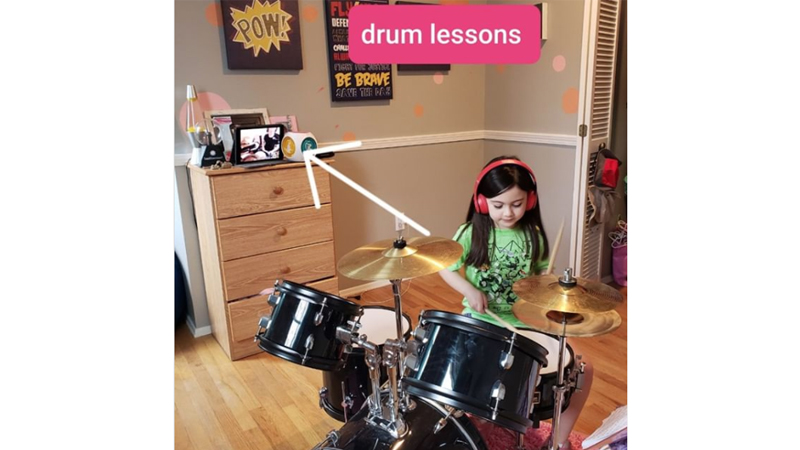
Luna, student of Scott Hafferkampon, on drums

Over 500 students are taking online music lessons so they never have to miss a “beat.”

Have you always wanted your child to learn how to play an instrument but could never find the time? Well, we now have nothing but time, and Forté Music School is offering music lessons online to make learning safe and convenient. 

Students can still have hands-on, one-on-one instruction from an experienced Forté instructor while maintaining social distancing guidelines. Music lessons help sharpen the mind, incorporate new learning experiences, and–perhaps most importantly during this uncertain time–provide an emotional outlet. To help families retain a sense of normalcy, they can now log on and enjoy regular music lessons. New students are also welcome to begin lessons and instruments can be purchased online. 

Piano Lesson with Melanie Zientek and her student Adam Elfadl

The transition to the online format has been of little “treble” to the superb instructors at Forté. Using familiar, reliable platforms like Skype, Zoom, and FaceTime, teachers can guide students with ease. Some teachers even offer online lessons year-round, so students can stay connected from anywhere in the world. 

Parents and students alike are enjoying the transition. One parent exclaims, “[My son] enjoys the online lessons! He was so excited to see his teacher and to get involved again with his instrument after two weeks locked at home. He enjoyed having a change of pace with an activity he loves.”

Director Virgil Lupu has been working around the clock alongside Heather Williams (office manager) and Bogdan Berindean (Assistant Director) to make sure all faculty and students have everything they need to make the transition to online smooth and enjoyable.

Rebecca McLean, a Mandolin Student of Ron Lawson

“Music has such a healing power, one that is vital in uncertain times. I believe that our instructors provide such experiences, experiences that are especially beneficial at this time,” confesses Lupu. In initiating this transition, Lupu had to close the school for an early spring break. During this time, he and his staff created video tutorials for 3 different platforms, conducted phone and video call training sessions with all 35 teachers, and distributed iPads, keyboards, and method books to ensure every teacher had everything they needed. 

“I really couldn’t have done it alone. I am so grateful to have such reliable and hardworking staff,” Lupu credits.

Forté Music School ONLINE MUSIC LESSONS. Available 7 days a week; $22.50 per 30-minute lesson. [email protected]. 419-471-2100. .ForteMusic419.com 

Your Backyard Isn’t Cancelled: Six Tips To Celebrate Earth Day Right At Home

Here are six tips to celebrate Earth Day without ever leaving home:

  1. Get outside. Your backyard is an outdoor living room and a safe place for pets and kids to play. Science proves spending time in your family’s yard is good for your health and well-being, and it is imperative today as everyone looks for creative ways to stay well while being confined to the home. Researchers have found that people living in neighborhoods with more birds, shrubs and trees are less likely to suffer from depression, anxiety and stress.
  2. Make the outdoors a family project. Take your loved ones outside to assess your space. What’s working well? What could be improved? What can you plan to do together in your backyard? Anything needing to be cleaned up? Make a plan to expand or spruce up your yard.
  3. Connect kids to nature. Free online, do-at-home lesson plans are available from TurfMutt.com. The environmental education program provides resources and activities, based on STEM (science, technology, engineering and math) principles, that gives kids the prompts they need to have fun learning about and exploring nature and science in their own backyards.
  4. Know your climate zone. Learn about climate-zone appropriate plants, the importance of pollinators, and how backyards can support local wildlife. Conduct a plant inventory to determine what’s currently thriving in your backyard. Match that up against the USDA Plant Hardiness Zone Map to determine the best types of turf, trees, shrubs, and plants for the climate zone. 
  5. Keep pollinators in mind. Your yard is an important part of the connected ecosystem providing much-needed food and shelter for pollinators, such as birds, bees, butterflies, bats, and other creatures. Select a variety of plants that will bloom all year long. The Audubon Society’s database can help determine which birds will be attracted to which plants for unique regions so you can make smart choices about what to plant. 
  6. Plant, prune or mow. Staying confined to home base means more time for gardening and yard work. Order garden supplies online or have them delivered from a nearby nursery. Mow the lawn and trim bushes while the entire family enjoys outdoor time!

Research shows that people who gardened for at least 30 minutes a week had lower body mass indexes (BMIs)—a measure of body fat—as well as higher levels of self-esteem and better moods overall. They also reported lower levels of tension and stress.

For further facts and tips on saving the planet one yard at a time, go to www.turfmutt.com.