As parents prepare for their K-12 kids to return to school, protecting them from disease continues to be a priority. In addition to the schedule of regular vaccinations, COVID-19 vaccinations and boosters are now recommended for all school-aged kids.
But a national kid-focused virus is possibly rearing its head just in time for fall classes: Pediatric Hepatitis.
Identifying an outbreak
The Centers for Disease Control and Prevention (CDC) are investigating a rare outbreak of pediatric hepatitis of unknown cause in the U.S., beginning in October 2021. To date, the number of “persons under investigation” (PUI) by the CDC across the country is 357 in 43 states, including cases in Ohio and Michigan.
Hepatitis is an inflammation in the liver that can result in liver cell damage. Because it often originates from a virus, it is communicable (a more serious problem as school approaches).
“It’s quite serious when these kids are getting sick,” explained Alexa Hirschfeld, CNP, with ProMedica Urgent Care for Kids. “And while the CDC study has a small number, of the 357 children, six percent have needed liver transplants, and four percent have died.”
Looking for causes
Hepatitis A is the most common type of pediatric hepatitis, and it is highly contagious. Not all children who are infected experience illness, according to Hirschfeld, but among those who do, symptoms can include:
Abdominal pain
Fatigue
Dark urine
Pale stool
Fever of over 104 degrees
Yellowing (jaundice) of the skin or eyes
The causes of hepatitis in children are difficult to identify; in fact, it is not unusual for the cause to remain known. Studies around the world have identified adenovirus, a common virus that often causes cold- and flu-like symptoms, as a likely cause of the current batch of hepatitis cases. CDC is also studying other infections, such as SARS-CoV-2 (the virus behind COVID-19) adeno-associated virus (AAV-2), or a combination of infections, as contributing to the hepatitis.
The COVID-19 vaccine had also been linked as a possible cause of hepatitis. “The median age of patients in this study is two, which is below the age where kids are receiving the COVID-19 vaccine,” said Hirschfeld. “So, it’s hard to believe that the vaccine would be related to this.” The CDC has also ruled out the COVID-19 vaccine as a cause.
Being diligent parents Pediatric hepatitis “is a rare disease, so it’s wise for parents to be aware, but not scared or fearful,” said Hirschfeld. She recommended several steps for protecting your family from hepatitis, along with fighting infection in general:
Hand washing throughout the day, especially after using the restroom or before eating.
Keep kids home if they’re not feeling well, so they won’t pick up or pass along anything.
Disinfect surfaces around the home, especially in the kitchen and bathrooms.
Practice good general hygiene, at home and when you’re out.
Develop good habits – for diet and sleeping – that will help protect you from illness in general.
If parents suspect their child is experiencing these symptoms, particularly gastro-intestinal problems and loss of appetite, they should begin at their local urgent care center. “It’s important to see a doctor when symptoms present themselves,” she said. “We can’t test for hepatitis at the urgent care level,” but the urgent care can determine whether it’s important to send the child on for further analysis.
“Overall, it’s important to take good steps to protect your kids from this or other viruses,” she said.
Tatum Park was established in 2019 to teach the community about urban farming.
Sonia Flunder-McNair is the founder of Urban Wholistics, a program that brings urban farming to Toledo neighborhoods
Residents of many Toledo neighborhoods cannot make it to farms for fresh produce, so Sonia Flunder-McNair brings the farm to the city. McNair, a self-described urban farmer, is the founder and CEO of Urban Wholistics, an organization that hopes to plant gardens in city lots and teach youth the joys of growing fruits and vegetables.
“My mission is to plant more trees and create more holistic green spaces within communities that have been historically excluded from healing places in nature,” McNair said.
McNair, a Toledo native, began her health journey after a serious medical crisis in 1995 that left her hospitalized for many weeks. She vowed to turn her health around, and to teach others how to do the same. She studied herbal education and began an organic product line.
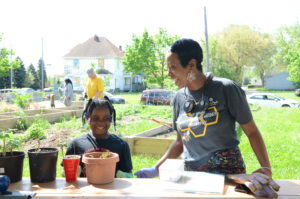
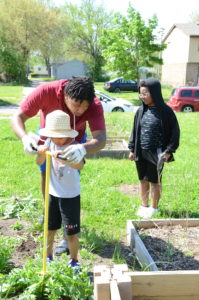
Staff and volunteers work side by side with youth at Tatum Park.
McNair, whose family has resided in the Junction neighborhood for sixteen years, began to dream of how to start a community garden that would provide fresh produce for her neighbors while teaching children and adults the benefits of sustainable farming and healthy living.
That dream became a reality in the fall of 2019, when she began her farming project with the creation of Tatum Park, a former land bank demo site next to the historical Art Tatum House.
“My job is to teach the community how to become self-reliant and to love where they live by taking care of the approximately 2,000 open spaces within the Junction community alone.”
With help from ABLE (Advocates for Basic Legal Equality), McNair was able to create a garden that provides produce for the community, as well as learning opportunities for children and adults.
“Urban Wholistics has created a one-of-a-kind program with a curriculum that meets the Ohio Learning Standards to teach urban farming to youth.” added McNair. “We believe that our primary responsibility is to instruct how to produce life-giving herbs and food by creating local food hubs that will allow residents an opportunity to buy and sell handmade items and fresh produce.”
Participants in the program have also ventured outside of the garden to promote the cause of urban farming.
“We’ve had the opportunity to speak to the Ohio House of Representatives in support of Rep. Paula Hicks-Hudson’s house bill 592, The Youth Farming Initiative. Serving as a founding member of the Women for Solheim, my youth farmers also had the opportunity to meet and engage with Good Morning America’s Robin Roberts at the 2021 Solheim Women Summit. Some of our youth farmers had the opportunity to address her personally with their questions, and many were inspired by the encounter.”
McNair has created her own organic skin and hair care products that she markets as SONIA Organics and SOrganics. In addition to the produce grown at Tatum Park, the group also sells T-shirts and other merchandise, and will soon sell lip balms made from beeswax sourced from their own beekeeping. The group can be found with other local vendors on Saturdays from 10am-2pm at the Urban South Youth Farmers Market, which is adjacent to Tatum Park at 1209 City Park Ave.
Future projects include establishing a fruit tree orchard on the land and planting no-mow clover in their 2023 Summer Clean Air campaign.
As a mother of three and grandmother of seven, McNair is passionate about creating a healthy and sustainable environment for the next generation. “We are committed to making a strong contribution to an improved environment, creating job opportunities, and giving back to our community,” she said. Future events will include a Family Day at Tatum Park on Sunday, September 11, and a launch of their School of Urban Agriculture in October. For more information on how to volunteer, donate, or partner with the program, visit the Urban Wholistics website.
This month, your Virgo child is full of adventurous curiosity and will. Though they usually like to be home, they will be more open to such excursions this month. Contact family members and friends to set up playdates to capitalize on this burst of social energy. Virgos are cranial and creative, so you can also purchase drawing books. For tiny ones, go to cookpad.com, where you’ll find edible finger paints! These are very safe, easy to clean up, and quite tasty!
Another idea: find pictures of your Virgo doing something they love, whether it be dancing or baseball. Then take it to your local photo center for them to enlarge and print for you. While you’re there, pick up some little round stickers for their guests to pin the nose on their picture. You all will get a good laugh watching where the nose gets pinned.
It’s particularly important this month to let your child know that they are helpful and appreciated. I wish you and your child a happy birthday month and a safe journey into discovering a world outside their own safe space at home.
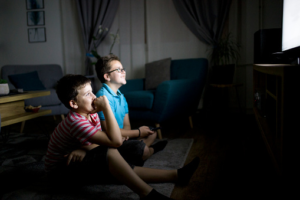
With technology playing an ever larger role in our day-to-day lives, even from a young age, the subject of screen time can be a source of contention between parents and their children. Parenting educator Laura Linn Knight, author of Break Free from Reactive Parenting, shared her thoughts on navigating family guidelines around screen use, the benefits and dangers of technology, and how rules may change as summer vacation ends and a new school year begins.
When talking about screen time, Knight refers to the host of electronic devices that children and adults might use — tablets and phones, video games, TV and movies, and more.
“We know that when children are using screens, it releases a significant amount of dopamine,” Knight said. There are healthier activities that also release dopamine, such as exercising and socializing with friends, Knight added, but screen use initiates dopamine in addictive ways more akin to what is seen from drugs and alcohol.
“What I see in children and with the families that I work with is that often there’s this initial pleasure from screens, and then the meltdowns and the emotional volatility when they’re asked to get off,” she said. “Really, they’re having kind of a withdrawal.”
The good and the bad of screen time
Knight said that pediatricians have established clear guidelines for younger children, including no tablet use except for family video chats for kids under two, and then limiting device use for children ages two to five to educational purposes.
“And then after five years old, it really becomes up to the parents,” she said. Particularly with adolescents, Knight said, it’s important to set limits. “We’re having a huge increase of screen time among adolescents, and we’re finding that there’s also this correlation of children feeling more depressed.”
It is important to note, Knight said, that the same devices can be used in a variety of different ways, and parents need not be entirely anti-screen; there are creative and collaborative uses for devices that can be beneficial.
“I think screens can bring communities together. There’s activities where whole families can work together,” she said. “For example, my husband loves 3D printing, something that he’s really passionate about that involves a screen. He and our son create different things with a 3D printer. So when I’m thinking about screen time, that’s not really where my attention and focus is going as I set up the limits and the boundaries within my home.”
Dr. Amy Allen, Chief of Student Supports for Toledo Public Schools, agrees that technology does have a place in children’s lives.
“We can no longer suggest that children do not use technology on a daily basis,” Dr. Allen said. “It has become a very effective way for us all to communicate and to learn. However, in order to have a well-rounded student, screen time should be considered only one part of a healthy environment.”
She added that parents should model appropriate screen behaviors when using their own devices, such as putting down their devices and being very intentional with their interactions with children and adults. Dr. Allen also agreed that monitoring both a child’s screen time as well as what they are watching is crucial.
For activities like playing video games and watching movies, Knight recommends setting a time limit and letting the child be responsible for allocating that time, making occasional exceptions as situations allow. For example, if screen time is limited to an hour but her son wants to watch a movie, that may be allowed.
Collaborating with your kids
Knight stressed that having conversations with kids about technology is vital, exploring the benefits, negative effects, and science of screen use together.
“It’s important for parents to become informed and educated on the subject so that they can decide ahead of time what they want the rules and boundaries to be within the home,” Knight said. “Then they need to be sitting down and having a family meeting with their children and sharing the appropriate facts, sharing age-appropriate findings with them, and talking also about family values.”
Each family’s values should shape how they think about technology, Knight said, and it can be useful to write these values down.
“We value quality time together. We value family dinners. We value playing together,” Knight said of her own family’s guiding principles. “So if we have this as our guiding value and we’re really clear about it as a family, it makes sense that we only have an hour [of screen time]. Because we want to do other things together. Families that practice this tell me that there’s more understanding and there’s more participation from children,” she added. “It’s less authoritarian and more of a family decision that’s been made.”
With the start of a new school year approaching, parents will likely want to adjust screen time rules. Knight suggests starting that conversation early and practicing the new routine. “Going back to school is such a shock for children in so many ways,” she said. “They’re readjusting to new friends, new teachers, they’re getting up earlier at school for longer hours. It’s a lot on them emotionally, socially, and physically.” Ideally, then, parents should try to minimize stress around new rules at home by easing into new expectations early.
For more advice on screen-time management and other parenting tips, check out Laura Linn Knight’s book, Break Free From Reactive Parenting,on Amazon, Barnes and Noble, bookshop.org and other major book sellers. You can also follow her on Instagram @lauralinnknight.
What’s the story with “Cocomelon”? Is it harmless fun, or more than a little bit addictive?
By Chelsea Convis and Laurie Bertke
Dr. Aimee Drescher, a clinical psychologist for Mercy Health, said being attuned to your child and their needs is key to determining what shows are appropriate and even helpful.
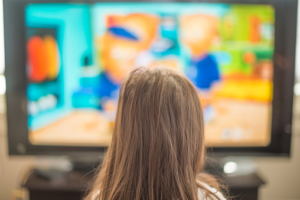
Many parents would like to avoid having their young child watch TV at all. But those parents might also agree that, at certain moments, it’s not that bad to plop a kiddo down with a show while trying to get dinner ready or paying bills. That is even more likely if the show is specifically made with children in mind, like “Cocomelon.”With its catchy nursery rhymes and original tunes, as well as bright cartoon characters, “Cocomelon”seems like a great way to capture kids’ attention.
But what if shows like “Cocomelon”areactually quite harmful for children? Anecdotal conversations between parents concerning the negative impact of “Cocomelon” on their children have been circulating on social media, and it seems that neurodivergent children might be getting hit the hardest. One mom shared that her young son, a “Cocomelon”viewer, tried to run away from home, while hundreds of Redditors share parenting horror stories of trying to turn off “Cocomelon” only to be met with angry shrieks of protest.Many moms share that they become worried about “Cocomelon”after seeing other moms on TikTok sharing how harmful they thought the program was for their kids.
So, what’s the scoop on “Cocomelon”? Should you steer your child away?
Know your child
Although there are no academic studies on how “Cocomelon” affects neurodivergent children, parents express both concerns and positive stories in comments on social media about the program. Image courtesy of Unsplash
First, pediatricians at the University of Michigan urge parents to consider that, in general, the descriptor “educational” applied to apps and shows doesn’t mean they are educational.
“For little kids, no screen-based activity is ever as educational as talking, singing, or playing with you,” the medical professionals concluded.
Dr. Aimee Drescher, a clinical psychologist for Mercy Health, said being attuned to your child and their needs is key to determining what shows are appropriate and even helpful.
“You would want to be very careful about having programming that is above their developmental level,” she said. “It can be overwhelming if kids are not there yet.”
Regarding “Cocomelon,” Jerrica Sannes (a child development expert with an MEd in early childhood, currently located in Orange County, CA) was one of the first people to speak out with concerns.
One mom says, “Cocomelon worked great for my son. He went from nothing but baby babble at two years old to actually saying sentences before his third birthday. ‘Cocomelon’ and ‘Baby Shark’ songs helped with his speaking when speech therapy didn’t work. It depends on the kid themselves.” Image courtesy of Unsplash
On Instagram, Sannes wrote: “Cocomelon is so hyperstimulating that it actually acts as a drug, as a stimulant. The brain gets a hit of dopamine from screen-time, and it seems that the stronger the ‘drug’ aka the level of stimulation a show delivers, the stronger the ‘hit.’ This leads to 1) children experiencing symptoms of addiction and withdrawal, often leaving them dysregulated, and 2) a general discomfort with the speed of everyday life. The more children watch the show, the more the brain begins to expect that kind of stimulation. This makes it impossible for the child to play creatively and without entertainment.”
Sannes thinks that “Cocomelon,” with its two-second scene changes, fast camera movements, and emphasis on multiple effects, is too stimulating for some children.
What about neurodivergent children?
Neurodivergence is a nonmedical term that describes people whose brain develops or works differently for some reason. Dr. Drescher said neurodivergence is a spectrum that includes conditions such as autism and ADHD.
Some kids on this neurodivergent spectrum can be easily overstimulated, so programming should be evaluated in light of the individual, versus “a general consensus of what is good or bad,” said Dr. Drescher. “With ‘Cocomelon,’ it sounds like it can be quite stimulating, so with kiddos who are not entirely neurotypical, it could be overwhelming for them.”
Although there are no academic studies on how “Cocomelon”affects neurodivergent children, parents express both concerns and positive stories in comments on social media about the program.
One mom says, “Cocomelon worked great for my son. He went from nothing but baby babble at two years old to actually saying sentences before his third birthday. ‘Cocomelon’ and ‘Baby Shark’ songs helped with his speaking when speech therapy didn’t work. It depends on the kid themselves.”
One dad said it helped his nonverbal daughter learn “to sing”. But another grandmother said “Cocomelon” became “like a drug” to her two-year-old grandson. “He had to have it to wake up, sleep, and pretty much demanded it all day long.”
How much screen time is too much?
Some claim that “Cocomelon,” with its two-second scene changes, fast camera movements, and emphasis on multiple effects, is too stimulating for some children. Image courtesy of Unsplash
Some experts think that viewing “Cocomelon”is absolutely fine for young children. Nicole Beurkens, a psychologist in Grand Rapids, finds “Cocomelon”stimulating, but not overwhelming. Its bright colors help babies (whose eyesight is not fully developed) to see what’s going on, and the repetition of the music is educationally valuable for children.
While the American Academy of Pediatrics screen time guidelines exist for a reason, it’s reasonable for parents to focus on the bigger picture as they apply those rules within their families. If you are going on a five-hour car ride, for example, it’s okay to let your child watch a movie that exceeds the allotted screen time recommendation.
“I would say knowing when it becomes harmful is more important than the actual amount of time that they’re spending.” said Dr. Drescher. “If it’s impeding their ability to get out and spend time with family members, spend time with parents, that’s when I’d say it becomes harmful. You don’t want to just stick your kid in front of a TV all day long and have no interaction with them.”
If your child refuses to go to bed, is unable to be redirected from television to a different activity, or becomes rigid about watching a program at the same time every day, Dr. Drescher said these can be additional warning signs that screen time is becoming problematic.
In terms of evaluating programs for educational value, Dr. Drescher advocates for those that teach about cultural diversity and include social-emotional components such as how to talk about feelings.
“It’s great to learn the ABCs,” she said. “It’s also even better to know how to interact in the world. When you have examples of positive social interactions and talking about emotions, I feel like that’s going to carry kids much further, especially in the world we’re living in right now, after they’ve been isolated for a period of time.”


 As parents prepare for their K-12 kids to return to school, protecting them from disease continues to be a priority. In addition to the schedule of regular vaccinations, COVID-19 vaccinations and boosters are now recommended for all school-aged kids.

 Participants in the program have also ventured outside of the garden to promote the cause of urban farming.
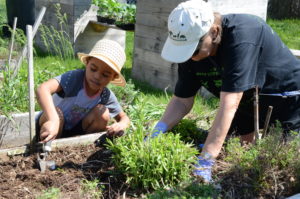 Future projects include establishing a fruit tree orchard on the land and planting no-mow clover in their 2023 Summer Clean Air campaign.


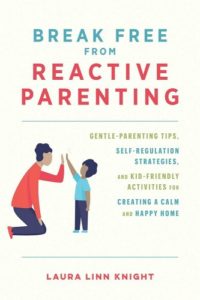 With technology playing an ever larger role in our day-to-day lives, even from a young age, the subject of screen time can be a source of contention between parents and their children. Parenting educator Laura Linn Knight, author of