Home Blog Page 230

Not in Vain: Real life stories from Moms on losing a child to drug addiction

According to statistics from the Center for Disease Control, almost 850,000 people have died due to a drug overdose since 1999. And overdose deaths continued to increase from 2018 to 2019. For hundreds of thousands of parents, these statistics represent more than just numbers. They represent the loss of a child.

#NotInVain
Toledo-based #NotInVain provides mothers— over 100 more nationwide every day, according to the CDC— with a chance to avoid grieving alone. President PJ Champion started the nonprofit after the loss of her daughter, Christina, to crack cocaine and heroin toxicity. What began as a viral obituary reached nearly two million people and led to the realization of the lack of support groups for mothers’ grief from loss of children due to substance use.

Today, #NotInVain’s members number over 4,000, across all fifty states and nine countries. 

Through an active Facebook community, daily communications, crisis intervention, programs like “Heavenly Holiday Gifts for Kids” that provide comfort to children who have lost their parents during the holidays, as well as a yearly retreat, #NotInVain provides community and support to those affected most by the drug epidemic. The group also connects mothers in need with a variety of resources through their website.

A helpful book
Not in Vain, Mothers Share Their Journey through Their Child’s Life and Loss to the Drug Pandemic, was published in October, 2020. Bobbie Ziemer, an Ohio native, is the mother of three children. She lost her daughter, Madison, on October 10th, 2017, and has since made it her mission to help spread awareness around a taboo topic while creating a safe space for those struggling with grief. Bobbie describes the book as being “filled with over 160 real-life stories from grieving mothers through the initial discovery of a child’s drug use to the devastating end of the journey.

“We have shared what we have learned, the emotional ups-and-downs, the ‘enabling,’ ‘tough love,’ ‘unconditional love,’ the effect within ourselves and our family, and what we wished we would have known or even done differently. Nobody wants to talk about it when it’s happening to them, or how families are completely lost when fighting this disease.”

While the book cannot bring back those who have been lost, it can help mothers who survive such tragedies. 100% of proceeds from both the ebook and paperback versions are being donated to the #NotInVain nonprofit organization. The book, along with other resources, can be found on Amazon or through their website at: notinvainmoms.com.

 Join the Movement, Support the Cause
Bobbie Ziemer, PJ Champion, and other women who formed the organization, believe “these real-life stories will further awareness and help provide comfort and navigation to those who arestruggling.” While the book may not provide professional guidance, it does offer a small glimpse into the lives of those mothers who have experienced grief firsthand. To donate, learn more about the book, or seek help among members of #NotInVain, visit their website or send them an email at [email protected].
The VI in Sylvania: Fresh Decor Plus Cameo Pizza

The VI
4984 N. Holland Sylvania Rd.
Mon. to Thurs. 3PM-12AM | Fri. & Sat. 11:30AM-1AM | Sun. 11:30AM-12AM
thevisylvania.com


The Short CourseOutdoor dining: Yes.
Online ordering: Yes.
Carryout: Yes.
Delivery: Deliver Toledo, Slice, Doordash.Kids’ Menu: Yes.


Fully vaccinated, Ohioans and restaurants are bustling once again. Just as newly-opened restaurants must find their rhythm, restaurants post-COVID are doing the same. While the last year was a tough one for many businesses, it was especially brutal for restaurants. The restaurant industry lost many jobs during the pandemic and now faces a new challenge— finding enough workers.

A new pizza fave for the kiddos

We arrived at The VI during prime dinner time on a weekend, and the entire restaurant was full, both indoors and outside. The hostess requested we wait outside or in our car to maintain social distancing. She called us and seated us within the 20-minute wait time that she had projected.

Once we were at a table, it was clear that our young waitress was spread thin, but she was cheery and accommodating. I asked for her appetizer recommendations, and without hesitation she said the pickle bread was the most popular. I had heard the same recommendation from others, so we ordered it to share.

Our drinks arrived after a time, but we never received the pickle bread. Our waitress was nowhere to be found, presumably running from one customer to the next, so when our meals arrived after nearly an hour’s wait, we didn’t mention the pickle bread Both kids ordered the Cameo pizza as we’d heard rave reviews. Since our son is lactose intolerant, we requested his pepperoni pizza without cheese, specifying that we wanted just sauce and pepperoni. Another server delivered our food, and both kids’ pizzas arrived with cheese. We alerted them of the mistake, and they put a rush on a replacement pizza— thankfully, they brought him a plate of fries to munch on in the meantime. 

I ordered the chicken club sand-wedge — chicken, bacon, Cameo cheese and LTO (lettuce, tomato, onion) sandwiched between the Cameo family pizza crust—and a side of fries. It was a hearty sandwich, providing me with leftovers for lunch the following day. Alex ordered the American smash burger, which tasted thoroughly homemade and fresh off the grill. He upgraded to the tater tots, but after trying my fries, he regretted the choice, wishing he had stuck with the fries.

Camille, our five-year-old, devoured her pizza and happily exclaimed that it ranked as her new “#1 pizza!” Dexter (8) didn’t receive his pizza until we had all finished our meals, so we packed his to go, but he was equally happy with his Cameo crust covered in sauce and pepperoni.

A rich Sylvania history

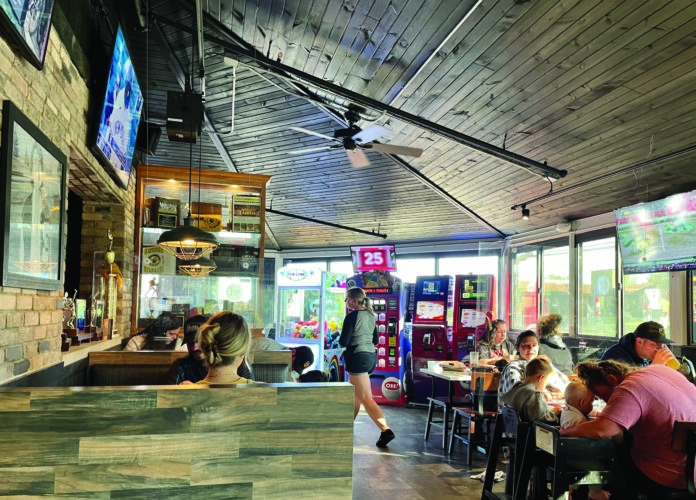
After The Village Inn closed in January of 2018 due to health code violations,  the owners of Bar 145 bought it with the plan to make it a “neighborhood sports bar,” according to co-owner Jeremy Fitzgerald. The new VI is decidedly more open than the former Village Inn, and the modern decor includes brick and oak with a dozen TVs gracing the walls.

Sylvania residents were invited to drop off photos and memorabilia to adorn the walls of The VI, as an ode to Sylvania schools, where Fitzgerald’s children attend. Co-owners Andy Grombacher and George Simon are also Sylvania residents, making The VI truly a local Sylvania spot.

Perfect for summer weather, the outside patio is stunning with a new bar, ample seating and plenty of umbrellas to create a perfect casual outdoor dining experience.

The arrival of Cameo Pizza was much anticipated, as it won awards at the 2019 Pizza Palooza at Sylvania’s Centennial Terrace. Cameo Pizza originated in Sandusky where the beloved family pizza recipe, handed down for generations, is a crowd pleaser—even with picky young eaters.


Bottom Line:

The VI is a Sylvania sports bar known for its history, fresh remodel, outdoor patio experience and Cameo pizza. While we experienced a few hiccups during our dining experience, these will all surely be ironed out once restaurants are fully staffed. The authentically delicious pizza was a hit with our family. We plan to order takeout from The VI soon, and we suggest you do the same! 

Preschool Project Gives HOPE to Toledo Children

Preschool often conjures up images of storytime, finger painting, and pretend play, but it also includes important introductions to basic educational concepts, as well as valuable experience inside a classroom with peers. Not only are these activities fun for a child, but they allow for critical development, as evidence shows preschool provides the building blocks for success later in life. 

Preschool is preparing kids for kindergarten and beyond, but unfortunately, many Toledo children are behind. Based on 2019 KRA scores, 80 percent of Toledo’s children enter kindergarten not ready to learn. And once they’re behind, it can be tough to catch up to their peers. 

That’s why a recent announcement from a Toledo nonprofit is such great news for the community. The new HOPE Toledo Pre-K Inaugural Preschool Project will allow more four-year-olds to have access to high-quality preschool. 

A strong start, a brighter future

Research shows kids who enter kindergarten ready to learn are more likely to pass third grade reading tests, eighth grade math tests, graduate from high school, go on to college, and earn more income over their lifetimes. 

John C. Jones, president of HOPE Toledo, announced last month the organization’s partnership with nine community-based preschool providers to offer high quality, full-day, affordable preschool to more than 200 four-year-olds in Toledo. 

“We are truly excited to see our vision begin to come to fruition through our partnerships with these nine partner providers,” Jones said. “And this is just the start as we look to bring more providers on board in order to fulfill our mission – that every Toledo child has the opportunity to attend a high-quality early childhood educational program that prepares them to succeed in kindergarten and beyond.”

The initial nine providers are All 4 Kids, Believe Academy, Catholic Club, Children’s Discovery Center (Talmadge location), East Toledo Family Center, Learning Ladder Child Care Center, Rise and Shine Childcare Academy and Toledo Day Nursery. 

High-quality preschool

HOPE Toledo Pre-K is working to provide an opportunity for every Toledo child to attend a high-quality preschool. This means a preschool program with a comprehensive curriculum that includes basic education, as well as important social and behavioral skills. The latter involves working in groups, practicing listening skills and learning to respect teachers and classmates. High-quality preschools have professionally trained and well-compensated teachers. They also have smaller classrooms with small student-teacher ratios, and active parent engagement. 

High-quality preschool also needs to be affordable, so HOPE Toledo Pre-K offers tuition assistance on an income-based, sliding fee scale. The preschools also provide routine developmental assessments, regular evaluations and program oversight and accountability. 

Another factor in a high-quality preschool program is full-day instruction, which enables parents to work, knowing their children are cared for in a safe, engaging environment. 

Classes coming soon

Enrollment is open and currently available online. Classes are slated to begin September 1, 2021, but there is still plenty of time to register your child for the upcoming year. You can find more details and easy registration information here.

Starting your child in a preschool program today sets them up for success tomorrow. And there’s nothing more valuable than that. 

The Good Shepherd Animal Sanctuary: A Refuge on the Farm

Roxy and Lugh, two rescued thoroughbred racehorses, enjoying a summer day.

Now in its fourth year, The Good Shepherd Animal Sanctuary is a safe haven for those that trod on all fours or squawk and flap their wings. Located 25 minutes outside of South Toledo in Neapolis, they are the only Farmed Animal Sanctuary in the Greater Toledo Area.

Founding the Farm

According to Christine “Elle” Cox, founder and president of the organization, it all started five years ago in a boarding barn. She had originally come onto the animal rescue scene by saving off-the-track thoroughbred race horses. She was taking care of one while her best friend and co-founder of the organization, Colleen Wilson, was asking her what was next for her life.

“I told her, ‘I really want to start an animal sanctuary, but I want it to be all inclusive. I don’t want it to just be dogs and cats. I want it to be every animal,’” Cox said. “I’d been a vegan at that point in time for eight years, I’m now going on 13, and I just knew that I didn’t want to exclude any animal.”

It wasn’t easy. It took two years to build on the idea and look for a property that could realistically sustain their organization and all the different species that they were hoping to save. Finally, in 2018, while six months pregnant, Cox and her husband found the perfect land and jumped on it. It needed a lot of work, but they were willing to do it. “We built the barn by hand, put every last post and strip of fencing up by ourselves,” Cox said.

From left to right: Roger, Fiona, and Ruth. Fiona and Ruth are recent additions to the permanent family, saved from the Dayton hoarding case.

Right Now

The Good Shepherd is permanently home to 91 animals, which may seem like a lot, but Cox says that the majority, such as chickens, ducks, rabbits, and cats, are not very financially taxing. Permanent residents are able to be sponsored by the public for affordable annual or monthly costs listed on their site. Besides sponsorship, they also foster-to-adopt many animals as long as the foster can pass a farm check and prove they do not have other animals on the property used for stereotypical food sources, such as slaughter or selling eggs.

One animal that The Good Shepherd has been struggling to save and even find fosters for lately are potbelly pigs. They have recently launched Project Ohio Potbelly Pig Aid to garner money and support for a case in Dayton where 20 pigs were living in squalid conditions and breeding out of control. They were granted 13 pigs from the case and have been able to find fosters for most, even adding two to their own permanent residents.

“There really is kind of a trend that has been erupting among the exotic pet enthusiasts to purchase potbelly pigs under the guise of a mini, micro, or teacup pig,” notes Cox. “At the end of the day, there is no such thing.”

Cox urges the public to become informed of the animals in their care, make sure they properly seek medical care through vets, and also stop over-breeding by spaying and neutering their pets.

Want to help? If you’d like to go beyond donations or sponsorships, The Good Shepherd encourages individuals to volunteer. Learn more by visiting their website, https://www.thegoodshepherdanimalsanctuary.org/. They do not accept walk-ins. 

Sylvania Water Polo Seeks New Talent

My arms are still sore. My lungs are still working overtime. Hitting the gym too hard? Nope. Playing water polo. Last week I was lucky enough to join the Sylvania Water Polo team during their Try It camp, and, let me tell you, this is an exhausting sport. 

Watching Olympic water polo doesn’t quite do it justice. The athletes make it look effortless when it most definitely is not. The president of the Sylvania Water Polo Club, Erik Boyer, told me that players burn 3,000 calories in a match. 

I’ve always been good at most sports I’ve picked up, but not here. I used muscles that I didn’t even know I had (and probably never had, to be honest). But what an amazing full body workout! I’m really not sure why people use the gym when they could just play water polo. 

The Club 

What a fun group of kids this is! Not once did they try to drown me—I could handle that on my own anyways— and they were all kind despite my inexperience. They also were incredibly nice to the new kids trying the sport for the first time through the Try It camp, helping them out with pointers and encouraging them. The Club’s outreach coordinator, Doev Joelson, stressed that the Club fostered community and teamwork.  

The Club is open to all genders grades 6 through 12 who reside in Northwest Ohio and Southeast Michigan. Because it is a club sport, you don’t have to be a Sylvania resident or in the Sylvania school system. This helps build the community Doev was talking about by building friendships across school boundaries. Water polo, because it is not a super popular sport, is also a great way to earn a college scholarship.

The Club asks anyone interested to contact them, and you can attend three practices for free. They have practices most weeknights at 7pm, which you can learn more about in their upcoming calendar. The Club also has some big weekend tournaments coming up across the area, including trips to Columbus and Cincinnati. Their next game in Toledo is at St. Francis on Thursday September 9 at 6 pm. 

Learning the ropes

Friday night at practice, Coach Alberto Almeida forced me to jump right into the deep end. I hardly got to interview anyone before finding myself in the pool with the rookies from the Try It camp, treading water with only my legs, using my arms to block and shoot with the ball. 

By diving in myself, I learned a lot of rules that I didn’t know about water polo before. For instance, you can only hold the ball with one hand, and you can’t steal the ball when another player is holding it, but you can grab their shoulder to make their lives uncomfortable. 

Then we scrimmaged. The ball was thrown in, and I swam as fast as I could back and forth. Constantly. I was exhausted and ready to quit. But then, a loose ball popped up in front of me, and I furiously dog-paddled my dad bod towards it. As I grabbed it and threw it blindly towards the goal, I swallowed a big mouthful of water. Somehow, it went in! I immediately quit, jumped out of the pool, and collapsed poolside. Parents laughed at me, butI didn’t care. I was triumphant. Triumphant and exhausted.  You have to know how to quit while you’re ahead, right? Okay, maybe that’s not the message you want to send the kiddos, but it’s true for this journalist-turned-water-polo novice.

The Battle of the Border

I also attended a big invitational scrimmage—the Battle of the Border—with teams coming from Napoleon and Oakwood to play the Sylvania team. It was fun to watch. Some of the newbies from the Try It camp got to play in their first competitive matches. Just like Doev and Erik told me, it seemed to be more about community than competition. Some teams didn’t have enough players, so others would jump in and help them out. Even the coaches played when the numbers were low. Everyone was having fun while working every muscle in their body. It was “more of a family,” like Erik had told me the night before. 

Coach Alberto tried to get yours truly back in the pool in a competitive match. Sorry, Coach, I hadn’t brought my swim trunks. Not to mention, I was still too exhausted from the previous night’s practice. Who won? Who cares; everyone had a blast and got some really good exercise. 

Erik told me that his advice for interested students is: “Just come and try it. You might just fall in love with it.” I certainly did. 

Learn more about  Sylvania Water Polo and how to join on their website or Facebook page. 

Above photos by Erik Boyer. All photos from the Battle of the Border scrimmage tournament.

How to Raise an Anti-Racist Child

My wife and I are first time parents who are constantly learning about new developmental milestones. Though we didn’t expect to have to deal with racial biases now, as our child is only four months old, research shows that it is never too early to anticipate problematic patterns. Even at four months old, our child’s brain will react more strongly to faces of his own race rather than faces of people who do not look like him and his parents, a response that sociologists say will only grow stronger over the years.

It might seem like a ludicrous question, but here it is: How do we make sure we don’t raise a racist baby? There are plenty of ways to raise children while combating biases that can be anticipated and met head on, making those biases anything but inevitable.

Before language

Although we cannot talk to our child about it right now due to his age, there are some things we all can do to prevent this simple sociological response to faces that look different than those of his parents, the people he spends most of the time with, from becoming racial bias. First, introduce diversity into your child’s life with cross-racial friendships. Expose your infant to people with different skin colors and facial characteristics. Look for a daycare with attendees of different races. Hire a nanny or babysitter that looks different from you, or your partner, or your child. 

Next, incorporate diversity in the books you read. The Snowy Day by Ezra Jack Keats has earned accolades for presenting one of the first Black protagonists in a picture book. There are a plethora of books that will introduce your infant/toddler to children of different races. Check out the Diverse Book Finder which highlights diverse characters that allow children of color to see themselves in the books. When the child begins to watch TV, make sure the programming is filled with different faces as well. 

Work on your own biases

Professor Jennifer Eberhardt works with police officers regarding confronting biases. In her book Biased, she writes “Bias, even when we are not conscious of it, has consequences that we need to understand and mitigate. The stereotypic associations we carry in our heads can affect what we perceive, how we think, and the actions we take.

We all exhibit biases; that is something that we develop at a young age, when we grow up in a world filled with systemic and individual racism. Studies show that parents transmit these biases to our children—sometimes consciously, but often unconsciously. Children are wonderfully adept at picking up social cues from adults. Preschoolers have been shown to carry more favorable views of people that are treated better by their parents.  After watching a single negative interaction with an individual, young children are more likely to have a negative view of the person that is treated badly. 

For parents, these implicit biases don’t have the immediate life and death impact that they could have with police officers, but they do shape the world our children grow up in. You might consider yourself to be a very unbiased person, but it is the way you subconsciously treat people that most impacts the way your child observes and learns.

Talk to your children about race

If parents are uncomfortable talking about a topic, our children inherit that discomfort; often, they will silence their curiosity or internalize that race is a taboo topic. Instead, engage young children in discussion. Listen to them, and talk with them openly and honestly. Ask them why they think and feel certain things. If you are uncomfortable discussing race or you are just seeking pointers, check out these resources from the Sesame Workshop. 

Ibram X. Kendi, author of Antiracist Baby and How to Be an Antiracist, writes: “When we are afraid to talk about race, kids assume that it’s a topic that they, too, are supposed to avoid.” Kids often learn by kindergarten and first grade that race is not something to talk about, while also beginning to make selections of their peers based on race.  “You don’t want to assume children are ‘blank slates,’” Kendi writes. “This leaves room for racial societal messages to shape their understanding of racism instead.”

Dr. Eberhardt, who is Black, shares a story about her son, who, when he was five years old, saw a Black man on a plane and said “Hey, that guy looks like Daddy.” Eberhardt writes that the man looked nothing at all like her husband, except he was the only Black man on the plane. Her son continued to say, “I hope he doesn’t rob the plane.” “Why would you say that?” she asked. “I don’t know why I said that,” her son said. “I don’t know why I was thinking that.” She uses the story to introduce police officers to implicit bias, making the point: “We are living with such severe racial stratification that even a five-year-old can tell us what’s supposed to happen next. Even with no malice—even with no hatred—the black-crime association made its way into the mind of my five-year-old son, into all of our children, into all of us.”

With 2020’s summer of racial reckoning and focus following the police killing of George Floyd, parents and teachers everywhere are looking for ways to integrate the lessons learned into ways of teaching and raising our children. It had been a long time coming. And despite the backlash of some to the nationwide protests, it will be an enduring legacy that forced America to look closely into the mirror and see a nation that, despite steps forward over the years, still lacks equity and equality. It brought us face-to-face with the disturbing relics of our past that, rather than being vanquished, were immortalized in marble and celebrated. 

While, unlike police officers, our implicit or explicit biases are not likely to endanger the lives of people, that doesn’t mean we should be silent. Listen to your children. Talk to your children. Teach your children. Together we can build a more equitable world.