
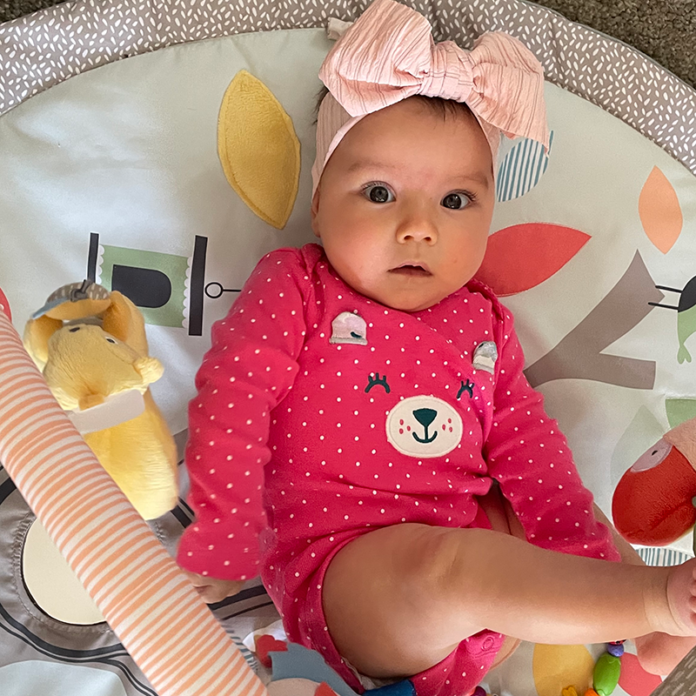
We want to see those sweet faces! Submit a photo of your little one’s baby face for a chance to be featured in the Show & Tell section of our July Baby & Maternity Issue!
Saying the Word “No” to Your Children: A New York Times Bestselling Author Weighs In

Here’s what I learned that served me and my children well: pick your spots. Consider the request. If you are always saying no, chances are that some of those no’s are negotiable, and a child knows it. But if you rarely say no and you mean it, they quickly learn that arguing will usually get them “no”-where. However, every now and then if a child makes a convincing counterpoint, you may want to reconsider.
We want our kids to understand their own power of mastering verbal skills without shouting, crying, and pouting. You want them to use reason. And when they do — and it agrees with your sensibilities — give them a victory once and awhile. I believe that on most requests parents should be responding with qualified yeses. Or with a “Yes, but first you need to… (fill in the blank: cut the lawn, take the dog for a walk, etc). And then, when you say no, you say it with conviction. You never give in because they throw a tantrum.
My philosophy when my kids were younger was to give them as much freedom as possible, and that meant letting them have control over many aspects of their lives. For example, their bedrooms were their own — they could decorate or arrange them however they wanted, and I always knocked if the door was closed. They could choose their own clothes without me passing judgment. And they could do what they wanted with their hairstyles – if my daughter wanted blue hair, that was her decision not mine, and if my son wanted hair to his shoulders or a buzz cut, it was his choice to make. I wanted to save my no’s for much more important things than fashion.
 As your children grow, make sure they earn some of their wants, needs, and possessions. If you give them everything they need when they are young, they are going to need you for most everything as they age! Your children need some emotional space, problems to solve, and consequences. They get none of that if you say yes to every request for material possessions and you solve every problem.
We shouldn’t shield children from all difficulties. Our job as parents is to raise kids who can do just fine without us. Solving every problem just creates dependency. Doing tasks for a child or teenager out of love, or because you can do it quicker or better, doesn’t help them learn responsibility.
I can think of two incidents with my own children that illustrate a couple of these choices children must make. When my two children were about 9 and 11 years old, we were shopping, and they wanted me to buy them handheld battery-operated mini fans that also sprayed a mist. I decided this was a good chance for the kids to learn the value of a dollar. (They had plenty of toys and material possessions so I was not depriving them of something important and, therefore, felt no guilt about my decision.) I said, “If you really want those fans, you will have to pay for them out of your savings.” They thought about it and said yes, they still wanted the fans.
I paid the cashier, and then the kids reimbursed me when I got home. A week later, I asked where the fans were. They said something to the effect that they were kind of boring and that one wasn’t working. I asked them if they thought the fans were worth the money. They both said, “No way!” Years later we laughed about the fans, although both of my children gave me a hard time for making them pay for them. They did, however, connect the dots to see there was a lesson about impulse buying.
A second instance I recall was my son qualifying for the town’s basketball travel team, which only the best players made. All the kids on the team had high skill levels, and, of course, the coach gave the most playing time to the best of the best. Consequently, my son sat on the bench during most of the games. One year he didn’t try out for the team. Now some dads might have said, “Don’t give up so easily.” But my view was that basketball should be fun, and that meant playing in the games. In his own way, my son showed wisdom; instead of spending another year riding the bench, he participated in a recreational league where he had plenty of playing time. He effectively said “no” to the time-draining, no-fun travel team, and yes to competing in a game he loved.
As parents, we especially should teach our teenage children about the power of no, particularly when it comes to time management. We all want our children to do well in school or college, and sometimes we become fixated on their academic skill sets and amount of study time. But equally important is the non-academic factor of time management.
Researchers Richelle Adams and Erik Blair identified good time management skills as having “a buffering effect on stress and are a key indication of higher performance.” While their report was focused on college students, we as parents can help foster this skill earlier by prompting our children to set priorities. And that means helping them avoid saying “yes” to every single opportunity that comes their way. Like us, our kids are bombarded by stimuli, and asking them to choose what is important to their education and aspirations — and what is not —helps them establish a lifelong pattern of control.
Time management is not an easy task for a teen or young adult when they are juggling both a social life and their studies. But as parents, we can get them started simply by asking them to have an awareness of what activities are taking up their time, then letting them decide which ones are bringing the least amount of satisfaction or are taking up an inordinate amount of time. Ask them to think about what activity takes the most from you and gives the least in return. Just opening a dialogue on the subject might cause your child to make small adjustments that lead to big gains academically and a stronger sense of well-being. Studies have shown that the students who perceived they were in control of their time had less tension in their life and a lower feeling of being overloaded.
Try It
- When your kids are young and they want a frivolous item, have them use their own money to purchase it. They quickly learn if their purchase was worth it.
- Initiate discussions with your teens about time management. The whole point is to make them aware of the various uses of their free time. They just might surprise you by using the power of no to prioritize what is most important to them.
- Put more emphasis on encouraging a child’s effort than the outcome. This will foster their sense of self-reliance, and show them that failure is just a word, and is temporary. (More on “failure” in a later chapter)
| Are you frequently telling your child how bright and smart they are? If so, you might be surprised by the findings of a study conducted by Claudia Mueller and Carol Dweck at Columbia University. In their research experiment, one group of children were told how intelligent they were when they completed a task, while another group who completed the same task did not receive praise. The children were then asked if they wanted to do a relatively easy task next or a hard one. Surprisingly the majority of the children who were praised chose the easy task, while the majority of ones who were not praised chose the difficult task. The praising made the children avoid failure and opt out of challenging problems.
So how should you praise your child? These same researchers conducted more experiments with children. One group was told how smart they were and the other were complimented for the effort. The ones complimented for their effort received better scores and task completion rates than those told they were bright. So, in a nutshell, choose praise for effort and your child will be more likely to choose, complete, and even enjoy difficult tasks. |
Michael Tougias is a NY Times Bestselling Author of 38 books including “No Will Set You Free”. Learn more at www.michaeltougias.com.
Digital health platform provides puberty & health education for parents and kids

Early in her practice as an ob-gyn, Dr. Melisa Holmes was shocked by how many women didn’t understand their bodies and how they worked. She wanted to change that, not just for adults but for young girls, too, so they could grow up armed with both facts and confidence to advocate for their health.
In 2003, a mom in her community asked Dr. Holmes if she would talk with her daughter’s soccer team about puberty. Dr. Holmes and her friend Trish Hutchison, a pediatrician, created an educational program for the girls and their caregivers. In addition to their professional experience, the two doctors are also mothers with five daughters between their two families. The program was such a hit, with repeated calls to present it again, that the two physicians knew they had struck a chord, and the digital health platform Girlology was born.
“Most parents today didn’t grow up with great education around health and wellness, especially reproductive health,” said Holmes. “They want to do a better job for their children, as well as protect them from all the misinformation and ‘noise’ out there on social media. Through Girlology, we help young people get accurate, shame-free information that builds confidence and improves their ability to advocate for their own health and wellness.”
Girlology’s online community is dedicated to making girls’ lives healthier by providing medically-accurate, shame-free information and support through short video tips, on-demand classes and live-streaming events. When the Girlology program began, Holmes noticed many of the moms were learning as much as the girls, and everyone was becoming much more comfortable having conversations about puberty and sexual health.
“There’s this sort of parenting cliff that we reach as moms — there’s tons of support and advice out there when our children are infants and toddlers, but suddenly as they’re heading into late childhood and adolescence, that support seems to go silent,” said Holmes. “We feel like we’re filling in that gap.”
Girlology supports parents as their daughter’s most trusted guide, providing families access to hundreds of tips and classes to navigate every health and body topic that could come up during adolescence and puberty. The content is relatable with a touch of fun and humor. From bra shopping and skin care secrets to period solutions, eating disorders prevention and even friendship, Holmes and Hutchison, who call themselves the “Mom Docs,” guide families through every age and stage of girl life.
“We hear from a lot of moms how we’ve improved the way they communicate and connect with their children,” said Holmes. “That’s one of the most important things we can do, because there’s a lot of research confirming that parent-child connection is incredibly protective for adolescents’ health and wellness. We all want to raise informed, confident and healthy children – we’re grateful that so many families trust us to be that resource.”
As the content continues to expand, Holmes says the volume can get overwhelming for families. So Girlology has recently created a “Quick Start Guide” with suggested playlists to help families easily locate the content the physicians believe is most essential for each age and stage of development, based loosely on third through eighth grades. This resource helps caregivers know what their kids should be learning at each age, plus what’s coming next.
Over the years since Girlology’s launch, Holmes and Hutchison have expanded the content to cover topics like body image, media literacy and mental health. They also launched Guyology in 2012, a parallel program on boys’ health and puberty. The physicians have also written five Girlology and Guyology books, with their sixth book releasing this spring. You-ology: A Puberty Guide for Every Body is the first book of its kind, published in conjunction with the American Academy of Pediatrics, embracing an inclusive gender-affirming approach and normalizing puberty for all kids through fact-based, age-appropriate and body positive information about the physical, social and emotional changes of puberty.
Especially after launching Guyology, it quickly became apparent to the physicians that all young people have similar questions and curiosities about their own bodies, but also about bodies that are different than their own. Holmes and Hutchison have long encouraged parents to let their daughters read Guyology and their sons read Girlology, but writing Youology was the next step to create a more inclusive community that embraces families with gender-diverse children.
“Every child is wonderfully curious and loves learning how the body works and grows,” said Holmes. “We explain the physical and emotional changes of puberty in kid-friendly language. That means boys, girls and gender-diverse kids can all understand each other better. When children understand what their peers experience, they grow up more empathetic and supportive. This understanding helps grow respect for all and creates a better world for everyone.”
Learn more
Girlology provides a substantial amount of free content through their social channels and newsletter. Plus, they offer an on-demand video library for members, with monthly or yearly membership options available. Visit girlology.com for details.
This article originally ran on MetroFamilyMagazine.com.
Donating Breast Milk, Saving Lives

The benefits of breastfeeding have returned to the main stage over the past several decades. This sacred practice has once again been mainstreamed, and more women are choosing to breastfeed their babies. But what do you do with your extra supply of breast milk? Gloria Shortridge, RN and lactation consultant of more than 25 years, started a breast milk dropsite at the WIC clinic located in the Lucas County Health Department.
Shortridge, along with lactation consultant Laura Mason, and their team, assist with a variety of services at the clinic, regardless of the recipient’s income. Prior to the onset of the pandemic in 2020, Shortridge attended a WIC conference in Columbus where she learned about the OhioHealth Mothers’ Milk Bank. She returned to Toledo with a mission to start a dropsite, a place where mothers with extra milk supply could drop off donations.
Shortridge contacted OhioHealth and learned what was needed to begin. With the program getting approval from WIC and the Health Department, a freezer was purchased to store the milk. OhioHealth provided the boxes and coolers needed for shipping and donations began arriving a month later in January 2021.
Bank it
The Lucas County dropsite has been pleasantly surprised by how many have donated their milk, whether it’s been one time or ongoing, but they are hoping for more.
“We know there are still a lot of women dumping their extra milk, but it could be used to help others. We take donations of any amount,” Shortridge says.
Milk dropped off in Lucas County is stored in the freezer at -20 degrees and is shipped to Columbus to be pasteurized and prepared for distribution. Each box shipped contains coolers holding up to 25 lbs of breast milk. Shortridge and Mason are mailing at least 100 lbs per week.
Christine Smith, with OhioHealth in Columbus, has been working to grow the OhioHealth Mothers’ Milk Bank since they started processing milk in Ohio in 2005.
“We describe it as, ‘Donor milk to a NICU baby is like a blood transfusion to a trauma patient,’” she says. “They need it for the best possible outcome.”
NICU babies receive 95 percent of the donations. Premature babies do not only need the breast milk for nutrition but also the antibodies to fight off infections. Smith adds, “The milk is pasteurized and cultured. It has to have no growth of any bacteria before it can be distributed. No viruses. This is how we know there are no germs in the breast milk.” Breast milk also helps with a common but serious condition for preemies, Retinopathy, which can lead to blindness.
How to get started
OhioHealth has a seamless registration process. They acknowledge that donating breast milk is a selfless act, “We try to make it as easy for the donor as possible,” Smith says. “We know that being a mom is a lot of work. We recognize the fact that they are donating out of the goodness of their heart and taking the extra time to do this. They’re not getting paid to do this.”
To begin, call OhioHealth for a phone screening to determine eligibility. If eligible, an extensive health questionnaire will be mailed or emailed, as well as consent forms to be completed by potential donor, her doctor and child’s pediatrician.
A blood test must be done, and St. Vincent’s Hospital covers the cost of phlebotomy services done in their lab. After approval, applicants receive a donor number. Donors can request help with supplies such as milk bags or labeling stickers from OhioHealth or the Lucas County dropsite. Donations can be delivered to the WIC office located at the Lucas County Health Department. Simply call ahead of time to make an appointment or show up, notifying the front desk you have a donation. If a donor does not live near a dropsite, OhioHealth can send the boxes and coolers needed for the donor to ship the milk themselves via FedEx with shipping costs covered.
Personal experience
Nurse Stacy McCarthy knows the stress of having premature babies and long NICU admissions. Bearing witness to premature and sick babies benefitting from breast milk, while her twins were fighting their own battle in the NICU, McCarthy later decided to become a milk donor. “I was producing more than I needed after my last pregnancy so I thought it would be a way of giving back. We saw first hand how much these babies need this milk.” She has been donating for over six months.
For moms unsure about donating, Stacy offers this encouragement: “If you could just think ‘what if this was my baby that needed this? ’ Seeing it from that side, and being in the NICU for a long time with our twins, we saw a lot of really sick babies who needed it.”
Women interested in donating can call OhioHealth at 614-566-0630 or Lucas County WIC Clinic at 419-213-2124. They may also send an email to [email protected] for further information.
Smash Cakes, Milestones and Mother’s Day
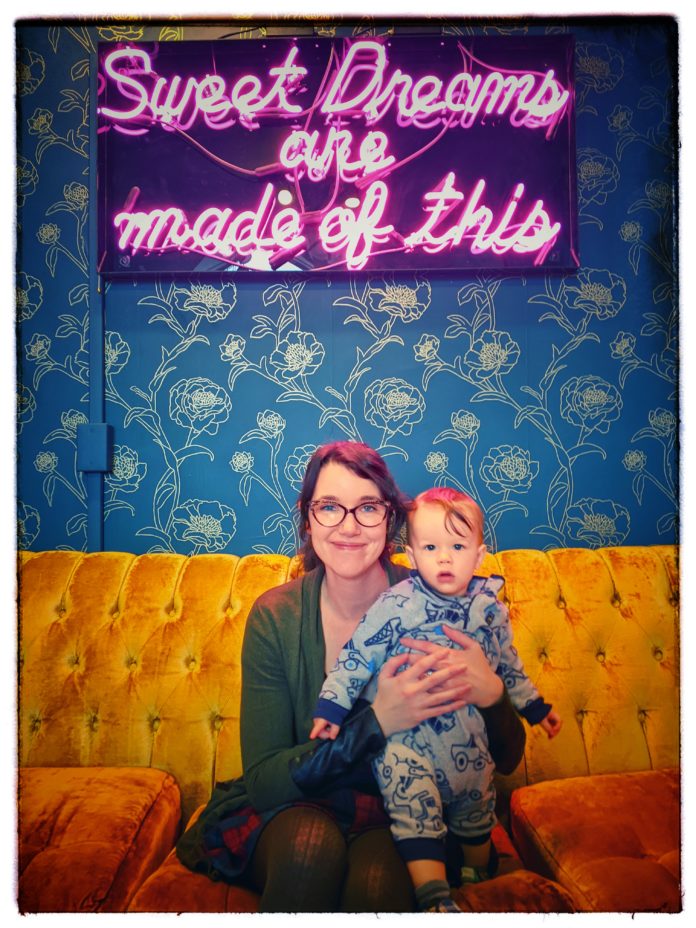
As I’m writing this on my son’s first birthday (what?!), I find myself reflecting on the past year of new momdom. It’s certainly been a whirlwind that I’ve enjoyed, albeit in a sleep-deprived haze. We still have two wake-ups most nights, but the weaning process is about to begin, so we are getting close to experiencing a full night of sleep. Wish me luck! I read in “What to Expect the First Year” that 70 percent of babies my son’s age sleep through the
night. Other sources cite a number somewhat less, but I can’t help but wonder, “Am I doing something wrong? Who ARE those little sleepy heads peacefully snoozing until morning, anyway?”
“Am I doing something wrong?” is a question that most moth-
ers consider at least once a day, if only subconsciously. Those thoughts are programmed from, you know, everything we see and hear about what a good mother is supposed to be. Additionally, it doesn’t help that fathers are often disempowered by jokes about their supposed ineptitude when it comes to changing diapers, putting on clothes, keeping up with the child’s schedule and so on…
Societal expectations can make both mothers and fathers feel as if they can’t do anything right. It’s a wonder that any of us make it through parenthood with our confidence intact. But, somehow, we do. I’m thinking about these things as both Mother’s Day and
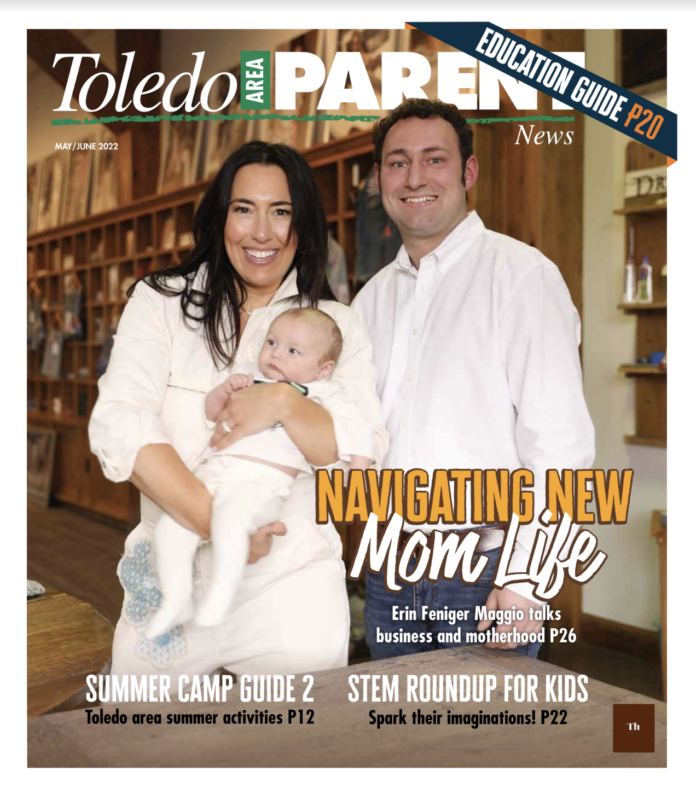
Father’s Day are approaching. I want all the moms and dads reading this to know that you are doing great! Now, excuse me while I go prepare for my one-year-old’s birthday party by cleaning the house, buying decorations and making a sugar-free smash cake before our guests arrive in a few hours! But first, here’s a preview of what this issue has in store for you: a feature that outlines the importance of paid family leave, complete with a list of what some Toledo companies offer; a profile on fashion entrepreneur and new mom Erin Feniger Maggio, who is on the cover of this issue; a Mother’s-Day-inspired review of Clara J’s Tea Room in Maumee and a continuation of our Summer Camp Guide.
Happy Mother’s Day and Happy Father’s Day to you all!
XOXO,
Erin Holden
Assignment Editor
Toledo Area Parent