Home Blog Page 683

Hey! We’re flying!

Comedian Louis Szekely, known professionally as Louis C.K., believes that we live in a world of momentous technology that is wasted on the biggest group of unappreciative babies. I know with chemo and “mom” brain I can’t recite his sentiments verbatim, but I do my best relating Mr. Szekely’s thoughts. I tell my children on the way to the airport, “People talk about delays. You can get from New York to California in five hours. Before, it would take thirty years, and people would die or give birth on the way. You end up getting there with an entirely new group than you started with. Now you can pretty much watch a movie, use the bathroom and you’re home.” It truly helps put things perspective.

“B.C.” (before children) flying was a completely different adventure. “B.C.” I would take reading material that I would actually delve into, wear highly inappropriate shoes and eat assorted “adult” munchies instead of being armed with Cheerios, fruit snacks, and
apple juice.

My first major solo flight as a young adult was to Rome, Italy. I sat between two Italian men that could not speak a word of English. I fell asleep and woke up to find the man to my left stroking my hair. With his fingers still embedded in my HUGE 80s hairdo that had its own zip code, I quickly grabbed my “Learn Italian in 10 Minutes a Day” book. I soon regretted that before the trip I’d opened it an average five minutes a week, but somehow managed to firmly say, “Tenere le mani a posto.” (Keep your hands to yourself.) At that point I thought it best that I inch my way closer to the older gentleman to my right. He was excited to show me something he bought and leaned over to produce a plastic bag from under his seat. He opened it to reveal a heap of crustaceans and a foul stench. It took me a moment to contemplate whether it was best to stick with the man with smelly crabs or head back to the one that could give them to me. Smelly crab man won out. I truly believed that nothing could top the odor of crabs on a nine hour flight until I sat next to a woman who continually fed grapes to her pet ferret. We ended up hovering over Atlanta for three hours. You will understand why the little varmints ended up on my “no way in &^%$ we will ever own one of these” list.

Years later I was blessed to have the opportunity to take my children to Rome. There was a massive delay, and we had to be rerouted to Germany. After my dark-skinned, Mediterranean-looking daughter was “randomly” picked for a pat down at the security checkpoint, we boarded. Our first major priority was to sit together. I knew it wouldn’t be a problem. If someone refused to change seats, I would calmly tell them how best to deal with a preteen with severe motion sickness and would hand them a half-dozen “barf bags” to be on the safe side — works every time.  

Hours and hours and hours later, having lost sleep, one DVD player, the contents of Lauren’s stomach (I wasn’t kidding about the motion sickness) and a boarding pass for our next flight, we arrived in Germany. Knowing we had six hours before our flight to Italy departed, I had grand thoughts of us seeing the sights of Munich. Instead we spent the ENTIRE time in the airport trying to get a new boarding pass. My child’s diary was not filled with images and stories of Europe that day. It read, “The people here in Germany are mean. And I counted four people who didn’t wash their hands after going to the bathroom.”

You don’t know what you’re made of until you’ve taken three children through the Atlanta airport. That being said, there is a part of flying that I LOVE. I enjoy looking around the plane and watching the interaction of people sitting next to each other bonding. Out in the world without turbulence, slight delays and $3 pretzels, they might pass each other by. Recently on a flight home, I watched a tattooed 6’5” gentleman with earrings protruding out of all sorts of places, showing photos of his kids to the grey-haired grandma sitting next to him. My girls, who get lost in their electronics on flights, always ask me why I usually end up hugging the person I’m next to. I guess I’m just lucky, and like comedian Louis C.K., I appreciate the true miracle of flight. We are sitting in a chair in the air — it’s pretty incredible. So bring on the delays and the temporary frustrations, and remember you’re heading toward loved ones, adventure and
times remembered.
Setting a tradition

“Hello, daddy.” It was the small, high-pitched voice of my daughter coming through my cell phone as I was driving.

“Hi, Elizabeth. How are you this morning?” I had left the house before she woke up. Hearing her voice raised all kinds of thoughts and emotions. Particularly, the need for a good explanation of why I’d left for a trip to begin with.

“Good. How are you?” 

“I am doing fine. I’m driving right now,” I explained. “I am so happy to hear from you. Are you ready for school?”

“Yes. I miss you.” Ouch. Those three words are a vacationing dad’s kryptonite. I missed her too.

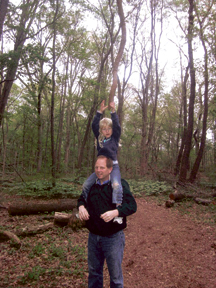
I was headed out on an annual trip to the Appalachian Trail. My friend Brian and I have been hiking since we were in college and, with some interludes, have made a tradition out of our hobby with an annual trek. This year would be a seven-day adventure in southern Virginia. I was looking forward to the trip because I would get away from the office, and it was a small fulfillment of a dream to complete the entire Appalachian Trail. But at the same time I was dreading it, because it meant so much time away from my family.

As I was driving and remembering my daughter’s voice I asked myself: how is my enjoying a hiking trip a benefit to my children? My dilemma is obviously not as difficult as what other fathers have to go through. Fathers have to leave for military service, travel for jobs, and are separated because of divorce. My separation was voluntary, but created a dissonance. 

I needed a reason beyond my own happiness — I wanted to know my time away would benefit my family in some indirect way. I found what I was seeking through the brief passersby and locales on the trail — two sisters, a father and son, and a community long abandoned. 

The two sisters, traveling the trail together, were completing a dream that had begun over forty years before. They had started hiking with their parents, and continued when they were adults, attempting to hike the entire Appalachian Trail. But that attempt ended in central Virginia. Husbands, children and life got in the way of going back again. Now in their early sixties, they were still hiking, again trying to conquer the more than 2,000 miles of trail.  

The father and son were continuing a tradition started when the son was just a boy. Now he was married and still hiking with his dad. This sport was the bond between the two and kept their relationship alive. Anyone who knows the ebbs and flows of fathers and sons can understand that this is an accomplishment.

The long-abandoned community was a settlement of freed slaves who lived along a creek near the base of a mountain. Though nature had now reclaimed most of the property, the community was still alive in the stories and remembrances of those who once lived there.

So how do these three interconnect? The sisters taught me that a lifetime dream is something to be pursued, and although family can cause roadblocks to that dream, they can also help facilitate it. The father and son taught me that things important to us are worth sharing with our children, and that giving them dreams to pursue is not the same as making them live out our dreams. The abandoned community taught me that traditions and family heritage are something we create every day through what we do, much more than what we say.   

So I did find some value in my trip for my children. They know that hiking is important to me; they know that I have a dream and am pursuing it; and they may want to involve themselves in that dream when they are able. I think they will also know that the reciprocal is true: I will help them pursue their dreams. In the end that is what family is all about — helping and supporting each other as we travel along the path of life.  Sometimes that path may involve carrying a backpack, both literally and figuratively.

Body blues (and triumphs)

If I had the chance to give a new mom advice on motherhood, it would be that being a healthy, happy mom has nothing to do with a number on a scale. In fact, being a healthy mom has nothing to do with numbers at all. Being happy and healthy is a lifestyle and “can-do” approach to raising your family and living your life. Three children and eight years later, I have finally figured this out first hand. Now that I have, I am more confident with my body and health than before having children. When I put on my favorite pair of jeans, I am not hung up on the size, but on the energy and confidence I have wearing them.

Let me begin by giving you a little background on my body blues and triumph. Being a mom to three young, energetic children I coped with the all-too-familiar nausea, swelling feet and growing belly during each of my pregnancies. Many times I felt out of touch with my body. I was unfamiliar with the “new” me and I felt helpless, but was expected to accept these changes with open arms. After the birth of each of my children, I remember feeling overwhelmed when I would look in my closet, and found myself wondering if I would ever again feel confident and attractive? 

I felt disconnected from the image of myself that I had come to recognize for so many years, and the pressure to bounce back and look as if I never had a child, let alone three, was enormous. The media and parenting magazines gave me an image of motherhood that was unrealistic and unobtainable. It wasn’t until recently, after the birth of my daughter, that I’ve become more in tune with my body and committed to my health. I no longer find myself wishing and wondering when I step on a scale, but instead I’m excited about making a healthy dinner and taking a family walk at the park. It took several years for me to accept and work on me. It took focusing on my energy, instead of the scale, to get to the place I am today.  

Mindful eating, positive self talk

Amy Hanson-Akins, a local clinical therapist and health and wellness coach, shares a similar message with new mothers that she councils. Amy’s approach to positive body image comes from mindful eating and positive self talk. She encourages new moms to be as mindful about eating and exercise post baby as they were during their pregnancy. She says highly restrictive diets are not healthy for a new mother or her young child, and encourages mothers to think of their new body in a more positive way by focusing on health versus weight. Have gratitude and be appreciative for the gift of life your body has created, and continues to give through so many ways. Many moms may feel overwhelmed after the birth of a child, but Amy encourages them to make small, consistent changes every day, like natural movement they enjoy.

She also counsels mothers to focus on their overall health, active lifestyle, and eating well. Ask yourself how you can maintain a healthy lifestyle, feel good, and pass on positive body image to your children. Be careful with the media today — there is an onslaught of pressure regarding body image and weight, and it is most often negative and unrealistic (with the bombardment of photo-shopped images to blame). One of Amy’s suggestions for mothers is to find a “Fat-Free Zone” where you can talk openly and freely without the pressure of numbers, sizes, weight, and pounds. It is positive to have a group of mothers who can support each other through the trials and tribulations of motherhood without judgment and the pressure of body image.

Youth, magic and mystery

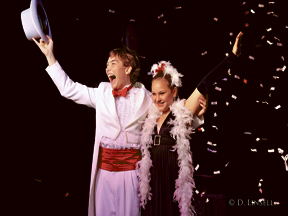
In this month’s Tween The Lines we’re featuring successful working teen Eli Portala. He has magic in his genes — the 14-year-old Toledoan is the son of veteran magician Andrew Martin, and he’s built up an impressive resume of his own. He’s just returned from a once-in-a-lifetime trip to Italy with his mother, where he appeared on the TV show La Grande Magia (The Illusionist), performing his own dazzling magic act.

You’ve just returned from your triumphant appearance on Italian TV. How did you get such a great opportunity? 

They [the producers] saw me in Las Vegas. I was doing the World Magic Seminar. I came in second there, and they liked me. They wanted me on their show, so they flew me out. I was shocked! To have somebody not even in your own country want you to perform — and they paid for EVERYTHING. That was really cool. 

Was there some culture shock for you, as a Toledoan abroad? Did you know any of the language? 

I learned a little. “Grazie” means “thank you!” Trying to communicate got a little frustrating sometimes, but I got through it. It was fun!

You’ve lived almost your whole life as a magician. When did that start? 

I’ve been doing it since I was 18 months old. My father got me started — he’s been doing it for, like, 40 years. He’s the best. But performing in public? When I was 6 years old, they wanted me to do a show at KinderCare. My mom said, “he’s only six years old! He doesn’t HAVE a show!” But word must have gotten around. I was very popular among the pre-schoolers. 

What was your first trick?

Making food disappear! Making it reappear was a little less impressive…

Do you have a trademark, as a performer? 

Well, I’ve got my personality! I just have fun, and enjoy what I do. As far as tricks, I like doing old stuff, stuff that’s been around for a long time and been put away in a dark closet. It’s cool to keep the old magic alive. I do Houdini’s “Metamorphosis.” You have two people and a crate. One person gets inside and you lock it up. The other person gets on top. A curtain goes up and they switch places, instantaneously. That’s probably the oldest trick I do. 

You’ve performed as a family for years. Any funny stories from the road? 

A few years ago, we got invited to do America’s Got Talent. We were in this big ballroom and our rabbit got away and ran between the wall and a divider. These dividers were huge — we had to call maintenance to move them. We slowed down the production a bit! The whole crew had to come down to get this furry little rabbit. 

What would you do with your life if you weren’t doing magic? 

Maybe acting? But who knows? I might be playing baseball.

An answer for autism

Kim Renner knows the pain of a parent searching for an explanation. Observing her child’s social and communication delays, she waited years for a diagnosis. She eventually learned she is the mother of an autistic child — a missing piece in the puzzle that her parental life had become. A stockbroker at the time, she found a medical environment where no formal method for discovering these disorders existed — the observations from unsure parents developed the diagnosis.

Inspired to switch careers, she is now program director for the Toledo Children’s Hospital’s Autism Early Learning Program, a full-time, year-round program devoted to helping parents of children as young as 12 months with Autism Spectrum Disorder. Autism is diagnosed in one out of every 88 children (and one out of every 54 boys) in the United States, providing parents with an explanation for their children’s delay in communication, lack of social response to others, and manifestation of restricted/repetitive behaviors or verbalizations. The Autism Early Learning Program seeks to not only diagnose early, but to also treat. 

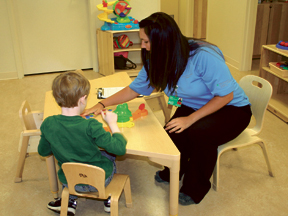
The program is staffed by a team of professionals, including special education teachers and speech/language pathologists, who work with children up to age six. A former child care center building houses the program, with rooms for learning toileting skills, gross motor skills (like riding a bike), speech, an outdoor playground and a typical kindergarten classroom. Parents can observe staffers working with their children through a remote camera system. The center will soon include a “living room” where parents can practice exercises in a home-like environment with staffers to offer assistance. Children work with team members on a one-to-one basis six hours each day, progressing toward joining the mainstream. The program was developed in consultation with Cleveland Clinic Autism Development Solutions (CCADS), a full-service, consulting division of the Cleveland Clinic Center for Autism, where the program’s staff members were trained in ABA, applied behavior analysis.  

Renner would like all new parents to understand the benefits of early diagnosis and treatment. “Before, children often weren’t diagnosed until age five,” she said. “Now, with the use of the Autism Diagnostic Observation System, we have a standardized tool for assessing the behaviors that might indicate autism. We see if we can elicit the behaviors in a clinical setting, and then we can use the information to make a diagnosis as early as 12 months. An early diagnosis means that we have so much more time to put a treatment plan in place, and to work on the skills the child will need. I would like to see all kids have the best opportunity for top quality support.”

The program is tuition-based; children three and older with an individualized education program (IEP) may be eligible for autism scholarships through the Ohio Department of Education. Parents and others are important members of the team, and there is plenty of training regarding challenging behaviors. “We teach our parents to learn advocacy skills for their children,” Renner said, “and try to put them in touch with other community agencies that can offer assistance with parental support and sibling concerns.” Those agencies include the Autism Society, and the Great Lakes Collaborative for Autism and Harbor, which have offices in the same building.

The Autism Early Learning Program is located at 2040 W. Central Ave. For more information, contact program director Kim Renner at
419-291-7080 or visit www.promedica.org.

Bold new buys

Becoming a parent can make you realize you have needs you never knew about — that’s what Ryan Wright discovered when he and his wife had their first child in September 2011. In Wright’s case, the need he discovered was for quality children’s retail, and he decided to do something about it. Now, the couple has opened Lullaby Lane in the Shops at Fallen Timbers, selling quality brands that local families might not necessarily find elsewhere. Lullaby Lane carries strollers from sought-after makers like Baby Jogger and Chicco, blankets from Aden & Anais, bags and clothes from Petunia Picklebottom and Mud Pie and many others. “Our main objective is to get [new parents] to come out and register,” Wright says. Registering earns parents free announcement cards, with more promotions to follow soon. With their comfortable 4,300-square-foot space and experienced staff, Lullaby Lane can help families rest easy. 3100 Main St., Maumee. 419-878-0127.www.lullaby-lane.com.