Home Blog Page 667

Helping families in troubled times

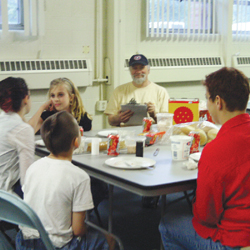
"When you see a little kid run to his dad or mom because he sees them for the first time in months … you're done," says Margaret Wuwert. "You're hooked." She's talking about her work as executive director of the Children's Rights Council, which oversees supervised parent-child visits for adults in the court system. Parents facing criminal charges or abuse allegations, whether true or not, can sometimes be kept from their children for long periods while their case works itself out. CRC makes court-approved supervised visitation possible, bringing parents and children together three times a week at Hope United Methodist Church on Sylvania Avenue. But they need your help. For the first time in CRC's 13 years in Toledo, Wuwert is having difficulty getting enough volunteers to supervise the visits. No special training is required, and the time commitment can be as little as one evening a month. The only real qualification, according to Wuwert? "You just have to love kids."

For information, contact Wuwert at CRC, 419-473-8955. www.crckids.org.

Going swimmingly

A Toledo woman has won recognition on the national stage for her good work — and she's in position to receive a lot more. Wanda Butts of the Josh Project has been recognized by CNN as a Top Ten CNN Hero of the Year, and will be eligible to win the year's top honor and the $250,000 prize that comes with it. The Josh Project is dedicated to teaching urban youth the valuable and life saving skill of swimming, and is dedicated to the memory of Butts' son, John-Joshua, who died by drowning in 2006. The project provides low-cost swimming lessons and water-safety training to anyone with a desire to learn. Online voting for the Hero of the Year began on September 20, and continues through Wednesday, November 28. If chosen for the quarter-of-a-million dollar grant, Butts plans to build an Aquatic Center in the heart of Toledo, where at-risk children can swim every day. It's a legacy that Josh, and Toledo, can be proud of, and every vote counts. Check out cnnheroes.com to see their segment on Butts and the Josh Project, and to cast your vote.

www.joshproject.org

https://www.cnn.com/2012/05/10/us/cnnheroes-butts-josh-project/index.html

Science from the street

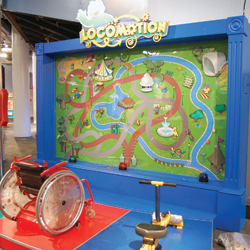
Kids can learn about what makes them tick and what keeps them healthy — with the help of some familiar friends, as Imagination Station welcomes Sesame Street Presents: The Body, a special new exhibition featuring the characters of the beloved PBS program. Young visitors can explore three different education zones, each with its own focus. "Your Outsides" gives a tour of the parts of the body, with puzzles, sign language games, shadow puppets, and a little help from Bert and Ernie. "Your Insides" gives a kid-friendly look at what's going on in there, as Oscar, the Count and friends explain digestion and the internal organs in ways young folks can understand. And in "Staying Healthy," kids can learn how to keep things running smoothly, in simple ways like keeping clean (with the help of Ernie and his Rubber Duckie!) and getting plenty of exercise. That last one won't be a problem, with "Rosita's Locomotion," which gives little muscles a workout while kids learn how they function by pumping, rowing and running. Whether you're raising a young surgeon, fitness enthusiast or just a Sesame Street fan, you won't want to miss it.

Through January 27, 2013. "Big Kids" admission (13 and older) is $9.50, kids 3 to 12 $7.50, and kids 2 and under free. One Discovery Way. 419-244-2674. www.imaginationstationtoledo.org.  
 

Beyond “please” and “thank you”

In a fast-paced world, with Facebook increasingly taking the place of face-to-face interaction, the idea of "good manners" seems a little quaint. Mention "etiquette" to your kids and you might get a raised eyebrow — if you're lucky. But does it have to be that way? Rita Taylor-Teplitsky of Gentle Image Consulting doesn't think so. She's bringing her series of etiquette seminars for kids age 8 to 12 to Stone Oak Country Club this November, just in time to get kids "socially savvy for the holidays." The first session on Saturday, November 3, looks at "Surviving the First Introduction," showing kids that it's fun to meet new people if you have the right skills to make a good impression. The second class, on Saturday, November 10, covers "Dining and Restaurant Etiquette," unlocking some of those mysteries of place settings (which one is the salad fork?) and demonstrating how to conduct oneself like a lady or gentleman. Finally, on Saturday, November 17, learn the "Art of Party Manners," which will let would-be social butterflies learn how to be poised and comfortable in social settings, even if they don't know anyone.

9am-noon. $45 per class/$115 three classes. Stone Oak Country Club. 100 Stone Oak Blvd., Holland. 602-909-6563.
www.gentle-image.com.

Scorpio kids

The first word out of your Scorpio child is “whozat” (who is that). They will pick up every rock to see what is under it. They take their toys apart to see how they are made. They are curious about the human body. Scorpios love magic and surprises. They are fascinated by learning and are excellent students. Mathematics can be their favorite subject. Give them microscopes and magnifying glasses and they are occupied for hours.

As the weather gets cooler they enjoy picking up leaves so they can see all of the different sizes and shapes. In November they may have difficulty concentrating, so parents need to be patient with them. A surprise birthday party delights the Scorpio child. The key word to keep them happy is “surprise.” They may be a little obstinate when an eclipse enters their sign on the 13th of November.
 

A field of dreams in one boy’s mind

For hours at a time the boy would play, by himself in reality but never alone in his mind.
In a crumbling concrete alley behind his two-story house, built a year before Babe Ruth first stepped on a Major League Baseball field, the boy, his tattered glove and a rubber ball were at the center of the universe.
He would hurl that ball, again and again, at one of two three-foot-wide sections of cinderblock on either side of a garage door with flaking white paint. He played every infield position, and seldom did he make an error.
Hitting that wall about a foot above the ground would produce a standard ground ball, which he would scoop up cleanly before gunning the ball again, this time high off the wall, to simulate the throw to first base. As the ball bounced off the cinderblock, the boy shifted infield positions. Now, he was the first-baseman, waiting at the bag for the throw that would just barely beat the imaginary runner to first base.
Around the horn he would go, just like in infield practice before his Little League games. He would adjust his arm angle on his tosses to mimmic the actual throwing angles each position player would use to relay the ball to first base. He’d plant his right foot and make a strong, overhand throw as the third-basemen. He’d use a crow hop and throw on the move as the shortstop. As the second-baseman, he’d employ more of a sidearm toss.
But baseball isn’t only played in the infield. If he threw the ball hard but bounced it on the ground about a foot in front of the wall, it would rise in the air like a fly ball headed toward the outfield fence.
Now, the boy became an outfielder, bent on robbing the unseen hitter of what looked like a certain home run. Across the alley was a garage painted green (what other color could the outfield wall be?).  The garage door protruded slightly, leaving a one-foot ledge about six feet from the ground.
That ledge, in the boy’s stadium of the mind, marked the top of the outfield wall. The boy had mastered the ricochet to the point where he could make that ball fall from the sky near that ledge almost every time.
So, as the ball descended, the boy would drift back toward the garage. Timing his leap perfectly, he would extend his glove just above the ledge and snag the ball before it left the park, stealing a sure home run from the batter.
Other times, the boy would take his imagination into his backyard, with its thick, green lawn not much bigger than a welcome mat. A plastic bat, a sponge ball, and the memorized lineups of teams drafted from his baseball card collection became the tools of the game.
He not only knew the lineups, but he knew the batting stances and quirks of every player in his lineups. He’d mimmic their swings as he hit that sponge ball, even adjusting the force of the swing to the power of the real-life player.
The back of the boy’s house was a mix of odd angles and varying roof lines — the perfect set for an imaginary stadium. A ball reaching the roof of the breakfast room, added to the house years after it was built, was a home run. The main roof line then angled down above the addition and over my bedroom. Anything making it that far was an upper-deck shot. In straightaway center field, the outer wall rose the full two stories, making it the toughest home run to hit.
For hours, the imaginary stadium would be his sanctuary. As that boy’s favorite team, the Detroit Tigers, plays in the World Series this week, I’ve been thinking a lot about him.
I miss him.
 
John Deem grew up in Toledo and graduated from the University of Toledo. He now is a writer living in Huntersville, N.C.  He can be contacted at [email protected].