
Home Blog Page 620

Life after cancer

Having cancer is a life-changing experience – one that may cause patients to have a new perspective of themselves, their faith, their relationships, and their life. Even after treatment, many cancer survivors find it challenging to return to a normal, daily life. Their world has been flipped upside down and they may wonder, “What do I do now?”
More than 11 million people in the United States are classified as cancer survivors, meaning that they are currently living with or healing from cancer. Whether you are a cancer survivor or you know someone who is, understanding common challenges of “survivorship” can help you or a loved one enjoy a healthy, happy, meaningful life.

Common Survivor
Challenges

Fear of recurrence: Many cancer survivors fear that the disease may come back without warning. They may fear that any minor symptom is a sign that cancer has returned. This may cause problems such as anxiety, irritability, or lack of sleep.
Depression: Experiencing a life-threatening disease can be traumatic. Cancer survivors may feel alone or neglected, especially if others give them less attention once they seem “fine” or “back to normal.”
Physical problems: Fighting cancer certainly takes its toll on the body. Some cancer survivors experience “chemo brain,” a term used to describe brain challenges such as trouble concentrating, remembering or multi-tasking. Other survivors experience fatigue, an inability to have children, pain, or changes in weight or eating habits.
Major life changes: Cancer has the potential to affect life in negative and positive ways. Yet even the positive effects may be challenging because they are so life-altering. Survivors may have a fresh outlook on life, seek new adventures or passions, or cut off weak relationships.

“Survivorship” TipsThe best thing cancer survivors can do is take care of themselves. It will take some time to find out what “normal” means. Even though cancer survivors may not be receiving active treatment, they still need support through this transitional time. Here are a few ways cancer survivors can help themselves heal after their cancer journey:
Make the most of follow-up care: Being involved with their individual health care may help some cancer survivors feel more in control of their lives and their health. If you are a survivor, work with your doctor to develop a follow-up care plan. Be open with your doctor, telling him/her of any symptoms, pain, or questions you may have.
Take advantage of complementary care: There are many beneficial treatments available in addition to those prescribed by a doctor. Complementary care – including yoga, art therapy, movement therapy, and massage – may reduce stress and improve quality of life. Patients should talk with their doctor first to determine whether the addition of this treatment is the best course of action.
Be easy on yourself: Cancer survivors sometimes blame themselves for the challenges they are facing, even without realizing it. They may feel stupid or crazy because they can’t yet function the way they did before cancer. It’s OK for cancer survivors to grieve the losses they’ve had and to have “bad days” like everybody else.
Find a supportive network: Just as it’s impossible to fight cancer alone, it’s also impossible to survive cancer alone. If you’re a cancer survivor, talk with family members, friends and other survivors about the challenges you face. Accept help when you need it from those who offer and keep up with your contacts during your recovery. If you have a loved one who is a survivor, know that the need for support may last a lifetime.
In our local community, there are resources available for cancer survivors to help them with this transitional time. This month, the ProMedica Cancer Institute debuts its survivor center, a clinic that provides coordinated and customized follow-up care for patients. At the center, a medical oncologist and a nurse practitioner work with patients to create a care plan that is unique to their physical, social and emotional needs. Other support services – such as complementary therapies, support groups, genetic counseling, educational seminars, and social work support – are also available. For more information, call 877-291-1441. 

Dr. Valdivieso is the Medical Director of the ProMedica Cancer Institute, which offers comprehensive oncology programs and services to patients across northwest Ohio and southeast Michigan.ProMedica Cancer Institute is a member of ProMedica Health System.
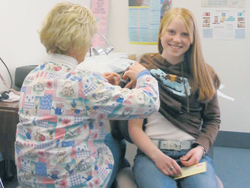
The Ohio Department of Health encourages school immunizations

Over the past 70 years, public health has made significant advances in the fight against pertussis – better known as whooping cough.  In the 1940’s, before widespread immunization efforts, there were as many as 147,000 cases of pertussis in the U.S. each year.   After immunization began across the nation cases of pertussis declined, for examples in 1976 there were just over 1,000 cases reported in the U.S.   However, since the 1980s, there’s been an increase in the number of cases of pertussis, especially among teens and babies less than 6 months of age. This has happened particularly because of waning immunity.  In 2008 there were more than 13,000 reported cases in the U.S.
During the first half of 2010 many states have been reporting increased cases of pertussis as compared to the same time last year. Here in Ohio, there has been a slight increase of pertussis cases statewide, but the good news is that pertussis is preventable and treatable.
In efforts to reduce the spread of pertussis across the Buckeye State, the Ohio Department of Health (ODH) added additional immunization requirements for school entry for 7th grade students.  Beginning this fall, all children entering 7th grade will be required to have a tetanus, diphtheria, and pertussis (Tdap) or tetanus and diphtheria (Td) booster shot.
Pertussis is a serious respiratory infection caused by bacteria. It is a highly contagious disease that spreads from person-to-person when an infected person coughs or sneezes. Pertussis is known to cause violent coughing fits that can last months. When an infected person gasps for breath, they make a “whooping” sound. This sound is where the name “whooping cough” comes from.
Symptoms can be different depending on your age and if you have been previously vaccinated.  It is most dangerous in young children and infants. So far this year, no infants have died of the disease in Ohio.  However in 2008, three Ohio infants died from the disease.
Don’t panic
Vaccination is the easiest and most effective way to prevent the spread of pertussis.  Ohioans and their families should make sure they are up-to-date with the recommended pertussis vaccines. If you are not sure, call your doctor to see what’s best for you and your family.
By requiring these additional vaccines in adolescents, ODH hopes to minimize the spread of pertussis in schools and provide Ohio’s children with a healthier environment to live, learn and play. This new requirement closely reflects recommendations from the Centers for Disease Control and Prevention Advisory Committee on Immunization Practices, and involved consultation of local health districts, medical providers, the state Medicaid program and school nurses.
The Tdap vaccine is widely available through many health care providers in Ohio, including family physicians and pediatricians.  Additionally, the vaccine is available for children through age 18 at local health district clinics for no or low cost.  Some local health district clinics also have Tdap vaccine available for adults at low cost.. 

For more information on pertussis or the Tdap vaccine please contact the ODH Immunizations department by phone at 1-800-282-0546 or by email at [email protected].

Total recall

Last month, I wrote about the many wonderful products out there to make baby’s life easier.  But the existence of all of these gadgets has a downside.
Imported products have enabled parents to have access to cost-affordable goods to address all manner of baby needs, from feeding to sleeping to playtime.  But perhaps due to lower health and safety standards abroad, or inadequate internal controls at manufacturers, or maybe due to corporate concerns about litigation, inevitably, some number of these products will be subject to the dreaded recall.
Danger in the nursery
As parents, we’ve run into a few recalls ourselves.  The first was the recall of “drop-side” cribs that occurred in the fall of 2009 after the tragic deaths of a number of infants due to strangulation in the movable parts.  We’d, of course, registered for a drop-side crib without thinking about the implications of movable and vulnerable plastic parts.  We’d liked the way the crib looked visually, matching the theme we’d selected for baby Dee’s room, and didn’t even notice the somewhat fine print on the web mentioning the crib’s drop-side feature.  Generous family friends had the product shipped to our house from one of the big box department stores that sold the item.
Baby Dee, not a particularly good sleeper, spent most of her first few months in a bassinet or sleeping in one of her parent’s comforting arms.  When the government announced its recall of drop-side cribs some eight weeks after Dee was born, she had yet to spend a night in the meticulously assembled crib.
The recalled cribs were defective because their plastic rails could warp over time, allowing an infant to squeeze her body into what could end up being a dangerous space.  Our crib had such plastic parts, but for whatever reason, it was not actually one of the cribs listed on the Consumer Product Safety Commission’s (CPSC) recall notice.  But we’d read the stories about infants suffering devastating or fatal injury due to drop-side cribs.  And we’d seen the passage of state laws banning such cribs and a recommendation by the national engineering body, the American Society of Testing and Materials, that no crib contain moving parts. I contacted the store which shipped us the crib, only to be told that, since we had missed the 90 day return window, and we did not have one of the specifically recalled cribs, we were out of luck.  A month later, more manufacturers’ cribs were added to the list.  On the Today show, the head of the government’s CPSC watchdog agency stated that she thought no parent should use any drop side crib.  Still, the store, and then the manufacturer, refused to take the crib back.  We ended up searching for an immobile crib and tossing Dee’s first into the attic.
Don’t panic
Then there was the baby Tylenol recall.  This time, the recall was motivated by somewhat vaguely described “quality control” issues, and the bottle of suspension that had soothed a few minor fevers for baby Dee was on the list.  Though we did get a full refund this time around, imagine our angst that we’d given her several drops of this product that now belonged in the trash!
Sometimes, companies offer “fixes” that do little to sooth parental anxiety.  When millions of roman blinds and window shades were “recalled,” the manufacturers’ solution was to send out cleats that could be used to keep drawstrings out of baby’s reach.  But what if the string slips off?  Or if a sleep-deprived parent forgets to tie down the shades after a long night of teething-related protests?
There’s no way to prevent some products one buys for a baby from facing a recall.  How to remain calm is every parent’s challenge.  Perhaps it’s enough to remember that no product can substitute for a watchful, loving family. 

Geoffrey Rapp is a law professor at the University of Toledo and the father of a one-year-old baby girl, “Dee”. Contact him at c/o
[email protected]

Frank, freakiness and flannel

As soon as I could walk and fit into the smothering, “If you keep your head tilted up you can breathe.” bright orange life jacket, I have been heading north.  It was inevitable after bringing cousins, and an eclectic assortment of schoolmates, that I would one day request the company of testosterone.  My parents were able to be spared the dreaded “Can I bring my boyfriend?” until I was a freshman in college.
In retrospect, heading to Canada is the perfect litmus test for potential suitors.  You take three showers a day? Strike one.  Is there something else you are willing to do besides read professional journals?  Strike Two.  You expect me to shave my legs and wear eyeliner in the woods?  You’re out.  I had none of these concerns with my boyfriend from Ohio State.  In fact the only concern I had about my outdoorsman, 6’5” Frank was that I was going to have a heck of a time getting him to come back to reality.  He was a flannel shirt and Levi guy.  I’m certain his Honda motorcycle made my surgeon grandfather do a 360 in his grave.  Frank was going to be just fine with weiners on the fire, but without electricity or running water. 
Things were going so well.  My Dad got a sidekick of maleness.  They continually joked about being “real men”.  When asked what they would like for breakfast they responded with a hearty “A loaf of toast, a dozen eggs and a slab of bacon!” Please.
I decided to humble my overly confident woodsman wanna-be by rigging up a can filled with stones and attaching it to a fishing line.  My Mom and I placed the can under his bed, ran the line out the window along the side of the cabin, threaded it through my window into my room and waited for the black of night.  Later that evening, I waited until I was certain that Frank was in REM sleep. I pulled the string and in the penetrating silence the stones sounded like a huge hairy being dwelling somewhere within the house.  Frank emerged in his jockey undies (another wonderful way to see if a man is for you ), holding the rifle we kept but never used, above the door in full blown, “I may turn these whitey tidies yellow but I will protect you” mode.  In fear of a misfire we quickly told him of our prank.  Thankfully humor prevailed even though it took a few Molson’s to find the “funny”.
I was always reminded by Gram that “If you can’t take the heat, stay out of the kitchen.”  We had a great night on a small island near our place. There is nothing like a dinner made on the fire under the stars.  When we returned my Mom and I began our nightly pilgrimage to the outhouse.  Thankfully, although a bit awkward, it was a two-seater.  We opened the door to find a silhouette of the form of a man.  He had a familiar flannel shirt and a pillowcase over his head with one opening for an eye.  I screamed and in my peripheral vision I could see my mother’s mouth open as if it was to snap off the hinges as a scream somewhere deep within struggled to release itself.  Very funny.  The old “put a dummy in the outhouse” ploy. Cute.
The dummy who we fondly named “Jason” since the movie “Friday the 13th” gave our men their inspiration, stayed in the outhouse for a few days. My mother insisted we move it because it was beginning to have a stench that can only be described as putrid. She had Frank lean it against the cabin to air out.
Evening once again arrived after a day of fishing, kayaking, and perfecting the art of doing nothing. My mother had second thoughts about our “Jason” placement.  She informed me as she walked into the cabin to make dinner that the thing was giving her the creeps. Unbeknownst to us, Frank had removed the one-eyed pillowcase from Jason and placed it on his own head.  He was wearing his usual flannel attire, so when he tossed Jason and stood in the same spot, it slipped by without notice.  The woman who gave me birth walked by unsuspectingly as my soon to be former flame reached out and grabbed her.
It was at that moment that I discovered that you actually can wet your pants out of laughter and in this case fear.  The rest of the night my mother sat at the kitchen table.  I was a bit concerned because after one beer she does a great Miss Alabama impersonation.  I had no idea what she was planning to do with the bottle of Yukon Jack she was firmly holding in her right hand.  Her left hand was grasping a large glass full of ice.  I can still see her planted at that table, the sound of the ice clanking in her glass as she continued to pour what she soon referred to as Yummy Jackson.  She kept asking and answering her own inquiries as if in some possessed state. “Are you ever going to ask a boyfriend here again?” NO! “Will you ever think about asking? NO! “If you think you’re thinking about thinking about a boyfriend coming here, will you ever think that?” NO!
Needless to say, “Nature Boy/ Jason Lover” and I didn’t make it.  A word of caution:  If you are asked on a holiday with “the family” of someone near and dear, leave the flannel shirts and pillowcases home.
Mary Helen can be reached c/o [email protected].

Inspirational impact

 Sometimes it is underestimated how much impact children and teenagers make in the local community, but the Ringling Brothers and Barnum & Bailey aim to recognize the great accomplishments of area youth. Nominations for the Barnum Award, in honor of P.T. Barnum and his inspirational accomplishments working with youth, are being accepted through Sept. 10. Three local award recipients will be chosen by a panel of judges based on their accomplishments, creativity, innovation and ability to inspire others. A $1,000, $750 and $500 grant will be given to the three winners, respectively. Nominations may be submitted by those over the age of 21 by completing a questionnaire. An award ceremony will be held  at 7 p.m. Wednesday, Sept. 22 at the Huntington Center. To nominate a child or for more information, visit www.thebarnumaward.com.

Make a difference

One of the most mutually beneficial actions a teenager can make is volunteering. Not only are they directly helping others, but volunteer work also broadens their perspective on life, allows them to appreciate positive situations and builds experience. That opportunity is available at Josina Lott Residential and Community Services. The facility for the developmentally disabled is looking for volunteers to help coordinate activities and with general work. Hours are extremely flexible and volunteers can choose to work at any time between 9:30 a.m. and 2:30 p.m. or just during game nights on the first and third Wednesday of every month. Community Development Coordinator Karen Weisman said new faces interacting with residents is the most valuable aspect of having volunteers.  “They don’t have any other way of getting out and meeting people in the community,” she said. “It helps them with camaraderie and friendship.” For more information or to volunteer, contact Karen Weisman at 419-866-8428 or [email protected].