Home Blog Page 263

Open House Guide 2020

On average, and in normal times, children spend 1,000 hours each year in school, and that doesn’t include extracurricular activities. With school being such a huge part of a child’s life, it is important to find the perfect fit where a child can feel comfortable, challenged, and engaged. Fortunately, in the Toledo area we are lucky to have many school options for our youngest residents. We’ve compiled a list to help you determine which schools you’ll want to check out for the young ones in your home!

iLead Spring Meadows
1615 Timberwolf Dr., Holland
419-491-7423 | ileadspringmeadows.org
Open House: Check website to schedule a tour

iLead stands for international, leadership, entrepreneurial development, arts, and design thinking which are the primary focuses of this public charter school. Any child in K-8th grade in the Toledo area can attend iLead as there are no district boundaries. The school is similar to public schools in the sense that it follows common core standards and participates in state testing; however, the approach to meeting these standards is very different from many public schools. iLead emphasises Project Based Learning which allows students to learn and apply content standards through their own discovery and research which they then can apply to various projects. This allows students to take ownership of their education, but is still facilitated by teachers. Also unique to the school is the multi-age classes where children of different grades work together in the same room. This allows children to get more individualized attention and helps them build social skills. Working and busy parents would also appreciate the school’s before and after school care options.  

The Maritime Academy of Toledo
803 Water St., Toledo
419-244-9999 | maritimeacademy.us
Open House: August 3 – 7 (a virtual Open House will also be available)

The Maritime Academy of Toledo helps students in grades 6-12 develop the skills they need for the next stage of their lives. The academy has a strong focus around nautical/maritime-themed studies; however, like any middle school and high school, this academy also focuses on all core content and standards for Ohio’s public schools.

Students graduating from the academy are leaders, innovative, and have strong character. Additionally, graduates can leave the academy with credentials to attend a traditional four-year college, start a career on a commercial vessel, earn a spot with the US Merchant Marine Academy in New York, go through an officer training program, or attend a state maritime academy for undergraduate and graduate programs leading to mariner careers. These are all results of the first state-approved Maritime Career Tech Education Program in the United States. 

Additional programs include a culinary and hospitality program, and apprenticeships for building trade work. This academy would be a great fit for a student who learns well with hands-on activities.

St. Francis de Sales High School
2323 W. Bancroft St., Toledo
419-531-1618 | sfstoledo.org

Open House: 
St. Francis de Sales works to help young boys transition into Christian practicing gentlemen. The school provides a moral, intellectual, physical, and social foundation for all its students. The high school has been recognized as one of the top 25 Catholic high schools in the nation and it has an extraordinary Advanced Placement (AP) program which is highly accredited with 20 AP classes. The success rates on those tests have been recognized by the College Board as some of the best in the state. Along with academics, St. Francis focuses on providing opportunities for the young men to deepen their faith through retreats, mission trips, and volunteer projects. Athletics is also a source of pride as the school has 27 state championships in 7 different sports. The school has great athletic facilities to promote physical development. In addition to teams, the school has intramural sports as well as a variety of academic clubs, a yearbook committee, chorus, bands, musicals, a school TV station, a school newspaper, and much more.

St. Ursula Academy
4025 Indian Rd., Toledo
419-531-1693 | toledoua.org
Open House: November 15th Noon-3pm

St. Ursula Academy is Toledo’s oldest all female Catholic college prep school for girls from 6th grade to 12th grade. With over 550 students enrolled, the school still has an impressive 12:1 student to teacher ratio, which means much more individualized attention for students. The ultimate mission of the school is to ensure that the young women embrace their own possibilities, explore new passions, grow in their faith, and become leaders in school and the community. The school has 20 Advanced Placement courses as well as honors courses to challenge students and prepare them with the possibility of college credits while in high school. Additionally, the school provides a one of a kind “best fit” college quest where students work throughout high school to find the best college for them. In addition to academics, the school has 13 varsity sports as well as a great fine arts and performing arts program. 

Children’s Discovery Center
Locations in Toledo, Holland, Perrysburg, and Waterville
419-867-8570 | childrensdiscoverycenters.com
Open House: Call for an appointment

With centers throughout the Toledo area, Children’s Discovery Center is a great close option for many families. This early care facility is a place where students learn through exploration, and it works hard to support children and families in a creative Christian environment. Children’s Discovery Center has programs for infants, toddlers, preschool, and offers a Discovery Express School for kindergarten aged children. Additionally, Camp Discovery is a summer camp program for school aged children. The school follows Reggio Emilia’s approach to learning which focuses on creating strong, powerful, and capable children. The center’s educators are degreed teachers who go through on-going training during the year. The programs are all Step Up to Quality star rated and the centers have won various local and national awards. 

West Side Montessori
Perrysburg: 13587 Roachton Rd., 419-874-9385
Toledo: 7115 W. Bancroft St., 419-866-1931
Montessoritoledo.org
Open House: Contact to schedule a tour

Montessori is a child-centered education approach where the students take ownership and a lead in their education. A lot of the methods include self-directed activity, collaborative play, and hands-on learning. West Side Montessori works on nurturing the whole child by creating a school environment that focuses just as much on the heart of the child as it does on challenging the child’s intellect. Along with core academics, the school also believes in the importance of outdoor education, the arts, physical education, and technology education for the growth of each child. The school has very impressive student to teacher ratios ranging from 4:1 – 12:1 depending on the age group. Students from as young as toddlers up to 8th grade can enroll in West Side Montessori. Extracurricular activities are also offered and include a variety of options such as karate, soccer, chorus, and gardening. 

Maumee Valley Country Day School 
1715 S. Reynolds Rd., Toledo
419-381-1313 | mvcds.org
Open House: September 3rd 6:30-8:30pm

For those as young as three years old all the way up to 12th grade, Maumee Valley Country Day School has a place for all children. Education at Maumee Valley is personal, experiential, and global. Each child is viewed as an individual and children are taught in the means that best fits their learning style. Students learn by doing at Maumee Valley. The school provides real events and experiences where students can explore, ask questions, take risks, and develop a deeper learning from those experiences. Maumee Valley knows that students will eventually go on to explore the world, and in order to become global citizens students study global issues and work to solve the challenges that they see. One way the school is working to solve global issues is by partnering with Duke University and Johns Hopkins University as part of the Global Public Service Academy for Health where students travel and work around the world providing health services. In addition to the impressive academics, Maumee Valley also has a wonderful fine arts and performing arts program, athletics, college counseling, and a biliteracy program.

Horizon Science Academy
2600 W. Sylvania Ave., Toledo
419-474-3350 | horizontoledo.org
Open House: August 7th (student orientation)

Horizon Science Academy is a school of high standards where all students work on rigorous lessons which ultimately lead to gaining skills necessary for success during and after high school. The small size of the school leads to personalized instruction and an environment where everyone feels seen and welcome. Being a science academy, the school does focus on math, science, and technology, but all core subjects are taught including foreign languages and performing arts. Students have the opportunity to participate in athletics, school clubs, cultural exchange programs, and various trips. With frequent parent teacher conferences, parent dinners and picnics, and a Parent Teacher Organization, parents play a large part in the success of the school and their child’s education. 

Sleek Academy
519 Ordway Ave., Bowling Green
419-353-3898 | sleekacademy.us
Open House: August 13th 5-6pm

A relatively new school, Sleek Academy opened its doors just two years ago in 2018. The newly renovated school knows the importance of the environment in which children learn, so the school has a health and wellness classroom, life skills room, and industrial arts classroom. Students are given a one-hour lunch/playground time because Sleek Academy understands the importance of social education. The educational methods are innovative with project-based lessons that allow students to learn curriculum along with life skills, independence, and confidence. STEAM (science, technology, engineering, arts, and mathematics) is the fundamental basis for the learning style of Sleek Academy. The hands-on approach to learning creates engagement for students and allows them to explore real-world scenarios. 

Directing the Digital Drama

“Do not prepare the road for your child, prepare your child for the road.”

This practical piece of wisdom proves even truer when applied to cyber safety, which is more pertinent now more than ever as children spend more time on their screens than pre-coronavirus. 

Encourage self regulating and self monitoring 

Monica Abdelkodous, a school psychologist and mother of four, advises that conversations regarding digital responsibility should happen before electronics are introduced: “Encourage your child to self regulate and self-monitor. Praise his successes and talk through the short-comings.” 

Abdelkodous suggests that when your child fails to meet expectations, ask him to talk through his perspective, noting that his self-observation may provide insight and empower him to make better choices in the future. Set boundaries and limits and be consistent with enforcement.

Members of the MVCDS Upper School student support team, in discussing the issue, have the following suggestions for screen use: “…children’s brains are not fully developed, and…they are not able to regulate their own electronic usage. Adolescents need adult support…in using electronics responsibly and limiting excessive use. Implementing docking stations in the evening, in order to keep electronics limited during sleep time is a beneficial strategy. Parents can also help by modeling healthy electronic use and setting up ‘no electronic’ times for the entire family.”

Prepare your child 

Ultimately, straightforward and sincere talks about being a responsible digital citizen is how to “prepare your child for (avoiding dangerous parts of) the road.”  

Here are other practical tips for dealing with cyber safety? If you discover…

  1. Disturbing, destructive, or inappropriate content: Use this exposure as an opportunity for learning. Be ready to answer questions and take time to think about the message you want to convey to counteract the content your child saw. 
  2. Child unknowingly posts content that endangers him/her: Apps like Familylink can help by allowing you to set restrictions and alerting you to your child’s digital activity. Make certain your child understands the relative permanence of posted content.  
  3. Cyberbullying or predatory activity: Common Sense Media is an online resource to help you navigate the issues of cyberbullying and online predators.

Digital addiction: Look for signs of addiction, such as overreacting when s/he is not permitted to use a device or you limit screen time. The sooner you take steps to offset the addiction, the better self control your child can exercise.

Benefits of Learning Sign Language

Mainous, right of center holding her granddaughter Hollyn, with her family (minus another 12 family members!)

By Lindsey Melden and Erin Schoen Marsh

COVID has presented many problems for the educational community, but one rising trend is the teaching of languages in virtual and homeschooling situations. Parents who have always wished their children could learn another language at school are using this time to introduce their little ones to Arabic, Spanish, French, American Sign Language (ASL) and more. 

Language connects human beings, creates relationships, and opens doors to a different culture and way of thinking. Learning basic sign language can allow communication with the Deaf community, create neural pathways that help the brain function more efficiently, and link the mind and body in ways that other languages do not. Plus, for those who are deaf and hard of hearing, knowing basic sign language can make all the difference–especially now that lip reading is impossible with masks. 

Language deprivation

According to the National Center for Biotechnology Information (NCBI), the first five years of a child’s life are critical for brain development and language formation. When a child is deaf or hard of hearing (HoH), their brain has a harder time collecting language input. Children receive audible messages all day through TV, radio, and surrounding conversations. Yet when a child can’t hear, skills developed by those experiences are lost. When sufficient language exposure is blocked during the critical years of early development (birth to age 5), children can develop language deprivation with long-term negative effects. Sign language can fill in those gaps, creating a rich and vibrant foundation of language and connection, explains the Nyle DiMarco Foundation. 

The history of ASL 

Julie Mainous, a mom and grandma from Delta, was born with normal hearing to two Deaf parents and learned ASL as her first language. The term for hearing children of deaf adults is CODA. She is a Toledo area interpreter and tutor and says, “Signing is a part of me. I am drawn to it. It is so visual and vibrant.” 

Mainous interpreting at her church, Monclova Road Baptist Church

Mainous’ father was raised when the medical opinion of the time was to discourage Deaf and HoH children from learning sign language. In extreme cases, children would have their hands tied down at school to keep them from signing. The thought was that sign language would actually delay speech development and leave children more isolated, although there is no empirical evidence to support this. Even though ASL has existed for nearly 200 years, it has only recently become an accepted tool for parents to help their children acquire valuable language skills and be successful, and many school districts, including local school districts, discourage learning ASL for HoH students. 

Emmah Artino, mom and a resident of Toledo’s Old West End, is a Toledo area interpreter with a Deaf spouse who is also a child of Deaf parents (CODA). Her Deaf father had an experience almost identical to Mainous’ father: “My dad had his hands tied and struck at his ‘mainstream’ school and wasn’t allowed to learn sign until he was 18. He was told he would never be more than a janitor. He became an engineer.” 

“It’s a common story that many Deaf people share,” Artino continues, ”…being denied language and therefore opportunities, and not all Deaf/HoH are as lucky in their lives because of [that denial of opportunities].” 

Resources for families

Mainous loves that she was taught ASL as a child and feels it has helped her in life. “It’s not ever going to hurt them,” she says. “Just give your child all the tools to communicate that you can. See what they thrive on, and then you can adapt.” 

Amy Figliomeni, Teacher of the Deaf/Hard of Hearing for Educational Service Center of Lake Erie West, says, “Watching young deaf students become empowered when given access to language through ASL is transformative….Through immersion in ASL, the child is able to be included in communication at home and school and to express him/herself, which reduces frustrations, builds relationships, and provides the foundation for future learning.”

For those who would like to learn ASL, Artino advises, “I highly recommend finding a language model or coach” because finding a native signer is important for hearing parents who don’t sign themselves. Both Artino and Mainous recommend the Deaf Services Center of NW Ohio as a local resource for parents seeking interpreters, advocacy or ASL classes. 

Artino also organizes all of the interpreters for Toledo Pride, and she encourages any parent who is on the fence about teaching ASL to their child to “find Deaf and HoH people and listen to their stories.” 

Signing for ALL kids

Not only does learning ASL greatly benefit children with hearing loss, but it’s also beneficial for any child. Children with speech delays and speech apraxia can benefit from using ASL to communicate their thoughts, and children receive the same intellectual benefits from learning ASL as they do learning any second language. 

Parenting is not a one-size-fits-all experience, but providing children language tools and a new way to connect with the wider world is a gift in and of itself. 

SIDEBARS OR BOX OUT: 

Benefits of learning ASL for any child:

  • Connection: children can communicate their frustrations when speech prevents them from doing so.
  • Good for the brain: research shows that learning a second language boosts problem solving, critical thinking, concentration, memory and more.
  • Good for school: bilingual children have improved reading, writing and math scores.
  • Confidence: learning a new language gives children a sense of empowerment and accomplishment.
  • Empathy and inclusion: bilingual children have more positive attitudes toward other cultures, and when more people know ASL, more Deaf/HoH children will be included in classrooms and adults in workplaces. When everyone is included, everyone wins. 

Sources: National Institutes of Health (NIH) and Nyle DiMarco Foundation.

OPTIONAL SECOND SIDEBAR: 

Learn ASL Together Online:

ASL App: learn conversational ASL in an app designed by Deaf signers.

Signing Time: a kid-approved online subscription with ASL songs, videos, and more.

ASL Nook: YouTube channel made by a Deaf family 

The Nyle Dimarco Foundation: learn more about the value of Language Acquisition & bilingualism for children with hearing loss

LETTER FROM THE EDITOR: Educational Playdates

I spent weeks agonizing over the decision of whether to send our kids to in-person, hybrid school or to attempt online learning. With only weeks to decide, there were too many questions left unanswered, too few details, and too many risks and unknowns. It felt like a lose-lose situation.
While I had many concerns, one that repeatedly surfaced was the need for socialization. My kids (7 and 5) have each other, but they need and enjoy spending time with peers.
And that was one hurdle I felt I could address. I contacted my friends with children approximately the same ages and worked out a schedule for educational playdates. We meet with only one family at a time and space the meetings apart 5-7 days. We stay outside as the weather allows.

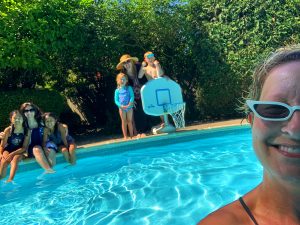
Socially Distanced Pool Date Over the Summer
Pulling from our own cultures and educational backgrounds, each parent teaches a mini-lesson that lasts 10-20 minutes–yoga, reading, writing, Arabic, American Sign Language (ASL), baking, art–and then we allow the kids to play while the parents sit and chat.
We decided to make the best of an awful situation, utilizing small groups and pooling our resources to teach our children the things we wished they could learn in school. These educational playdates give the kids, AND us, time to socialize. Socialization is good for the mental health of our children and parents, as well, while teaching and working from home, also crave human connection. 

What are you doing for schooling for your children during this unprecedented time? How are you handling everything? We’d love to hear from you. Leave your thoughts on our website, Facebook, or Instagram: @toledoareaparent.

In it together,
Erin Schoen Marsh
Toledo Parent Assignment Editor 

What working + teaching looks like

Thank You, Toledo!

For over 13 years it’s been a joy sharing my family’s dining adventures with all of you through Toledo Parent. Our travels have taken us near and far enjoying breakfast, lunch, and dinner. Sometimes we enjoyed a greasy spoon diner and other times, a more refined evening out for a special occasion. But with all of the dining experiences, one thing remained a constant:  a celebration of the area’s fabulous and unique establishments and the folks who operate them. We met so many delightful and interesting people throughout the years, and it’s been a gift getting the chance to know a bit more about all of them. Everyone has a story, and I’m thankful so many shared theirs with us.
Connections happen around the dinner table
I didn’t expect to get emotional when I sat down to begin my Farewell Food Fight. I mean, it’s food! This is fun! But as I glanced over my spreadsheet listing Food Fight subjects  — which began in January 2007 with Toledo icon Inky’s Italian Food and ended with Fire Station, one of the area’s newest restaurants — a tidal wave of memories flooded over me. So much life has happened between those two dining adventures. So many stories, connections, ideas, teaching moments along with much laughter around our dinner tables.
As I flip through the list that includes over 150 Food Fights, I vividly recall each and every visit like it was yesterday, partially because this was my “job,” but also because eating together as a family has always been very important to me. With everyone’s individual schedules and activities, it was often the only time we were all in the same room together on any given day. We all need that time to slow down, take a breath, and check in with one another. Food for the soul is just as important.
So many places, so little time
It would be remiss of me not to highlight some of my family’s favorite spots we’ve found over the years, as well as the adventures of the Pizza Posse. (Trust me, our adventures will continue.)
I truly wish I could write about each and every local place we enjoyed. And honestly, I feel terrible only mentioning a few. But here it goes:
In 2011, we made our first trip to Glass City Café in Uptown for breakfast and have visited there many times since. It doesn’t get any better than a hometown diner with great music every Saturday.  They also host a lively and entertaining Bluegrass Breakfast the fourth Saturday of every month. The Original Pancake House, Rick’s City Diner, Chandler Café, Scrambler Marie’s and Briarfield Café (finally open again!) are always winners for breakfast and lunch with my family, too!
The Pizza Posse would agree that we drooled over our pizza pies at Inky’s Italian Food, Pizza Papalis, Charlie’s Pizza, Homeslice, and The Original Gino’s Pizza.
Rounding things out, some of our favorite dinner spots are still Cocina de Carlos in Waterville, Social Gastropub, Chowder’s N Moor, Sidon Grille, Reverend’s Bar & Grill, Schmuckers (oh those pies!), Ye Old Durty Bird, Inside the Five, and New Empire. Our town has so many great local eateries, and these are just a few of our favorites.
Lastly, when we want to take it up a notch or two, we enjoy a chance to dine at Mancy’s Steakhouse, Real Seafood, Nagoya Japanese Steakhouse, and Mancy’s Ideal.
One final thought…..
One thing I’ve discovered over the years is the importance of making family mealtime a priority, whatever that looks like for our family on any given day. It doesn’t matter if I brought home burgers and fries or spent all day preparing in the kitchen. The main idea is that my family sits down and shares the meal together. That little thing, even though it’s a brief period of time together, can make a HUGE difference. If you haven’t made it a priority for a while, try it. I think you’ll like it. 

Zickes kids overlooking the river
Zickes’ kids overlooking the river

Anti-Racist Kids Movies as a Tool for Parenting

RaShya Ghee is a Toledo attorney, lecturer and mom whose expertise is American racism.

American racism is at the forefront of our national discourse…again. International protests, the assertion that Black Lives Matter, and discussions about America’s racial history are on the lips of everyone from senator Mitt Romney to corporate giants like Amazon. This has prompted many parents to ask what more they could be doing to raise anti-racist children.

First, questioning yourself is a good start. Traditional learning environments do a terrible job of educating students accurately about America’s racial history. Most Baby Boomers and even some Gen X’ers were educated under these falsehoods and transmitted the beliefs these falsehoods formed to their children. Most Americans have an opinion about race but haven’t undergone any formal education on American racism. It is incumbent on those seeking to be anti-racist to do the work of re-educating yourself about this country’s racial climate, centering voices of color and those who study America’s racial trajectory, and seeking out diverse spaces. For a list of resources to assist in this endeavor, see here.

Second, your kids learn normal from you and learn a ton about race when you are not teaching. Be cognizant of that and make the effort. Who do you invite over to your house to entertain? Whose house do you go to for BBQs and birthday parties? What is the racial composition of their toys? Their friends? Is their doctor, teacher, or clergy person diverse? All of these encounters send implicit racial messages about who is valuable and which spaces are accessible and safe. Research shows that over 75% of white people have no friends of color. Do you fit into that majority percentage? How can you change that? 

happy-family-sitting-on-a-couch-and-watching-tv-4260639-min

It’s impossible not to encounter racial stereotypes in society’s messaging because they’re everywhere. Accordingly, it’s incumbent on parents, especially white parents, to do two things: 1) talk through those representations with your child(ren) and explain what’s appropriate and inappropriate and 2) deliberately expose them to non-stereotypical representations. Research shows that children whose parents do not explicitly discuss race default to negative racial stereotypes. Folks have been compiling some great resources to help with this (here is an example) but increasing your racial IQ will empower your confidence to do this more often and more effectively (and maybe with more family than just your kids right? Who knows! Not trying to get too crazy but it could happen!) so lean in hard to the resources referenced earlier.

Some kid blockbusters have broached these issues with subtlety. Race organically arises in two recently released kid movies, utilizing animation on the big screen to create more racially conscious compassionate little humans.

Frozen II
I have a six-year-old, princess-loving daughter like many families around the country, and when Frozen II was released, we converged on our neighborhood movie theater, stood in line for tickets and slushies, then nestled in for Frozen II. I didn’t have high expectations; my assessment of the original Frozen was that it was just eehh…average.

About halfway through the film’s sequel, however, I realized something: I turned to my mom with the wide eyes of an American racism scholar and said, “So this is about America’s racial history!” Disney effortlessly tackled America’s racial history without explicitly saying so, and I started to think that maybe this has been the answer to our fundamentally flawed understanding of American racism all along!

In the film, Elsa is called upon to reckon with the truth of the past. She discovers a different people, who are ostensibly indigenous people, trapped under and within a mysterious fog, and she finds out that her grandfather perpetrated an injustice on these people that allows Arendelle (her magical kingdom) to thrive and is the genesis of the fog. She discovers that in order to “do the next right thing,” she must endanger and potentially destroy the only kingdom she’s ever known if she hopes to right the historical wrong and save the whole of them all.

That’s right. This white woman, whose nation is in peril, goes on a truth-seeking mission to confront the past and make wrongs right. She uncovers that her ancestor committed a great injustice – and here’s the most important part – that isn’t her fault but that is her responsibility. She realizes that “the next right thing” means possibly destroying all that she has come to know and love in the name of freeing people who remained trapped under the weight of her ancestor’s error.

The beginning of the movie parrots the early colonial interactions with America’s indigenous people. It also reveals how revisionist versions of history inform every subsequent decision by leaders and distorts our present understanding of the way our society evolved and is arranged. It highlights the way that history’s “winners” get to retell stories in a way that portrays them in a favorable light and minimizes or outright conceals their transgressions. In the film, the story that Elsa’s dad tells her as a child paints Elsa’s ancestors as innocent, well-meaning victims who were bombarded by savage natives. That’s the same story that has been repeated throughout history about American settlers’ encounters with Indians. We then immortalize the “heroism” of these historic settler winners through statutes, holidays, and street names.

“The past is not what it seems. A wrong demands to be righted. Arendelle is not safe. The truth must be found. Without it I see no future. When one sees no future, all one can do is the next right thing.” -Grand Pabbie in Frozen II

The fog surrounding the enchanted forest functions as a fantastic analogy for the social barriers erected by racism. Race and racism in America is foggy. It’s constantly shapeshifting, from genocide to enslavement to Jim Crow to mass incarceration. Racism is amorphous and hard to capture but perceptible just like fog. The fog traps the indigenous people and even some of Elsa’s citizens in the forest with no way out. This parallels how many describe our country as a tale of two nations where those surrounded by racism are trapped within insurmountable barriers.

This is the story of America. White people like Elsa and Anna are the living beneficiaries of their ancestors’ wrongdoing. This country exists because of the genocide and theft of Native American people and lands. It was built on the backs and continued oppression of enslaved Africans and their descendants. Our nation is currently in a state of peril. White people must go on their own journey through the past and discover these truths. We all have a direct connection to these wrongdoings. Uncovering these connections, ascertaining the next right thing, then actually doing the next right thing, even if it means risking everything, might be the only thing that saves us all. 

Applying the film to parenting
Here’s how you could introduce all this to your kids in a way that doesn’t traumatize them: 

  • For the story of colonial encounters with Indians: “This is similar to what happened when British colonists arrived in America and met the Native Americans and we have been dealing with the repercussions of those encounters ever since. Colonists wanted Indian land and often used deceit or violence to get it. Then they made up stories afterwards to make themselves seem less guilty just like Elsa’s grandpa.” 
  • For the analogy of fog and racism: “Racism is all over our society and it works just like fog! It stops people from reaching their destination and even when they do, they usually have to work much harder than someone who did not have to navigate the fog. As good people and good citizens, we must work daily to help get rid of the fog of racism.” 
  • It would also be helpful to learn more about indigenous nations. This will help you identify other components of different cultures that the film got right. For example, the indigenous people in Frozen II mention “listening to nature” to inform leadership. This dovetails well with many Native American cultures that place inherent value on nature. 

Trolls World Tour
Unlike Frozen II, I was BIG geeked about Trolls: World Tour. Now this was more our speed. An entire film dedicated to singing & dancing had my family’s name written all over it. When I realized the messaging embedded in the storyline, Trolls: World Tour soared to my all-time top 3 kids’ movies easily.

In the film, Poppy gets an invitation from a troll royal she never knew existed. Her father instinctively and irrationally warns her that different is dangerous. He recounts an inaccurate version of their history, the crux of which is that different trolls must live separately for the sake of harmony. Poppy rejects this reasoning as outdated and flawed, defies her father’s admonitions, and sets out on her own to unite the separate troll kingdoms. Though well-intentioned in her efforts, Poppy insists that all trolls are the same and that differences don’t matter. When Poppy reaches the funk/soul/hip-hop trolls (ostensibly representative of Black Americans), they edify her understanding with three important truths.

First, they explain that differences are attached to varied histories and cultures and that it’s hurtful and harmful to disregard them. Secondly, she learns that her understanding of history is inaccurate and that her father is blameworthy for the events that caused the different trolls to separate. Finally, the rap used to explain all of this to Poppy touches on cultural appropriation and the way that the contributions of Black Americans to the arts have been concealed, exploited, and profited from without giving the true artists credit. This scene also highlights the role of hip-hop as a device of storytelling and healing within disenfranchised spaces. Recurring themes throughout the film are assimilation, diversity, revisionist history, colorblindness, and cultural appropriation.

Breaking down the message in Trolls: World Tour
First, the idea that different is dangerous is as American as apple pie. The lack of exposure Poppy had to different troll genres throughout her life mirrors how many white people live most of their lives in insular communities with only people who look like them from similar backgrounds. Many white Americans remain substantively unaware of the breadth of difference and what those differences mean outside of their insular space. Studies have found that communities are more segregated today than before the civil rights legislation. Historically, white people have touted that this segregation is necessary for their safety, which is another way of saying that “difference is dangerous.” Many whites live most of their lives never having their racial worldview challenged in any substantive way. The reaction of her father to the prospect of different trolls in the Pop Troll Kingdom mirrors the irrational fear that many white people have about racial minorities moving into “their” communities and neighborhoods.

Her father’s words and actions are rooted in fear. Fear has been America’s currency, and historically, white femininity was frequently proffered as the basis which required protection through segregation. Many white parents, especially white fathers, had an extreme fear of interracial relationships. Her father also blames both sides in his version of the past circumstances that led to the troll separation, saying stuff like “both sides were wrong,” which fails to acknowledge the power dynamics inherent in the positions of each side. Asking for equality is not the same as asking people to stop asking for equality.

Poppy’s rejection of this is also consistent with recent trends where white youth are more accepting and racially-conscious than previous generations. It is important to recognize that both Poppy and her father are exhibiting racist proclivities just in opposite ways. It’s true that Poppy’s impact is racist even though her intentions are well-meaning. It is possible to be well-meaning and still be racist. Crazy, right? Attempting to neutralize differences and make everyone the same is dangerously racist. It’s also an inextricable part of the American way. America, both its populace and its government, have frequently expected and even demanded that racial and ethnic minorities abandon their cultural variation to adopt and perform more white-centric norms.

Throughout America’s history, white people have not only demanded that Blacks, Hispanics, Native Americans, and Asians present as “American” (Californians even attempted to ban speaking Spanish) but have also communicated, both explicitly and implicitly, that their way is superior to all others. “Differences don’t matter,” said Poppy. This is animated colorblindness, which is dangerous. This is an important point that many white people who indulge in fantasies of a “post-racial” America continue to overlook: racial neutrality is not synonymous with equality. Neither Poppy nor her father value diversity, but in different ways. Poppy the Pop troll doesn’t value it because she doesn’t believe the differences are important. Her father doesn’t value it because he’s afraid of it. Sound like anyone you know? 

“Denying our differences is denying the truth of who we are.” -Queen Essence of the Funk Trolls in Trolls: World Tour 

Bringing the themes to your children
Here’s how you could introduce all of this to your kids in a way that doesn’t traumatize them:

  1. To quell the equivocation of danger with difference, say something like: “There are so many differences in the world. Beautiful differences, vibrant differences, meaningful differences. Poppy’s dad was missing out on all that beauty and vibrance when he was too afraid to welcome different trolls. Understanding differences is so important to how we understand and empathize with our fellow humans especially our friends of color. That’s why we _____________________ (took that trip to the African American Museum in DC last year).” 
  2. For the discussion about colorblindness and diversity: “Differences make us all beautiful and it’s important we try to understand how those differences impact our world. For a long time, many grown-ups made the mistake of trying to ignore differences, especially race. That’s what Poppy was doing when she kept saying ‘We’re all the same.’ That was a mistake and has only perpetuated racism. As a family, I want us to work on increasing our racial awareness so that we can help eliminate racism for good.” 
  3. To address revisionist history: “For a long time, white people like us were very uncomfortable discussing race and racism because most white people have not been good helpers to Black and brown neighbors, and that made people feel shameful. I want us to work hard at being good helpers in the fight to end racism and that means telling the truth about race and racism even when it makes us uncomfortable, just like the Funk trolls did when they told Poppy the truth. It’s a privilege that we only have to be uncomfortable by choice and that discomfort won’t mean jail or death like it often does for our friends of color.” 

Trolls II also highlighted the fear of white fathers about their daughters having interactions with the “other.” White women have played the supporting role in American racism for entirely too long. Having Elsa and Ana and Poppy lead this charge largely on their own was a fantastic pushback against the narrative that white women are fragile beings who lack agency and must be protected. It also accentuated a lesser known point that turning the tide on American racism will require direct action from white women. Both require a reconciliation with the past and honest confrontation with the lies that have been told about history and who those lies affect.

If you watch these movies unremarked, your children/family will miss out on valuable teaching moments that will make them more compassionate/informed humans as they navigate our American society. It’s important for you, their parents, to do the heavy lifting of re-educating yourself using the wealth of resources available on the internets. Confused about where to start? Check out my website for further information and advice in raising anti-racist children. 

RaShya Ghee
RaShya Ghee