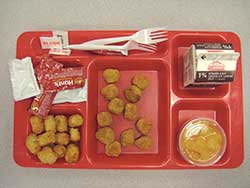
Homework is piling up, scheduled activities are becoming routine — school must be back in session. Throughout the year, students face challenges concerning their academic career, health and future. They may not realize it, but many of the choices kids make during school affect their performance later in the day. When the bell rings for lunchtime, students encounter what may be the toughest decision of the day: their mid-day meal. Should parents be concerned about the available options in the cafeteria? The United States Department of Agriculture regulates the portions of food that school cafeterias serve. According to section 210.10 of the USDA National School Lunch Program, schools must “limit the percent of calories from total fat to 30 percent of the actual number of calories offered, limit the percent of calories from saturated fat to less than 10 percent of the actual number of calories offered, reduce sodium and cholesterol levels, and increase the level of dietary fiber.” Unfortunately, parents are not able to join their children in the cafeteria to ensure that they eat a balanced meal. With tempting options like pizza, hamburgers, ice cream, cookies and other a la carte items, students may find it hard to make the “right” decisions of what to eat.
Healthy selections
“We look at how the products are delivered when they come to the school and then to the students and make sure it is as fresh as possible,” said Lisa Sobecki, Toledo Public Schools Board member and chair of its Food Chair Policy Committee. Sobecki and the rest of the committee work toward aligning nutrition with the school curriculum, transforming the cafeteria into a learning environment.
“When talking about healthy bodies and healthy eating, it should come into the cafeteria, as well as the classroom” Sobecki said.Fresh fruits and vegetables, salad bars and baked instead of fried foods are a few of the healthier options students have to choose from at Toledo Public Schools. The TPS Food Policy Committee strives to discover ways to make the food options appealing to students and nutritious.
That may be a difficult feat, but many organizations across the country are fighting for healthier options. In the Toledo area, Slow Food Maumee Valley supports activities that make it possible for anyone to access good, clean and fair food. In addition to hosting educational and social events throughout the year, this Labor Day, they coordinated a local eat-in in support of Slow Food USA’s Time for Lunch Campaign.The Campaign is pushing for healthier changes to the Child Nutrition Act, a bill that governs the National School Lunch Program, which provides more than 30 million children with a meal every school day. The Act is reauthorized every five years, and will face Congress again this fall.Paula Ross, co-founder of Slow Food Maumee Valley, says there is currently not enough funding in the bill. In fact, Slow Food USA is advocating to add one more dollar per day for each child’s lunch. “We need to give schools the resources. Investing in healthy food for our kids makes a tremendous difference,” says Ross. Action for Healthy Kids is a national organization that is “dedicated to improving health and educational performance of children through nutrition and increased opportunity for physical activity,” said Jan Meyer, the zone consultant for the Ohio Action for Healthy Kids initiative. Assisting with nutrition programs in area schools, Ohio Action for Healthy Kids claims that although schools do an adequate job serving students, there is always room for improvement.“Limit the less nutritious a la carte items… sometimes that’s where the school lunch program makes up lost money, but they need to be knowledgeable as to what is nutritious,” Meyer said.
Be a role (not a roll) model
How should parents help their children make decisions in the cafeteria? “Be a role model,” Meyer said, “sit down with your child and the lunch menu and talk about the foods you find important to eat.”
Acting as a positive role model at the breakfast, lunch and dinner table allows children to see good habits at home and carry them into the cafeteria. “Discipline and habits need to start at home because children are sponges, they’re going to absorb what they see on daily basis,” ProMedica dietician Lesley Raney said.Aside from eating well at home, Raney suggests discussing the options available at school. “Tell them its okay to have pizza, but have one piece instead of two,” Raney said. “Kids are growing, so they need to feel full… do not have just one item for lunch, help balance the meal with fibers.” Raney advises an average lunch could include a piece of pizza, salad, an apple and milk.Raney stresses including a glass of milk at lunchtime. “Milk gives them protein, fat and carbohydrates, as well as nutrients such as calcium and vitamin D,” Raney said, “always include milk or yogurt!”Performance throughout the day is enhanced by food intake; therefore sugars and foods high in fat should be avoided. A la carte items, such as ice cream, often include nutrients that enter and leave the bloodstream quickly, putting a lull in the child’s day.“Encourage your child to eat something healthy before they have a test or a game to enhance their academic or athletic performance,” Raney said. Students want to perform at their best ability, which is supported by healthy eating.Parents should encourage their children to make healthy choices, while also encouraging schools to offer healthier choices. Ross suggests that parents “talk with school boards, take a look at the foods the school is serving and don’t settle — nothing is more important.”
Locally grown initiative
One proposal many schools, including TPS, is interested in is utilizing locally grown foods. “Throughout the different seasons, schools have the ability to use local produce… but it is a challenge for schools, because of contracts with food service vendors,” Raney said. Raney suggests buying apples and other produce from local farmers to save money on travel costs and to keep food fresher.At Grove Patterson Academy Elementary, the students contribute to a vegetable garden where they learn about nutrients in produce. The TPS Food Policy Committee constantly looks for new ways to use local produce, but Sobecki says it is “sometimes difficult for us because of existing contracts with food vendors.”Finding the farmers and agricultural opportunities to make local produce possible in the cafeteria is part of the initiative for Ohio Action for Healthy Kids. “We need to educate the schools about how to do this… if we can make the option available and grow it, that would be great for the kids and the economy,” Meyer said.Ross adds that there are really good established farm to school programs, as close as southeast Michigan. “It would be a great thing if someone did that here,” she says.However, according to Ross, some of the barriers include affordability, centralized distribution centers (which steer schools away from traditional “cooking from scratch” methods), and “powerful forces (agribusiness) that benefit from us not thinking about what our children eat.”Despite these barriers, Ross says, “there are so many ways to involve kids in making healthy choices.” Whether it starts at the dinner table, or with parents joining forces to establish a farm to school program in their area, in the words of Raney, “we can empower and teach (kids) that we are what we eat.”
Check out these websites for more information:
Slow Food Maumee Valley www.slowfoodmaumeevalley.blogspot.com
Ohio Action for Healthy Kids www.ohioactionforhealthykids.org
Farm to School Programs www.farmtoschool.org
National School Lunch Program www.fns.usda.gov/cnd/Lunch