Home Blog Page 468

Seven Games to Liven up your Holiday Party

Playing a game at a holiday party brings everyone together, encourages laughter and creates wonderful memories. Games are not only for the kids. Adults enjoy the friendly competition and camaraderie that comes from playing a game. Having fun is contagious – even those who don’t participate in the game love to watch.

What’s in Santa’s Bag? – Make Santa’s bag out of an old pillow case or create your own with red fabric. Fill the bag with 10-15 small household items like a hairbrush, wooden spoon or apple. Tie the bag closed with a ribbon. Give each guest a sheet of paper and a pen and ask them to guess what is in Santa’s bag by feeling for items from the outside of the bag. When playing the game with young children, pair them up with older kids or parents to help them write their answers. The winner is the person who guessed the most items correctly.

Holiday Charades – Write the names of movies or holiday characters that are easily recognized by your group on index cards. Place the cards in a decorated box. Turn on some music, have all the players sit in a circle and pass the box around.  When the music stops, the person with the box has to pick a card and act out what is on the card. If your guests prefer drawing to acting, supply a large dry erase board and markers. When someone guesses correctly, turn the music back on and the game starts again.

Conjoined Gift Wrappers – This game works best with older children and adults. Pair up your guests and have them put their arm around the other person’s back, leaving one right arm and one left arm from the couple unrestricted. Supply a shirt box, wrapping paper, scissors, tape and a bow. Ask them to wrap the box together with each person only using one arm. Make it a relay race by having more than one team of conjoined wrappers. Give prizes for the fastest team or the best wrapped package.

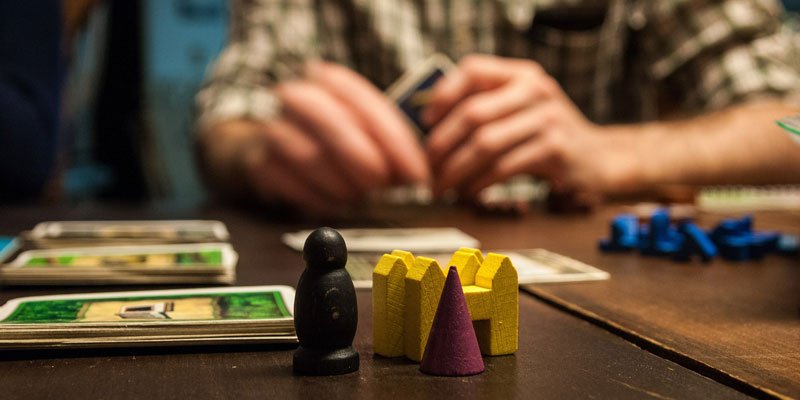
Candy Canes – This game is more commonly known by its non-holiday name, Spoons. Everyone sits in a circle on the floor or at a table. Place a candy cane in the middle for each person playing minus one. Using a deck of cards, the dealer starts by looking at one card at a time while he tries to find four of a kind. If the card is not one that he needs, he passes it to the next person. The first person to get four of a kind grabs a candy cane from the middle. When the other players see someone take a candy cane, they should all grab for one, too. The slowest person is left without a candy cane and is out of the game for the next round.

Name that Tune – Play a couple of seconds of a popular holiday song and ask your guests to name the song. A variation on this game for older children and adults could be to play the song and have guests sing the next line. More tech savvy hosts can put together several movie clips and have their guests name the movie, actors or next line.

Who is the Artist? – Provide a clipboard, sheet of white paper and a pen for each player. The players will hold the clipboard on their head while they draw a holiday scene as directed by the host. For example, draw a fireplace with six stockings; add a Christmas tree in the corner with a star on top, etc. When everyone is done, choose a judge to determine the best picture. This simple game will guarantee laughter from artists and judges alike.

Celebrity Hunt – Write the names of holiday characters (fictional or biblical) on an index card and tape to the backs of your guests without them seeing the name on the card. Have the guests mingle with each other asking only yes or no questions to try to figure out who they are. This is a great game for breaking the ice and socializing with everyone when guests first arrive.

Make your holiday party entertaining and enjoyable. Encourage your guests to get off their chairs, put down their plates and join in the fun. Playing a game breaks down the walls we build around ourselves as we share the holiday spirit and joy of the season.

Pam Molnar is a freelance writer and mother of three teens. Parties at their house include plenty of food, laughter, and of course, games. Pam is also the author of a party book series available on Amazon.


A Peek Into a Foster Care Agency

When people hear that I work for a private foster care agency, I am usually met with the following response:  “Wow, I could never do that.”

That referring to foster parenting.

Very often the perception of what foster care looks like is quite different from the reality.  Let’s delve further into what foster looks like and address some of those perceptions from an agency’s perspective.

Myth:  All kids that come into foster care are teenagers with major behavior problems.

Reality:  Youth of all ages enter into foster care.  At Adriel, the average age of children in foster care is 7.  Quality foster homes are needed for children of all ages.

Likewise, the circumstances which bring youth into foster care are as varied as the children we serve.  Each child is unique and brings his or her own set of strengths as well as behavioral challenges.   Usually, the concerns which bring youth into foster care are not the fault of the child, but rather an inability of the parents to care for the child.

Myth:  You can spot a foster child a mile away.  I wouldn’t want to deal with that.

Reality:  Foster kids are just kids.  They long to be treated like other kids and, like all of us, long to be loved and cared for and assured that they are worthwhile.  Most likely, your life has overlapped with foster families and you’ve never even known it.  These families shop in stores, attend schools, participate in churches, visit parks and festivals—just like other families.

Myth:  Foster youth move from place to place all the time.

Reality:  More than half of the youth that we serve are reunified with family (56%).  Some go on to be adopted (25%), some go to kin, or family placements (20%).

Myth:  I can’t adopt so I wouldn’t be a good foster parent.

Reality:  Not all of our foster parents adopt.  Many of them see it as their service to offer a stable, loving, caring home for youth as long as they need it.

Myth:  I want to adopt a child that needs a home, but my finances are limited.

Reality:  Parents that are approved to adopt through the foster care system can qualify for adoption assistance programs through the federal and state government.

Myth:  I would like to help but I am a single parent/divorced/working full-time/living in an apartment.

Reality:  Just like the youth we serve, our foster families come in all shapes and sizes as well.  Being single, divorced, a working parent, or living in an apartment does not make you ineligible to be a foster parent.

Myth:  I’ll never be able to let go.

Reality:  An Adriel foster parent, Don North, answers:  “It can be difficult and sad at times.  However, we decided that this will not keep us from serving children.  God has helped us to say goodbye and comforted in the process, and in some cases to stay in touch. “  The only way to love is with all your heart.  These kids become a part of your family, forever.

Myth: Foster parenting is so hard.  There is no way I could ever do that.

Reality:  There are several ways to help support foster care.  Being a foster parent is an important, needed service and, certainly, Adriel is in need of quality foster parents to care for youth in their homes and that need cannot be understated.  There are 12,500 children in Ohio in foster care and other out-of-home placements.

Another way to be involved is to be a respite provider.  Respite foster homes provide a much-needed service for children as well, giving them a safe, loving home while they are in transition.

Become an alternate care provider.  Foster parents are extremely dedicated and need a break from time to time like all parents.  Alternate care providers offer their service by caring for the youth and giving foster parents a short break.

Consider donating to Adriel.  Financial and in-kind donations are also an important service to the youth we serve.  Offering youth care bags, blankets, and pillows when a child is removed from their caregiver and comes to a foster home for the first time are small but meaningful gestures that help to provide a warm welcome to a youth in crisis.  Donations also helps to support our foster parent appreciation event, foster family Christmas parties, independent living items for teens, and much, much more.

And, if you are a person of faith, please pray.  Pray for the youth that are in foster care.  Pray for families who have opened up their homes and lives to caring for youth.  Pray for the parents who are not able to care for their children.  Pray for staff that are supporting these youth and families.  Pray for agencies that serve children in crisis.  Pray for Adriel, that we may faithfully carry out our mission:  that of “providing quality care for children in the spirit of Christian love.”

For more information on Adriel, visit our website at www.adriel.org

What Teachers Really Want

You’ve got the family holiday gifts taken care of, but you just remembered your kids’ teachers, coaches, and instructors might like a little holiday cheer as well. When you have multiple kids with multiple activities, it can seem a bit overwhelming. What do teachers really want? Is a gift card a great gift, or too generic? Is a teacher mug cute, or clutter?  I interviewed six teachers in different states, both men and women, from elementary to high school about the best and worst gifts they have received.

Gifts from the Heart

Eighth-grade South Carolina history teacher Ashley Cannon shared one of his favorite gifts from a student, “A photograph of Columbia after Sherman’s march. It was something I treasured and something I could use in my classroom.” Look for gifts that tap into a teacher’s interests; items that are both unique and useful are most appreciated.

Sarah Ford, a high school English teacher from Pennsylvania, received a gift that she still treasures today, “I had a student that had no money at all, but went to the Dollar Store and bought me an angel. She said it was because I was her angel and the reason she came to school. It was the most heartbreaking and healing thing anyone has ever done! I still put it on my tree for Christmas.” If your child picks something inexpensive but meaningful, it’s a great gift.

Gift Cards

What if you don’t know your child’s teacher well and you just can’t think of a personal gift? Don’t stress. The most appreciated gift on this informal survey was a simple gift card. Teachers love the flexibility to use as they wish. The teachers I interviewed loved gift cards from big-box stores, coffee shops, restaurants, bookstores, office supply stores, iTunes, Amazon, and even gift cards for a massage. Basically, if you want to be sure your child’s teacher feels appreciated, you can’t miss with a gift card. It may be generic, but it is useful and appreciated. Check your district’s rules for gift-giving first, some schools have limits on what teachers can accept.

Gifts for the Classroom

You might lose the element of surprise, but ask the teacher if they have any books or other classroom items on their wish list. Making their classroom a richer environment benefits both the teacher and future students. As Nick Cherry, elementary teacher in Indiana put it, “Teachers can always use books.”

Bring a Teacher Lunch

While homemade food can be a little suspect, bringing a teacher a catered lunch can be the highlight of their year. Shanna Morgan, elementary school literacy coach in South Carolina mentioned that one of her favorite gifts was a catered lunch from a local cafe, served on fine china during her lunch break.

Gifts to Skip

The teachers I interviewed preferred not to receive knick-knacks, mugs, water bottles, or candles. They were also apprehensive about homemade foods, since they couldn’t be sure if they were safe or not (and some suffer from food allergy and couldn’t eat them anyway). The other items tended to become clutter, “Anything consumable is good. Think about all of the “stuff” a teacher may accumulate over years and years of teaching. It’s honestly burdensome to many,” noted Jenny Olsen, former elementary school teacher.

They also had great stories about gifts that were given with love, but might have missed the mark a bit. Ms. Morgan remembers a “half of a candy bar… but he did decide to share.” Ms. Ford recalled, “A bag from Victoria’s Secret. It was just hand lotion, but it was the most awkward thing to open in the history of gifts.” Jen Rohr, an elementary school teacher in Virginia, received a used candle as her funniest teacher gift. Mr. Cannon’s least favorite involved some suspicious looking candy made by a student which he tried and quickly tossed.

Stay in Budget

If you have multiple children and teachers to buy for, the cost of teacher gifts can escalate quickly. As much as we’d all love to give teachers a well-deserved fifty-dollar gift card to their favorite restaurant, that’s just not feasible in most family budgets. A five-dollar gift card and a thoughtful note show appreciation without breaking the bank.

Whether your time and budget allow for creative in-depth gifts or simple cards, teachers appreciate parents and students who take the time to say, “thank you.”

Sara Simeral is a freelance writer and mother to twin six-year olds.
This year she plans to buy gift cards for the twins' teachers and have the kids write special notes to each.

Don’t Let Cold Weather Stop Your Kids From Getting Enough Exercise

Cold weather often stops children from getting the exercise they need for optimum health. Encourage your child to play outdoors, even when the weather turns chilly. Bundle up. Do family activities such as ice skating and sledding. If you can’t get outside, dancing, bowling, visiting an indoor pool, watching an exercise video, or even walking around the mall are great ways to exercise. For more ideas, visit Mercy’s Kohl’s Kids in Action Website at www.mercyweb.org/childrens_kohls_kids.aspx.

Kohl's commitment to Mercy Children’s Hospital is made possible through the Kohl's Cares cause merchandise program. Through this initiative, Kohl’s sells $5 books and plush toys, where 100 percent of net profit benefits children’s health and education programs nationwide, including hospital partnerships like this one. Kohl's has raised more than $274 million through this merchandise program. For more information, visit www.Kohls.com/Cares.

About Mercy

Mercy is a member of Mercy Health (formerly Catholic Health Partners), the largest health system in Ohio and one of the largest non-profit systems in the country. Locally, Mercy is based in Toledo, Ohio and serves 20-counties in Northwest Ohio and Southeast Michigan. Mercy provides comprehensive primary and critical care services to residents as well as a robust physician group, Mercy Medical Partners, Life Flight critical air transport services and Mercy College of Ohio.

Mercy is proud to provide over $92 million in community benefit in 2014 which includes charity care and community health services. With more than 7,300 employees and 2,200 medical staff members, Mercy has been a part of the Northwest Ohio community it serves for 160 years.  

Please visit mercyweb.org for additional information and connect with Mercy on Facebook and Twitter @mercynwohio

Have a Thanksmas Celebration!

As the mother of 5 small kids, I know how crazy holidays can get. Cooking, cleaning, shopping, dressing up, traveling, rushing and going into debt are just a few of the joys to look forward to from Thanksgiving until New Year’s Day. Why not take a day in between all that chaos to have a low-key Thanksmas celebration ? Invite who you want! Eat what you want! Wear what you want! Here are some details, as well as some dos and don’ts, for having a great annual Thanksmas* celebration!

Thanksmas is a great excuse to keep in touch with the friends you can’t even seem to spend time on the phone with anymore. I mean, Facebook is a great social outlet, but it’s not the same as a face-to-face conversation and a hug. Also, we overextend ourselves during the main holidays, and we need a day when we can focus on fun, relationships and relaxation.

Thanksmas is a holiday when religion doesn’t matter; it’s about spending time with loved ones — not just family. It can be held anytime between Thanksgiving and New Year’s Day, usually on a weekend, never before noon. Hold this celebration at your place, someone else’s house if your space is limited or in a church basement.

Thanksmas includes friends, neighbors, a family you want to get to know better, your own family who might be out of town during the main holidays, etc. Invite who you want, not who you feel like you should. This is a great time to invite someone like that cool ex-aunt who you never get to see anymore.

Start with the invitations, and have your kids take green and red construction paper and trace their hand on the front for a turkey shape. Then head to the clearance section of your local party store and pick up leftover Thanksgiving goodies like plates, cups, napkins and decorations. While you’re there, grab some red and green plastic utensils, then find a plastic or fabric Christmas tablecloth (ask someone you know if you don’t have one). Download a bunch of Christmas music or pop in your favorite holiday CD.

Below are some extra tips to have a great annual celebration:

DON’T try to cook the perfect meal because the goal of this “holiday” is to have fun. Go ahead and cook a turkey and a ham if that’s what floats your boat, but I’m giving you permission to do something different like make pizza, stir-fry, tamales or bratwurst. It’s your party, and the sky’s the limit! Being a little goofy gains you extra Thanksmas points.

DON’T dress up. I’m not saying to ask your guests to come in jammies (okay, maybe I am), but for the love of all that is Thanksmas, please do not allow your guests to dress up! Give a prize to the guest with the worst hairstyle.

DON’T diet because I decree that calories don’t count today. Just enjoy yourself today and don’t beat yourself up over it. I’m not saying to make yourself sick, but take a day off from weight obsessions and the usual holiday stresses.

DON’T stress out. Your house does not need to be immaculate, and your cooking doesn’t need to be gourmet. Make your celebration a potluck so most of the meal is taken care of. Put out crayons, coloring books and games for the kids. And if you happen to pop something in the DVD player for the kids like “A Christmas Story” or “Polar Express” (or even Tom and Jerry’s “The Nutcracker”) so you can have some adult conversations in another room, I won’t tell anybody.

DO make it low-key and fun. On the invitation you might ask invitees to wear their worst holiday sweater. Consider having a White Elephant gift exchange (hey, one guest’s trash is another guest’s treasure).

DO give back. Come up with a charity, and have your guests bring something for it, like canned goods for a food bank or diapers for a local crisis pregnancy center. Teach the kids about religious freedom and diversity, and it’s nice to get together with all kinds of different people.

*For those who don’t celebrate Christmas, you can name this special in-between holiday “Thanksukah,” “Kwanzthanks” or just “mid-holiday.”

Kerrie McLoughlin is excited to throw her first Thanksmas party since having her kids.
Visit TheKerrieShow.com for all sorts of holiday fun!

Practicing Gratitude

At the restaurant a young girl fidgets in her chair. The server places a tall glass of milk in front of her. “What do you say?” reminds her mother. “Thank you,” responds the child dutifully. As parents, we often play a role in this scene. But what are we teaching?

Ben Hall, father of nine-year-old Ella, asks, “Does the child feel thankful when she says ‘thank you’ after being reminded? I don’t think so.” Reflecting on his own childhood, Hall believes such an interaction merely “forces good behavior or manners.” He suggests real gratitude is “similar to appreciation and awareness,” something he and Ella’s mother are mindful of teaching their child.

Experts suggest Hall is onto something. Certainly good manners are important. But true gratitude runs deeper and does more than foster civility. Several recent studies suggest that gratitude is the single best predictor of well-being. A child who feels and expresses gratitude for the people, experiences, and things in his life is more likely to demonstrate resilience, do well in school, and build lasting social connections. He is also less likely to suffer from depression or engage in antisocial behavior.

But can gratitude be taught? Wendy Mather, social worker and former facilitator with The Virtues Project, believes a lot of the teaching amounts to good modeling. She says, parents “must cultivate the virtue of gratitude for themselves before they teach it to their children…It’s more than just writing ‘thank you’ cards. It’s the ability to convey our feelings of appreciation and thanks out loud and silently for the good and not so good in life.”

The language we choose communicates much. Occasional venting to one’s spouse can provide relief at the end of a tough week. But it shouldn’t be common fodder for conversation with our kids. Instead of describing the cashier as “crabby,” we can show empathy by saying, “She must not be having a very good day.” Or we can focus on the positive: “That woman behind us was so understanding when I couldn’t find my bank card. I really appreciated her patience.” As Mather says, “Model patience and understanding and optimism when it comes to dealing with trials and tribulations. Life’s challenges are our biggest teachers.”

In addition to modeling, Mather encourages parents to “catch your child in the act of practicing gratitude,” and label it. During a snack you might say, “You are grateful for that juicy pear; I can tell by how much you smile as you eat it!” Or when your child becomes immersed in collecting stones at the creek rather than sticking to your scheduled hike, take time to notice her appreciation of nature’s offerings.

Parenting can be all-encompassing. Busy moms and dads find it challenging to eat well, get enough sleep, and exercise regularly. But according to Mather, such self care is important in our practice of gratitude. She says, “We tend to run on autopilot when we feel run down, tired, and stressed. We can truly savor and appreciate our riches, in whatever form…when we take care of ourselves.”

Ben Hall believes “we teach gratitude in times of quiet reflection.” He echoes the need for breathing space, both as an individual and as a family. In today’s 24/7 whirlwind of technology- enhanced communication and entertainment, creating those islands of tranquility can be difficult. Yet, intentional transitions between the varied spheres of our lives—work, school, community, home—allow us to reflect on, learn from, and appreciate our experiences. Hall says a period of silence before a meal allows us to “consider the presence of the food, the cook, and the origin of the food.” Rather than an entitlement, the food becomes a blessing and a gift—one for which we are truly grateful.

And the best part? Gratitude produces more of the same. A grateful person is more likely to reciprocate and to provide support to a third party, thus contributing to stronger familial and community bonds. As Mather says, “When we express appreciation we attract gratitude. It’s a language of love and connection.”

13 Ways to Grow Gratitude:

-Choose language of optimism. Focus on gifts, blessings, and abundance rather than needs and entitlements.

-Ask for help. Even when it’s not “time prudent,” ask your kids to help with household tasks.

-Thank specifically. Let your child know exactly why you’re grateful. “Thank you for reading to Sammy this afternoon. He really loved snuggling with you.”

-Silence before a meal. Take a few moments to think about the food and how it got to the table.

-Best of the day. At bedtime, ask your child to describe what was best about her day.

-Create a gratitude jar. Write (or draw) the things you’re grateful for, and collect them in a jar. Read them as a group each week.

-Make a collage. Use pictures, words, fabric, and small objects to represent the things you’re grateful for, and discuss as a family.

-Volunteer. Find organizations in your community with kid-friendly helping options.

-Pass it around. Sit in a circle. Each person tells something they like about the person on the right.

-Random acts of kindness. At the drive-thru, pay for the car behind you—and let your child in on the secret.-

-Don’t overindulge. Resist the “Everyone has___!” and “I need it for ___!” arguments.

–Make them earn it. Extra chores and helping neighbors are great ways to make some pocket money.

-Turn it around. When faced with a challenge, find the silver lining by asking: “What did I learn from this?” “Is there something I can be grateful for?”

Ashley Talmadge is a freelance writer and mother of two boys. Her articles have appeared in dozens of parenting publications across the U.S. and Canada.