Home Blog Page 246

What To Do When The School Wants To Remove IEP Service

Jennifer’s son was on an IEP (Individual Education Plan) for seven years due to a diagnosis of ADHD and an LD (learning disability) in writing and reading. During her son’s most recent team meeting, the school personnel stated they would like to remove his services since he was doing well in school. Jennifer felt that if the services were removed that her son would not continue to receive good grades.

According to the National Center for Statistics, the number of students receiving special education services has increased, from 6.4 million to 7.0 million between 2011–12 and 2017–18. The National Educational Association states that nationwide the current average per student cost in public schools is $7,552 and the average cost per special education student is an additional $9,369 per student (total average cost is $16,921 per special education student). This additional cost might be a reason school personnel would want to remove services for IEP students who are receiving high grades.


“If a child is improving and meeting goals that does not mean declassification is the answer. In my practice, 99% of the time a child’s performance improves due to the IEP services. Removing the services could lead to regression,” says Dr. Kimberly Williams, a Pediatric Neuropsychologist and Clinical Psychologist. 


When the school recommends removing your child’s IEP services, here are some suggestions to follow:

Enable Your Right to Stay Put

Many parents don’t realize that if a school tries to remove IEP services, they can enact their legal right to “stay put” which means the services must stay in place.

Under the law, parents are a member of the special education team (even though it may not feel that way at times). You can submit a letter requesting that the services “stay put” which means that the IEP cannot be removed.

Get Documents Time Stamped

Any letters such as a “stay put letter” that you submit needs to be time-stamped to prove that the school received the letter. If your case moves to mediation or due process, then you will need documentation to prove your case. If it isn’t stamped as received, school personnel can state they never received it.

Request Meeting Notes

You can request meeting notes from every IEP meeting. It is recommended that you do this for every meeting, even non-contentious ones so that you have a record of everything discussed.

Speak To Free Organizations

A Parent Training and Information Center is an organization that provides free information to parents of children with disabilities. This organization can provide you with free advice regarding the next steps to take.

By federal mandate, every state must have a Protection and Advocacy System for people with disabilities. Ohio’s program, Disability Rights Ohio, can be accessed at disabilityrightsohio.org or by calling 800-282-9181.

Research Non-Compliance Issues

If the school indicates a plan to remove IEP services, the school might not be providing the accommodations.

Often the district wants to declassify because the child “does not use” the IEP accommodations. This may be the fault of the school and a non-compliance issue of the district. Children may not use services because they are stigmatized and/or child may not be a good self-advocate. Using services is not the responsibility of the student, it’s the responsibility of the school team to enforce.

IEP’s Don’t Expire

An IEP does not “expire.” It remains in effect until a new one is written, or [parents and educators] agree that an IEP for specialized instruction and related services are no longer needed. If you write a “stay-put letter” then the last IEP remains in place until the disagreement with the school is resolved.

Check if the Student
Achieved the IEP Goals

Parents must ask if the IEP goals and the objectives have fully been achieved. “Almost there” or “we anticipate improvements” does not count. If goals have not been achieved an IEP cannot be terminated.

If it is determined that the IEP goals have been 100% achieved, then new goals may be necessary.

Often the IEP goals and objectives are improperly written and the means to objectively measure success is inadequate. Parents should closely review the IEP goals and, with the ssistance of an organization like Disability Rights Ohio, consider having a neuropsychologist review them.

Parents can say, “Based on the information presented, the child has not met his goals so the IEP has not been met.”

Request Additional Testing

If you don’t agree with the school’s evaluation, parents have the right to request additional testing. Parents can ask for an evaluation if one has not been completed within three years by the district. If an evaluation has been completed within three years and the parents don’t agree with the findings, then they can request that the school district provide an Independent Evaluation. Normally the parent is given a list of experts in the area and field to choose from and the amount the district will pay for the evaluation.

Use Data

If your case goes to mediation or court, then they will want to see data such as official state test scores and evaluations. School grades are subjective and do not count as grounds to remove an IEP. Also, one data point (or evaluation test) is not enough evidence to remove an IEP.

Sometimes schools respond to data and evidence. A parent can research and explain that ADHD is a lifelong disorder. Although children’s symptoms can improve, as curriculum demands change, they can still require accommodations. In the situation of the student receiving an IEP for seven years that already implies longstanding needs for support and if changes must occur, it should be gradual and not all at once.

You can also provide other types of data such as a record of the number of hours, it takes to complete homework.

Parents can present information that teachers wouldn’t necessarily see, such as a log of how late a student stays up completing homework or the stress they express to parents or other trusted adults. Often, school personnel see high grades and a student well prepared for class without understanding the effort it took to achieve the grades.

Parents are a mandatory part of the IEP and so their evidence of how the student functions outside of the school is critical information that must be considered and written into the present “levels of performance” section of the plan.

Parents can state, “Based on the data presented, there is still a gap in the child’s academics/behaviors that can only be addressed through specialized supports and services.”

Try to Collaborate
with the School

It may feel challenging to work with the school, but it is important to try to reach a middle ground because that is usually the best option for your child. It is important for parents to work with their school districts. Often, the best outcomes for kids occur when parents and school districts work together in a collaborative manner. While that is not always possible, that should be the goal.

Hire An Advocate or
an Education Lawyer

If you are unable to make any progress with collaborating with the school regarding your child’s special education services, it might be necessary to hire a professional. Special education attorneys and non attorney parent advocates can highly effective. Contact the Educational Service Center of Lake Erie West at 419-245-4150.

A Dance of Dragons: Michigan author writes fantasy tale of ballet and fire-breathers

Michigan native and author Jennifer Carson loves fantasy. Magic, knights, daring-do and dragons. Especially dragons. Carson has written nearly a dozen fantasy books, and almost all of them feature a dragon somewhere. The one that doesn’t, Hapenny Magick, featured a dragon in the sequel.

So it makes perfect sense that a dragon is the lead character of Carson’s latest children’s work, Dragons Don’t Dance Ballet. But the title character’s struggle has a real-world basis.

Overcoming doubts
“My four boys and I were always pretty involved in theater, dancing and singing. So we were all in a holiday show, and my parents had come up to spend Christmas with us,” Carson said.

After the show, Carson’s mother had some unkind words for one of Carson’s fellow dancers. “My mom said, ‘That girl had no business being up there on that stage.’ And I was like, ‘What are you talking about? She’s the best adult ballet dancer in the troupe!’ I may have looked more like a ballet dancer, but she danced way better than me.”

The incident stuck with Carson, leading to her wanting to tell a story about someone overcoming doubts to prove they belong as a dancer. How to tell that story in a way that would be receptive to a young audience, as well as not offending her friend?

“Well, I can make them animal characters. Okay, well, what kind of animal characters would no one ever be able to say that kind of character would be able to dance ballet? And because I’m such a fantasy geek, I guess, the dragon just popped in my head and I ran with it,” she said.

Author Jennifer Carson.

How did dragons get their fire breath?
Carson’s love of fantasy runs all the way back to her childhood. She’d grown up reading “A Wrinkle in Time” and other fanciful stories, but it was a visit to a Michigan renaissance festival that really sparked her imagination.

Still, she’d never really considered being a writer— she primarily thought herself an artist. One day about 15 years ago, as her children were playing, Carson began drawing a dragon (of course). Her then-seven-year-old son asked a question that changed Carson’s life.

“He asked me how dragons got their fire breath. And I had no idea, I had no origin story to refer to, nothing. So, being the modern mom I was, I jumped on the internet— which was relatively early, then— and I didn’t see anything there, either.

Then, soon after, she got her answer— in the middle of the night. “It always seems like my best ideas come to me at like four o’clock in the morning,” Carson said. “I had this little dragon character talking to me, telling me how he got his fire breath, by eating some magical pepper.”

Finding Wonder
The kernel of an idea soon grew into her first book, To Find a Wonder, published in 2009. She has since written ten more books, often using fantasy as a metaphor for the idea of what makes a family and a community.

“I don’t necessarily shoot to have messages in my work, I just come up with a ‘four o’clock in the morning’ idea, and sometimes it writes itself in five minutes and sometimes it takes 15 years,” Carson said.

The basic idea behind Dragons Don’t Dance Ballet came together very quickly— Carson estimated the rough draft was written in less than an hour, with additional rewrites and edits done to polish the story after sharing it with her critique group. She said she wants her young readers to take a message of hope away from the story.

“Really, it’s a book about perseverance and going after what you want, and not letting people tell you that you’re not good enough, or you’re not something enough to do it— which I’ve been fighting my whole life.”

For more information or to purchase Dragons Don’t Dance Ballet, visit thedragoncharmer.com

Creating opportunities: The Ability Center accepting scholarship applications

The Ability Center of Greater Toledo is currently accepting applications for college scholarships to aid students with disabilities. Applicants must have a permanent address in either Lucas, Wood, Fulton, Henry, Ottawa, Defiance or Williams County in Ohio, or in Monroe or Lenawee County in Michigan, as well as carrying at least a 3.0 GPA and be enrolled in a post-secondary degree program. The deadline for applications is March 31. To apply, visit abilitycenter.org/programs/scholarship-application/.

Toledo! Submit Your Snow Angel

Want to share your family’s snow day fun with our readers?

Send in photos of your children making snow angels below! We’ll share the top rated pictures on our website and social media feed!

Let it snow! 

Ode to the ZIP Code 2021!

Want to write an ode to your ZIP code?

For the sixth year in a row, Adams Street Publishing has teamed up with The Fair Housing Center, The Arts Commission and the Toledo Lucas County Public Library for the Ode to the ZIP Code poetry contest.

Toledo-area residents can enter this free poetry competition by submitting a poem based on their ZIP code.

Each entry should be a five-line, acrostic, haiku-like poem, where the number of words in each line is dictated by the corresponding digit in your ZIP code. (For examples, see the winning poems from our 2017, 2018, 2019 and 2020 contests.)

This year, there are three age categories: two youth categories (ages 11 and younger, and ages 12-17) and one adult (ages 18+) category.

Top entries will be featured in the Toledo City Paper and Toledo Area Parent and the authors will be featured in a special virtual event in April. Winners selected from adult and youth categories will receive cash prizes.

Submissions run Wednesday, February 10 through Wednesday, February 24 

VISIT toledocitypaper.com/feature/ode2021 to enter!

Rules:

  • Poems must be five lines each, with the number of words in each line determined by the corresponding digit in your ZIP code.
  • No more than three submissions per poet will be accepted.
  • All submissions will be juried and published online.
  • TO BE CONSIDERED, ALL SUBMISSIONS MUST BE SUITABLE FOR PUBLIC CONSUMPTION.
  • Employees of presenting partner organizations are not eligible to enter.
  • Judges’ decisions are final and binding.
  • Winners will be notified by email.

Creating the World You Need: Lilah in the Land of the Littles heals big feelings

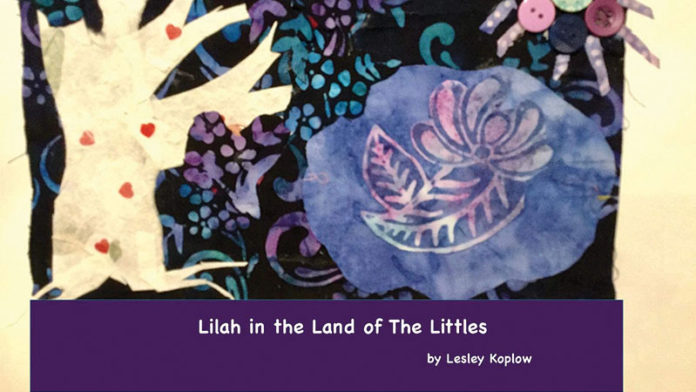
The rules have changed. Young children aren’t sent on playdates, school schedules have become variable and visits to family or friends are infrequent, if they happen at all. With the pandemic response to lessen the spread of COVID-19, young children are experiencing feelings of isolation, loneliness and confusion. Clinical psychologist, teacher and author Lesley Koplow published Lilah in the Land of the Littles for children looking for ways to heal during times of uncertainty. 

“You can’t really solve COVID-19,” Koplow says. “Children know there’s something out there that adults don’t quite have a handle on. But there’s nothing you can do in the here and now. I wrote Lilah in the Land of the Littles because it’s a book that children need. Using books to reflect, for kids, is a way to help them not feel alone.”

Author Lesley Koplow

In the Palm of Your Hand
Koplow’s book uses play and the dynamics of relationships to help children see a world where they can feel safely in control. It follows the main character Lilah and her best friend Jasmine through pages of beautiful collage art (also by Koplow) and inspires creative solutions through play that’s appropriate to preschool development.

“Parents explain, but children need to play in order to make emotional sense out of it. Young children take things at their developmental level, which is not the same focus as adults about the COVID experience. We have to listen to what the kids are reacting to and provide lots of active play material so it becomes something they can hold in their hand,” Koplow says. 

In addition to providing a safe way for children to deal with big feelings, Koplow says there is a lot of overlap for adults to benefit from this type of bibliotherapy. She brings her continued experience in her private practice (since 1989) and author credits (she just released her tenth book) to other roles within her profession— as Director of the Emotionally Responsive Program at Bank Street College, as well as the founder of Networks for Schools That Heal. Both programs focus on the wellbeing of children through the lens of child development and life experience. 

“Adults used to be children”
“We talk about your Big Self and your Little Self- making the connection of how you react as an adult or as a teacher or parent, and how you would have reacted as a younger self or as your little self at the same age as these children. This helps adults become more aware of what they’re teaching and provides a lot of crossover for healing.”

Koplow’s new book, Emotionally Responsive Practice: A Path for Schools That Heal, came out in January, just as her self-published Lilah in the Land of the Littles was released. Koplow chose self-publishing for Lilah because it was a quicker route to get the material into the hands of people who could use it. 

“It’s strange during this time that to be physically healthy we have to be physically apart. But to be emotionally healthy, we need to feel connected and close,” Koplow says. “Through the function of play, you can bring anxiety down and make the world that you need. Kids are great at that.”

Purchase Lilah in the Land of the Littles by Lesley Koplow on Amazon.