
Technology is woven into nearly every aspect of modern childhood. Screens and smart devices have become almost as common as crayons and storybooks. This fundamental shift means that the skills our children will require to be successful in adulthood are changing. For parents watching their toddlers master a swipe-screen before the potty, questions becomes apparent, including, ‘What is the right age to start coding?’
Why coding is a core skill for today’s children
The shift from physical playthings to digital devices suggests that we may need to rethink the way we educate our children. Learning to code may no longer be optional; it is an essential skill in today’s world because its principles are embedded in nearly every industry. The employees of tomorrow need to be tech-literate.
As Kailynn Pike, director of Snapology Toledo, which provides robotics and STEM programs for children, puts it, this is less about raising every child to be a software developer and more about equipping them with tools to think, create, collaborate and shape the world around them.
Coding helps develop numerous secondary skills
While the ability to program is a valuable skill in itself, the real power of early coding education lies in the numerous secondary skills it builds, exercising the cognitive muscles that benefit a child in every classroom.
Toledo Technology Academy of Engineering teacher Melissa Jacobs notices a clear advantage in her classroom that comes with learning coding: “I see it in their problem-solving skills in math class and their level of patience when working with other students.”
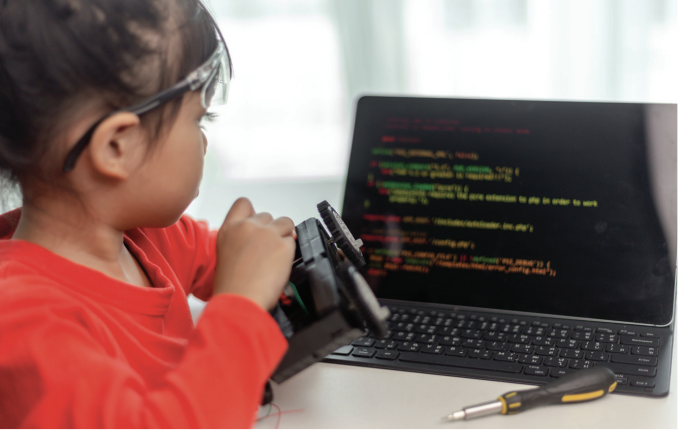
For younger children, the process of building physical robotic models–often a precursor to coding–strengthens fine motor skills and the ability to follow step-by-step instructions. As children transition to written code, they must learn to work out the “bugs” in the logic of their code. This process cultivates perseverance and critical thinking.
Maumee City Schools’ STEAM Teacher, Marissa Shank, notes that this debugging process also helps students become more detail-oriented and better collaborators when they work together to build code. Ultimately, coding is a covert way to teach essential skills like teamwork, communication and resilience that extend far beyond the computer screen.
Preparing for a technology-driven workplace
The long-term payoff of early coding is preparing children for careers that haven’t even been invented yet. Coding strengthens a student’s foundation in math, science and logical thinking by applying sequencing and cause-and-effect relationships. These skills are crucial across all academics. Professionally, coding opens a world of opportunities.
“It helps them think logically, work with technology and bring their ideas to life–all things that are in high demand in today’s world and will be even more essential in the future,” Pike said.
How early is too early?
The consensus among educators and programmers is clear: children can start exploring coding concepts as early as age four or five. Pike notes that at that stage, it’s not about memorizing complex syntax, but about learning patterns, sequencing, problem-solving and cause-and-effect thinking in fun, age-appropriate ways. This foundational period is when play naturally transitions into programming logic. For these youngest learners “coding” looks quite different from what computer programmers do.
Shank often introduces the concept of using a sequencing mindset. “They need to put their socks on first, and then their shoes, because doing those in another order wouldn’t have the same result.” This logical flow is the core of coding. At Maumee City Schools, younger aged kids start with activities like paper-based logic games or kid friendly robots. These “unplugged” activities set the foundation for the formal coding skills they will begin experimenting with in kindergarten and first grade.
Coding is for everyone
Learning to code is far more accessible than most parents imagine. The biggest misconception is that coding is only for “the tech lovers” or “the smart kids,” when, in reality, Jacobs insists, “It is for EVERYONE.”
You don’t need a technical background to foster this skill; simply being engaged and asking what your child is building makes a big difference, according to Pike. You can start by purchasing an inexpensive coding robot or using free apps and learning right alongside them. By dismissing the myths and embracing these skills early on, you aren’t just providing your child with an academic edge, you are empowering them to think, create and innovate in today’s world.

