Home Blog Page 4

How Learning Martial Arts Benefits Kids

Karate and kids go well together! In the western hemisphere the term karate is often used to describe any form of martial art. Strictly speaking though, karate is a type of martial art native to Okinawa. There are many popular martial arts from other places too, like Chinese Tai Chi and Qi Gong, Korean Tae Kwon Do and Hapkido, as well as Japanese Judo and Jiu Jitsu. Both Tae Kwon Do and Judo are official Olympic sports, so devoted students could become Olympic medal winners one day!

Bullied no more

Bullying is a fact of life for many kids. If they feel threatened and cannot confidently speak up for themselves, they may get upset.

When someone learns martial arts, they build self-confidence and recognize that it is the bully that is weak and not themselves. Knowing how to safely defend against attack and respond with appropriate levels of physical resistance with martial arts techniques eliminates bullying. Now, your kid can focus on what youth is for: learning and making friends!

Getting physically fit

Children have abundant energy. However, addictive touch-screen devices have captured their attention. Now, too much free time is spent stagnantly absorbing dopamine instead of playing outside like their parents and grandparents did when they were young. Children’s health is paying the price for this shift from active to passive.

Childhood obesity rates have climbed steadily upward in recent years. Moderate physical activity, like martial arts, burns off excess fat, and exercise naturally suppresses appetite!

Making friends

Spending time together is a great method for building lasting relationships! Attending martial arts classes gives kids opportunities to meet other kids that may go to different schools or live in different neighborhoods. Now, with martial arts, they have something in common from which to build friendships.

They can practice together at each other’s houses on the days they do not attend class. For children of the same age, this practice time can be easily extended into helping one another with homework. Does your kid or grandkid need a new friend? Martial arts might be how they do it. My daughter met her husband that way!

Setting and reaching goals

Good things take time to build. Martial art belt ranking systems give kids a tangible sign of success! I remember when I was a white belt – a beginner – and what it took for me to earn a yellow belt in Tae Kwon Do. It helped me to understand what it took to study something and excel at it. Each block, kick, and strike reinforces self-discipline and creates the state of mind needed to learn and focus for an extended period of time in order to reach a goal. This skill is transferable to other areas later in life, like graduating college.

Learning good behavior

Many martial art schools participate in intramural and/or open tournaments. This offers kids the chance to showcase their skills in a public setting. They learn that not everyone wins every time, but if they stick with it, they too can earn a trophy or a medal. It demonstrates that someone’s victory is not necessarily someone else’s defeat. Shortly after I earned my blue belt, I competed in an open tournament sponsored by my home karate school. I won second place in free sparring (fighting) and third place in form patterns (an orchestrated series of moves). The competitors that outperformed me earned their trophies. I was good. They were better. And that was okay. I was happy for them and for myself.

Spending quality time with family

I have spent thousands of hours practicing martial arts in my lifetime. Hundreds of those hours were spent with family: two of my brothers, both of my parents, my wife, our three kids, and one of my nephews. Four of my family members earned their black belts! I am thankful to my brother for introducing me to Tae Kwon Do, and to my parents for paying for it, when I was fourteen years old. It became a healthy and wholesome lifelong interest. I went on to earn a 4th degree black belt, eventually opening a Tae Kwon Do school with my wife, a 3rd degree black belt in her own right. We spent many an evening or Saturday morning participating in class together. It was time well-spent! Maybe there are members of your family that you would like to learn martial arts with?

How to get started

Begin by watching a class or two at a local martial arts school. Local options include the Allen’s American Martial Arts or the YMCA of Greater Toledo. The reputable schools allow potential new students to watch before they sign up. Some schools may provide the first lesson for free. Be wary of paying up front for a “black belt program” as only about 10% of students study long enough to get their money’s worth and earn a black belt. Then, consider how much time is available. To learn martial arts effectively, it takes at least two classes per week over several months, perhaps years. I attended 90-minute classes 3-4 times a week for a year to earn my first black belt. My brothers, wife, and nephew did the same.

Costs and caveats 

Beware that there are hidden fees when it comes to studying martial arts! Yes, there is the monthly charge which can be $50-$200 per month, per person, and require signing a lengthy contract. There are also the costs of uniforms, belt tests, tournaments, seminars, and optional private lessons or special classes (e.g., weapons). These add up quickly to hundreds of dollars, per person. Shop around before you sign a contract!


RELATED: Finding Strength: How Sensei Amanda Kaufman Empowers Through Advancing Karate


Tae Kwon Do is the best activity I have ever done! It gave me confidence and helped me build strength and character, and those are valuable lifelong skills. Give martial arts a try today with your friends or family. It just might become your favorite activity too!


Ohio again spent more than a billion dollars on private school vouchers during latest fiscal year

by Megan Henry, Ohio Capital Journal
October 19, 2026

For the second year in a row, Ohio spent more than a billion dollars on private school vouchers, this time for the 2026 fiscal year.

The total amount for Ohio’s five private school voucher programs was $1.173 billion, according to data from the Ohio Department of Education and Workforce. Nearly half of the money ($532.8 million) was from the Education Choice Expansion vouchers. This is the third full year with near-universal school vouchers.

“It’s frustrating to see this amount of money going to vouchers when our public schools still are not fully and fairly funded,” said Melissa Cropper, president of the Ohio Federation of Teachers.

“Right now, they’re funneling a lot of money to private schools and not fully funding our public schools.”

Ohio Education Association President Jeff Wensing also said the state needs to fully fund public schools.

“I think our policymakers … diverting more than $1.1 billion a year, maybe $1.2 to private schools probably isn’t the best decision because of the fact …  that these are public tax dollars going to largely unaccountable private schools, and that’s a concern when that happens.”

Ohio appeals court rules state’s private school voucher system unconstitutional

An Ohio appellate court ruled on Thursday that the EdChoice voucher program is unconstitutional. The program will still be able to exist, as the judges expected the state to appeal.

Interim Ohio Republican Attorney General Andy Wilson said in a statement last Thursday that he would appeal the decision to the the 6-1 Republican-controlled Ohio Supreme Court. Ohio Republican state lawmakers made Ohio Supreme Court races overtly partisan by adding party labels in 2021.

Wensing said that it’s incredibly obvious that it’s an illegal use of taxpayer money.

“The students using the EdChoice vouchers and EdChoice expansion are students already enrolled in private school,” Wensing said. “These families have been paying for their students to go to private schools, mostly wealthy families, and it’s a handout to the wealthy, a handout to the rich.”

The $1.173 billion figure is just under the estimated $1.18 billion the nonpartisan Ohio Legislative Service Commission predicted for the voucher programs for fiscal year 2026.

The five private school scholarship programs are the Autism Scholarship Program, the Jon Peterson Special Needs Scholarship Program, the Cleveland Scholarship, the Education Choice Scholarship and the Educational Choice Expansion Scholarship Program.

Lawmakers expanded the Education Choice Expansion eligibility to 450% of the poverty line three years ago through the state budget — creating near-universal school vouchers.

K-8 students can receive a $6,166 scholarship and high schoolers can receive a $8,408 scholarship in state funding under the EdChoice vouchers.

There were more than 105,000 EdChoice Expansion scholarships awarded, averaging $5,114 per participant, according to the ODEW data.

There were more than 42,000 traditional EdChoice scholarships awarded for a total of $284.6 million — with an average of $6,807 per participant.

For the Cleveland scholarship, there were more than 8,000 scholarships awarded for a total of $55.09 million — with an average of $6,875 per participant.

There were more than 6,000 autism scholarships awarded for a total of $186.7 million — with an average of $30,318 per participant.

For the Jon Peterson Scholarship, there were more than 9,000 scholarships awarded for a total of $114.2 million — with an average of $13,511 per participant.

There were 1,629,346 students enrolled in Ohio’s public schools during the 2025-26 school year, according to ODEW, but the number of students enrolled in the state’s public schools has been on the decline.

  • 1,652,539 during the 2024-25 school year
  • 1,665,521 for the 2023-24 school year
  • 1,671,645 for the 2022-23 school year
  • 1,672,198 for the 2021-22 school year

The number of students enrolled in nonpublic school has been on the rise, according to ODEW.

  • 185,584 students during fiscal year 2026
  • 181,244 during FY25
  • 173,156 during FY24
  • 169,807 during FY23
  • 167,395 during FY22

Total payments for the five scholarship programs for the past five fiscal years, according to ODEW data:

  • $1.09 billion in fiscal year 2025
  • $970.7 million in fiscal year 2024
  • $610.2 million in fiscal year 2023
  • $554.5 million in fiscal year 2022
  • $444.5 million in fiscal year 2021

Follow Ohio Capital Journal Reporter Megan Henry on X or on Bluesky.

Ohio Capital Journal is part of States Newsroom, a nonprofit news network supported by grants and a coalition of donors as a 501c(3) public charity. Ohio Capital Journal maintains editorial independence. Contact Editor David Dewitt for questions: [email protected].

Trick-or-Treating Times and Dates 2026

As Halloween ‘creeps’ towards you, it’s time to start thinking about costumes and, more importantly, when to wear them. You don’t need to be dressed as Sherlock Holmes to find out when your neighborhood is hosting trick-or-treating; we’ve compiled a list of them for you. Happy haunting!

Lucas County

Saturday Oct. 31

Holland: 6-8pm

Maumee: 6-8pm

Oregon: 6-8pm

Ottawa Hills: 6-8pm

Springfield Township: 6-8pm

Sylvania: 6-7:30pm

Sylvania Township: 6-7:30pm

Toledo: 6-8pm

Waterville: 5-7pm

Whitehouse: 6-8pm

To Be Announced

Monclova Township

Washington Township

Wood County

Saturday Oct. 31

Bowling Green: 6:30-8pm

Haskins: 6-8pm

Northwood: 6-8pm

Pemberville: 6-7:30pm

Perrysburg: 6-8pm

Perrsyburg Township: 6-8pm

Rossford: 6-8pm

Stony Ridge: 5-7pm

Tontogany: 5:30-7pm

Walbridge: 4:30-6pm

To Be Announced

Dunbridge

Grand Rapids

Lake Township

Luckey

Millbury

Fulton County

Saturday, Oct. 31

Swanton: 5:30-7pm

Monroe County

Saturday, Oct. 31

Bedford Township: 6-8pm

Erie Township: 6-7:30pm

Luna Pier: 6-7:30pm

To Be Announced

Whiteford Township

When “Behavior” Was Something More: A Mother’s Journey Through Autism and Catatonia

I am a nurse.

For more than three decades, I have cared for people in some of the most difficult moments of their lives. I learned to recognize changes from a patient’s baseline and to speak up when something didn’t look right.

But when it was my son, I wasn’t standing at the bedside as a nurse.

I was standing there as his mom.

My son is autistic and has an intellectual disability. I know him the way only a mother can: his personality, his routines, the way he communicates. So when things began changing in the fall of 2025, I knew something was wrong.

Where did my son go?

At times, he would freeze, stare, become rigid or hold his body in unusual positions. At other times, the picture was completely different: extreme agitation, aggression and self-injury. His communication changed. Things he had always been able to do, he suddenly couldn’t.

There were moments when he seemed out of reach, as if a wall had gone up between us and I couldn’t find the door.

As a parent, I was frightened. As a nurse, I kept thinking about baseline.

This wasn’t my son’s baseline.

When behavior doesn’t tell the whole story

When a child has autism or an intellectual disability, it’s easy to explain every new change as part of the disability.

It’s his autism.

It’s behavior.

It’s a phase.

But sometimes behavior is a sign of something medical.

My son was eventually diagnosed with catatonia, a medical condition that affects movement, responsiveness, speech and behavior. Up to 1 in 10 autistic people may experience it at some point, often in the teen or young adult years. Yet it’s missed again and again, because the signs look like autism to people who don’t know the difference.

Catatonia wasn’t misconduct. It wasn’t my son deciding to be difficult. It was a medical condition taking away his ability to function, and it couldn’t be reasoned away, redirected away or disciplined away.

Finding the right team

He had several hospital stays during the fall of 2025. Each time, I hoped someone would have answers. But local medical professionals weren’t able to help, and I watched my son continue to struggle while we searched for someone who could.

Eventually, he was admitted to Nationwide Children’s Hospital in Columbus, where he stayed from November 2025 into April 2026. For the first time, we were with a team who saw what I saw. They knew what catatonia was, and they knew how to treat it.

On December 10, 2025, my son began electroconvulsive therapy, or ECT.

I won’t pretend those three letters are easy to hear as a mother. ECT still carries decades of fear and stigma. But for severe catatonia, it is a well-established and often life-saving treatment, especially when medication alone isn’t enough.

His treatment didn’t end with one or two sessions. It continued after he left the hospital, and by August 2026 he had received about 43 ECT treatments.

That number still feels almost impossible to write. Behind every one of those treatments is a mother who hoped for more moments of the boy she knew.

To the parent awake at 2 a.m.

Somewhere tonight, a parent is watching their child change and can’t get anyone to listen. Maybe that’s you.

You don’t have to know the diagnosis to know something is wrong. You only have to say:

“This isn’t my child’s baseline.”

Watch for changes in movement, freezing or staring; speech and communication; sleep, eating or drinking; skills your child used to have; and new agitation or self-injury.

Write down what you see and when. Take short videos of your child walking, eating and going through daily routines, because doctors see a snapshot and you see the whole story. Ask directly: “Could this be catatonia?” And if help isn’t available close to home, keep looking. It may be worth the drive.

Get help right away if your child stops eating or drinking, has a fever or sudden changes in heart rate or breathing, or becomes severely agitated or self-injurious. Catatonia can become a medical emergency.

Where to find help

  • Nationwide Children’s Hospital, Columbus: experienced in diagnosing and treating catatonia, including ECT for children and teens.
  • The Catatonia Foundation (thecatatoniafoundation.org, 248-579-8829): information for families and resources to share with your child’s doctor.
  • SPACES: a webinar series on catatonia in autism for families and caregivers.
  • Other parents: families who have walked this road will understand without you having to explain.

We are still walking this road

My son’s story isn’t over. There have been hospital stays, treatments, setbacks and progress.

But there have also been moments when I see him coming back through the illness: pieces of his personality, his expressions, the things that make him who he is.

Those moments keep me going.

Sometimes the most important thing a parent brings into a room full of professionals isn’t a degree or a perfect explanation. It’s knowing your child well enough to say, “This is not my child’s baseline. Please keep looking.”

I started this story by saying I am a nurse. That’s still true. But on this road, I am first and always his mom. And I will always fight for him to be seen and understood.

Jodi Peacock is a registered nurse and mother in Toledo.

Ohio will lose an estimated $38M to administer SNAP. Metro areas will be hardest hit

Karen Kasler/ Statehouse News Bureau

By Kendall Crawford The Ohio Newsroom

(Published September 30, 2026 at 5:00 AM EDT)

The federal government will pay less to help Supplemental Nutrition Assistance Programs run starting on Thursday.

Historically, SNAP administrative costs have been shared by the federal government and the state. But, under the Trump administration’s HR1, or “One Big Beautiful Bill,” the portion the federal government covers will go down.

On Oct. 1, the federal government will cover 25% of administrative costs, rather than 50%.

Around 1.4 million Ohioans are enrolled in the program that provides low-income people monthly funds for groceries.

Ohio is estimated to have an immediate loss of around $38 million. Those funds are distributed to county Jobs and Family Services departments, which manage SNAP locally.

Metro areas face largest gaps

To prepare for these losses, the Ohio legislature budgeted a bit more for administrative needs, allocating around $12.5 million in March to offset counties’ losses.

In the past, the state used the number of caseloads and county poverty levels to determine how much each county gets. This time around, the legislature decided to split the funds equally among counties. Each county will receive $226,486, or – if a county lost less than that – the amount it takes to fill their gap.

Under this system, 59 counties’ budgets will be made whole again. But many of the state’s metro counties, which have bigger SNAP caseloads, will have to replace millions of dollars.

Cuyahoga County will face the largest gap, losing an estimated $7 million.

Republican lawmakers argued that these metro counties have enough in their general funds to step in, while rural counties did not.

“The bill treats all counties equally,” Rep. Brian Stewart (R-Ashville) said on the House floor in March. “These largest counties we are clutching pearls over have the money.”

Potential impact 

In Lucas County, where Toledo is, administrators say they are grappling with around a $2.5 million loss.

JFS Director Breda Osburn said it won’t be easy to replace, since the county’s funding is siloed and inflexible. Osburn and her staff don’t have the ability to move funding from programs that may be utilized less and funnel it to SNAP, which has around 69,000 participants.

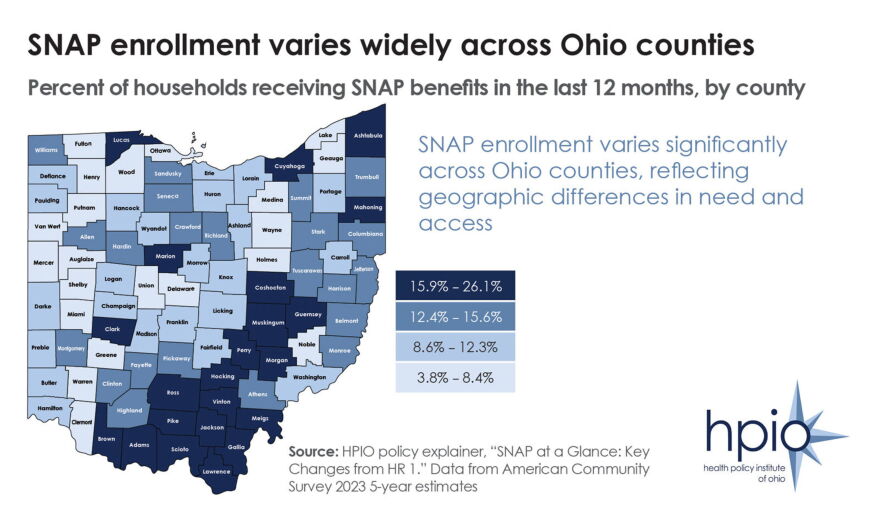
A graphic from the Health Policy Institute of Ohio, published in February of 2026, shows the percent of households receiving SNAP benefits.
Health Policy Institute of Ohio

Lucas County commissioners have stepped up to fill the gap this year. But, with rising costs, Osburn said that likely won’t be sustainable in the long-term.

She said the only significant way to shrink the JFS budget would be to cut staff.

“That would create much longer turnaround times for eligibility processing. It would create much longer wait times on the phones,” Osburn said. “It would also very likely drive up errors in the determination of benefit amounts.”

More changes ahead

The administrative cost shift is just one of the changes to SNAP under HR1. There are also added work requirements and changes to eligibility based on immigration status.

Starting next year, the state will be evaluated on its error rate, which tracks when a household receives either an overpayment or an underpayment of $57 or more.

If Ohio has an error rate of 6% or higher, then the state will have to pay a portion of the SNAP benefits themselves, which have typically been completely covered by the federal government.

In 2024, the state’s error rate was around 9%. Last year, the state’s error rate was just over 6%. If it were to remain at that level next year, Ohio would have to pay for 5% of benefit costs, which could add up to around $161 million, according to the Health Policy Institute of Ohio.

Osburn said the state reviews only a small fraction of cases to calculate the error rate, which she believes it’s not representative of the accuracy of the program.

“It’s really luck of the draw,” she said.

The Ohio Newsroom is a nonprofit dedicated to serving Ohio’s news deserts. Learn more at ohionewsroom.org.

Anthony Guinn Jr. “Leads the Way” with Community-Centered Youth Program

Anthony Guinn Jr. started the Lead the Way Initiative in 2013.

There are programs defined by what they offer, and then there are programs shaped around the exceptional people who lead them. Anthony Guinn Jr.’s Lead the Way Initiative belongs to the latter.

Established in 2013, the Lead the Way initiative is a youth program focusing on giving young people a safe and supportive environment where they can build confidence, learn accountability, develop leadership skills and be exposed to opportunities beyond what they may encounter in their everyday lives. It’s a behavioral and mental health after-school and summer program that works predominantly with youth aged from 5 to 17 but extends up to age 21.

The program runs program runs Monday through Thursday from around 3:30-7pm.

“Lead the Way bridges the gap between families who might have a single mom or single dad because it’s take a village to raise to raise a kid,” shares Anthony Guinn Jr., the director of the program.

Guinn, 41, was born and raised in Toledo, so this mission is very near to him. “How I grew up in the urban community was basically just being a follower, just adapting to my environment,” Guinn explained. “There was a lot of gang violence and drug dealing, so, with my background, I just don’t like to see young men and young women going down that path.”

The program runs Monday through Thursday from around 3:30-7pm, but it doesn’t stop there. They provide one-on-one sessions seven days a week with kids in crisis, also offering support to the parents in that time, too. The programs provides other services such as transportation to and from school, feeding the families as needed, and teaching young people basic hygiene.

“I want to say 85% of our clients live in urban communities, so if I see an area over there that needs to be picked up, that’d be something that we do,” Guinn explained.

As far as engaging the larger community, Guinn and his staff have sponsored three football teams for the mid-city football league. Additionally, they feed the homeless once a month and carry out regular trash pick ups. “I also try to teach the kids during service work, I just let them see that [they could end up on the streets] at some point if they keep down the route they’re keep going and not caring and thinking life is a game.”

The Lead the Way Initiative doesn’t seem to have a definitive list of services offered; rather, Guinn and his team seem to constantly adapt their time and efforts to the needs of the community.

“My company is really just a support system, not only for the youth but also the parents the household. We have vouchers if there’s a hard time in life and the family needs some assistance, we can come up with a little money to help out,” shared Guinn. “That’s what Lead the Way is about. We’re not giving up, and my slogan is no child left behind.”


RELATED: Save The Music Partnership Expands Music Opportunities Across Toledo Public Schools


Guinn highlighted the importance of giving kids access to the one-on-one sessions every day of the week, explaining that some of the young people might be embarrassed or shy participating in group settings, especially the older teenagers. “This isn’t just a program; this is your granny’s house, you know, this is where you go to to feel the love and the warmth, and that’s why we do services seven days a week. We just want to be supportive. The only thing we’re doing is bridging the gap.”

When asked about the impact of the program on the kids, Guinn lit up discussing the privilege of seeing their growth over the past thirteen years.

“Basically, I’ve just seen the growth, and the growth in me, too, not having a school background, just personal experience,” Guinn shared. “So, I actually grew with the kids. I’ve just seen how much opportunity they don’t understand they have. With Lead the Way, we want to give the kids that option, that outlook that you don’t have to sell drugs or kill to get the lifestyle that you want, like the nice cars or the flashy stuff, you can get it the honest way and become a dream chaser.”

Guinn has three children himself—one 22 year-old and a set of twins about to turn twelve—who strongly influence his work.

“When you’ve got your own kids, it’s different. Having a background where my father was absent and now getting to be a great father, I can understand what these kids are going through when they come to the program. And they’re not chasing their dreams because of the lack of support. So, I had to grow and mature and see things differently.”

Guinn’s dream is for community groups to work together for the betterment of the next generation. “My vision has always been that we all come as one,” he shared. “We all come as one with different entities, we’re all under the same umbrella of basically community service mentorship…We all just need to link up and become that chain of change. I envision that, and I send my hands out to every program from TPS schools to private schools, I send my hand out so we all work together to save our future—because these kids are our future.”

Brittani Hamilton, who works alongside Guinn, expressed just how inspirational a leader Guinn has been. “Anthony has dedicated his time to creating positive opportunities for youth in the Toledo community through mentorship, fitness, life skills, career development, and hands-on activities,” she shared. “What makes Anthony’s work special is his ability to connect with young people while providing the structure, encouragement and positive male leadership that many families are looking for in our community.”

The Lead the Way Initiative accepts drop-off donations at 3170 Central Ave. They also accept donations at their main office, 338 North Erie, located on the second floor of the building. You can learn more about the program, its mission, and how to donate at lead-theway.org.

“All we are is we that uncle you don’t have, that you’ve been missing. We are your dad if you don’t have one, your mom if you don’t have one,” Guinn said. “The Lead the Way Youth Initiative is here to stay.”