
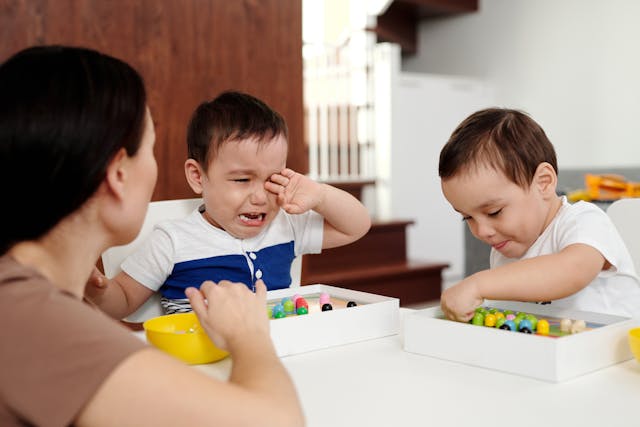
Few things test a parent’s patience like sibling rivalry. The constant arguing, comparisons, hurt feelings and cries of “That’s not fair!” can leave caregivers feeling overwhelmed and unsure of how to respond. It’s tempting to see sibling conflict as competition, bad behavior, or something children should simply “grow out of.”
A trauma-informed lens invites a different understanding: sibling rivalry is often less about rivalry and more about safety, connection and belonging.
Jealousy is a stress response, not a character flaw
Jealousy is frequently misunderstood. When a child reacts strongly to a sibling—by acting out, withdrawing or demanding attention—it’s easy to label the behavior as manipulative or immature. In reality, jealousy often signals fear: Will there be enough care, attention and safety for me too? As a mom of three, I notice that when one child is struggling (case in point, my teen suffered a bout of moderate depression last year) that another will seek attention in different ways (my then eleven-year-old son would come to me and just nap on me).
For children, especially younger ones, love can feel like a limited resource. Changes such as a new baby, different needs among siblings, school stress or parental exhaustion can activate a child’s nervous system. When children feel uncertain, their bodies respond before their words do. When my youngest daughter was born, my oldest was starting school. Despite the excitement over having a baby sister, there were tears and fits every morning for months about why she had to go to school when baby sister got to stay home with mom.
This doesn’t mean siblings shouldn’t have limits or expectations. It does mean that behavior is communication, and jealousy often communicates a need for reassurance.
Why “just be nice” rarely works
When emotions run high, parents often default to quick fixes: separating children, assigning blame or insisting everyone calm down and get along. While these strategies may stop the conflict temporarily, they don’t address what’s happening underneath.
When a child is dysregulated, their brain is operating in survival mode. Logic, perspective-taking and empathy are temporarily out of reach. Telling a child to “use your words” or “stop overreacting” assumes a level of regulation they may not have in that moment.
Trauma-informed care reminds us that regulation comes before resolution. Before children can problem-solve together, they need help settling their nervous systems.
RELATED: Health Literacy for Kids, Families
The role of adult regulation
One of the most powerful tools in sibling conflict isn’t a strategy—it’s the adult’s presence.
Children take emotional cues from the adults around them. When parents remain grounded, speak calmly, and avoid taking sides, children feel safer. This doesn’t mean parents ignore harmful behavior, but rather that they address it without adding fear or shame.
A regulated adult can say, “I see that you’re really upset right now. I’m here, and we’ll figure this out,” instead of escalating the situation with raised voices or immediate consequences.
Over time, children learn that big feelings don’t threaten their relationships—and that reassurance is available even when emotions run high.
Fair isn’t always equal
Sibling jealousy often flares around fairness. Trauma-informed parenting reframes fairness not as equal treatment, but as meeting each child’s needs.
One child may need more reassurance. Another may need more space. A third may need help naming feelings. When parents explain that different support doesn’t mean less love, children slowly begin to internalize a sense of security.
Naming this explicitly can be powerful: “Everyone in this family gets what they need to feel safe and supported. That won’t always look the same.” For example, my oldest wants physical touch and affection to connect. My son in the middle prefers his space until he is regulated and ready to talk. Forcing him to interact in the same way as his older sister would be inappropriate.
Teaching repair, not perfection
Conflict between siblings is inevitable—and not inherently harmful. What matters most is what happens after the conflict.
Trauma-informed parenting emphasizes repair over punishment. Helping children reflect once they’re calm, encouraging empathy and modeling apology and accountability teach skills that last far longer than forced apologies in the heat of the moment.
Repair sounds like: “That was hard. What do you think your sibling needed in that moment?” It teaches children that relationships can bend without breaking.
A gentler way forward
Sibling rivalry doesn’t mean something is wrong with your family. It means children are learning how to navigate relationships while their brains and nervous systems are still developing.
When parents respond to jealousy with curiosity instead of criticism, boundaries instead of blame, and connection instead of comparison, children learn a powerful lesson: there is enough safety, care and belonging for everyone.
And in that safety, rivalry slowly gives way to trust.

