
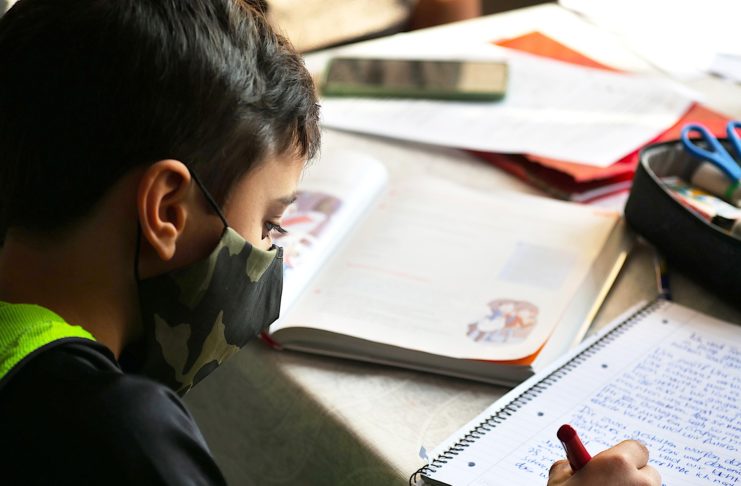
With COVID-19 cases rising again just as kids head back to school, parents may find themselves wondering what happens if their child is exposed to the virus in the classroom. Will they need to keep their child home, and for how long? Should the child be tested? Will this mean more remote school for everyone this year?
Fortunately, Lucas County did not see much disease spread within classrooms last school year, according to health commissioner Dr. Eric Zgodzinski. “We were masking up, we were staying relatively far apart from each other, and those things really did work last year,” he says.
Zgodzinski expresses confidence about the continued effectiveness of these mitigation strategies even in the face of the more contagious delta variant. “You’re going to be much better off if you’re masking and staying at least three feet away, to be able then to curb those issues of disease in schools, but then, of course, there are the quarantine and isolation issues,” he says.
 In its back to school guidance, the Lucas County Health Department recommends a layered approach to prevention that includes vaccination, good ventilation, regular cleaning, universal masking, social distancing of at least three feet, hand washing and respiratory etiquette.
To quarantine or not to quarantine
Earlier this month the Ohio Department of Health released a detailed flowchart to help guide decisions about the need for quarantine after a student or adult is exposed to someone with COVID-19 in the classroom setting. The flowchart addresses various scenarios based on school-wide preventive strategies, as well as the vaccination and masking status of the student, teacher or staff member who was exposed to someone with COVID-19 in a classroom setting.
The bottom line? If they are symptom free, individuals can safely remain in class and participate in extracurricular and sport activities if the school has all of the of the following layered prevention strategies recommended by the ODH in place:
- Masking required for all students and staff (regardless of vaccination status).
- Strategies to maximize physical distancing (at least 3 feet between desks).
- Documented COVID-19 prevention policies and procedures (identification of individuals experiencing symptoms, strategies to increase ventilation, protocols for cleaning, etc.).
 If a school does not have all of the above prevention strategies in place, the question of quarantining gets a bit more complicated depending on the contact’s vaccination status and whether they were wearing a mask. The ODH offers guidelines for several scenarios:
Quarantining is not necessary for fully vaccinated students and adults, provided that they wear a mask indoors either for 14 days or until a viral test performed three to five days after exposure has come back negative. Vaccinated individuals can remain in class and participate in extracurricular and sport activities as long as they have no symptoms.
Quarantining is also not necessary for students and adults who are not fully vaccinated if the person who was exposed was wearing a face mask consistently and correctly. ODH guidelines call for the contact to continue wearing a mask indoors for either 14 days or until a viral test performed at least five days after exposure has come back as negative. They should continue to self-monitor for symptoms for 14 days following exposure, but may continue attending class and participating in sports and extracurriculars as long as they remain symptom free.
Anyone who tests positive for COVID should isolate for at least ten days from the date of the positive test.
Who needs to quarantine?
Quarantine is required if the recommended layers of prevention are not in place, the exposed student or teacher is not fully vaccinated and they were not wearing a mask at the time of exposure, according to the ODH. The student or teacher may only return to school, sports and extracurricular activities after seven days if they receive a negative viral test performed at least five days after exposure. They should continue to watch for symptoms of COVID-19 for 14 days.
These ODH guidelines for students and adults only apply to exposures occurring in classroom settings. Individuals who are not fully vaccinated and exposed to COVID-19 outside of the school setting should refrain from attending in-person school and participating in organized sports or extracurriculars throughout their quarantine period.
 Best practices for keeping kids safe
For the best chance at a safe and successful year, Zgodzinski advises parents to get their children vaccinated if they are eligible and to have them wear masks at school. It might not be necessary for the entire year, he says, but it is especially important now because the local community is seeing a rapid increase in COVID cases among all ages.
“The idea here is we need to get our kids in school and keep them in, and we do that by making sure that kids are vaccinated and masked up,” says Zgodzinski.

