
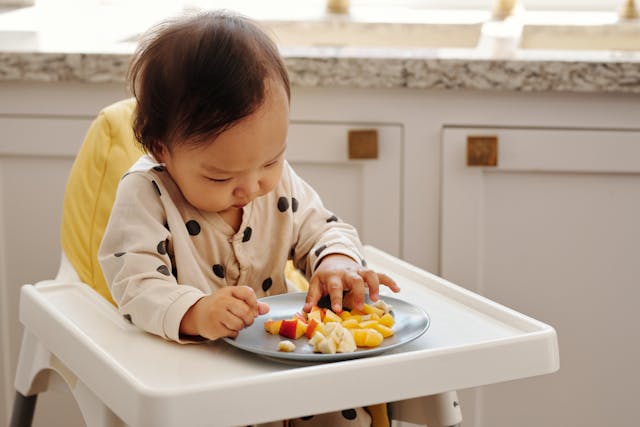
Despite the continued proliferation of fast food and pre-packaged snacks, there’s some good news involving healthy snacking and toddlers. Just not enough good news. A local dietitian explains that parents can positively tip the balance of nutritional eating for their children.
According to the Harvard University T.H. Chan School of Public Health, the most recent National Health and Nutrition Examination Survey, covering 1999-2018, showed that the diet quality of toddlers — defined as children aged 12-24 months — has significantly improved over the years.
Healthy Eating Index scores
Using the Healthy Eating Index to assign the 2,500 participating children a score from 0 to 100, the study, “participants’ diet scores improved to an average of 67.7 from 63.7. On average, the scores increased nearly 0.3 points a year. This positive trend was observed among all socioeconomic groups.”
The biggest improvement that the study found was fewer added sugars. It was also found that kids are now eating more whole fruits, whole grains, fatty acids and refined grains.
However, the study found that there is still room for improvement when it comes to kids’ health. In many areas — the consumption of vegetables, beans and greens, seafood and plant proteins, sodium and saturated fats — scores did not improve, falling short of current dietary guidelines.
Kelly Layton, a registered dietitian for Nationwide Children’s Hospital-Toledo, said, “Diet quality has improved in a couple areas, as the study mentioned.” Specifically, Layton cited increased fruit consumption. Adding, “The big one is a decrease in sugared drinks and replacement of white bread and white rice and white grain with whole-grain products.
However, Layton is in agreement with the study in that there is still work to be done when it comes to improving kids’ diets. “While there have been a couple improvements in some areas,” Layton said, “we’re still not hitting our goals.”
Snacking
The reason it’s hard to hit nutritional goals in the 12-24-month age group, she said, is because of the type of snacks that are available. “There’s a huge increase in the last couple decades in processed convenience foods, like chips, crackers, snack cakes. They’re easy and palatable. In some circles they’re considered the norm for snacks. It’s really hard to find snacks without sugar,” she said.
RELATED: Health and Wellness Guide 2025
It’s important to find those healthy snacks and to introduce them to toddlers. “A lot of dietary preferences are formed at that age,” she said. “The types of foods they eat at that age are critical, because that’ll be the foods they’ll like later in life.”
She continued, “For kids, the most important is fruits and vegetables. Parents should include a fruit or a vegetable — or both — in their snacks.” For example, she suggested serving baby carrots and hummus as a healthy snack.
On a positive note, she said, “there are more sugar-free or diet products more readily available and heavily marketed. And the fruit and veggie squeeze pouches can be a healthy snack.”
Besides choosing nutritional food, parents can take a more-active role in healthy eating. “Involve kids with meal and snack prep,” she said. “There are things that can be incorporated creatively. Fruit with yogurt or celery with peanut butter and raisins – ‘ants on a log.’ Whatever you can do to make trying new foods a positive experience.”
Also, parents can set a good example by eating more fruits and vegetables and drinking less-sugary beverages. The federal Departments of Health and Human Services and Agriculture are developing the 2025-2030 Dietary Guidelines for Americans.
“Hopefully the diet quality improvement for toddlers will continue lifelong,” Layton said.

