

New year, new routines, new challenges. Our Back-to- School Guide covers homework hacks, the debate over whether parents should track their kids, and how tweens and teens can navigate the ever-changing world of friendships. Everything families need to start the school year feeling prepared, connected and confident.
The “In Between” Years: Helping adolescents navigate friendship, conflict and belonging

By Brandy Browne
Parenting a child in middle school is emotionally complicated. One day, your child is happily chatting about recess and asking for help packing their lunch; then the next day, they are deeply invested in friendships, social circles and whether someone left them “on read” on Snapchat. The “in between” years— early adolescence, the tween and early teen years— are a season of tremendous growth, but also tremendous vulnerability. Friendships become more layered, peer approval carries more weight than familial approval and many children are simply trying to figure out where they belong socially.
Belonging in the “in between” years
According to Scott Buker, principal at Perrysburg Junior High School, much of what parents observe during this phase is rooted in one core need: belonging. Humans are wired for connection with peers, and there is no phase of development where this becomes as painfully obvious as the “in between” years.
“In junior high, students are exposed to different peers and that generates different interests, hobbies and connections,” Buker explains. “You start to see the birth of social circles a bit and everyone wants to be included into one of those circles, but at the same time, they have fear over the possibility of being excluded from those circles.”
Emotional highs and lows
That push and pull can create emotional highs and lows not only within peer relationships, but also at home. Parents may notice their child becoming more sensitive, more reactive or suddenly devastated by what may seem like small social moments to adults. These years are marked by significant social “firsts” as your child is learning to navigate the intense feelings stemming from a desire to belong for the first time. “Everyone is seeking a sense of belonging in some shape or form,” Buker adds, “and that leads to a whirlwind of relationship emotions.” Many parents may feel tempted to immediately jump in and fix friendship struggles. However, Buker encourages families to reframe conflict as a learning opportunity rather than something to avoid entirely. “The first step is understanding and embracing the idea that their child will have conflict,” he said. “Learning to navigate and work through the stress of that conflict equates to personal growth and helps build long-term resilience.”
Direct Communication
In an age dominated by texting and social media, many children (and adults) struggle with direct communication. Small misunderstandings can snowball quickly when conversations happen through screens instead of face-to-face interaction. Buker encourages parents to coach children toward open, honest conversations when conflict arises. “Encouraging their child to have open and real conversations, face-to-face, with their friends when conflict arises and showing them that vulnerability doesn’t show weakness and that it is important for others to connect through empathy,” he explained.
Children often need guidance in learning how to express hurt feelings appropriately, apologize when needed and move forward after disagreements. “I think too many times children let things linger and they dwell on the feeling it causes as opposed to being direct and honest about what they felt,” Buker said.
Parents can help by modeling healthy communication themselves or even role-playing difficult conversations with their child.
Trusting instincts
At the same time, parents often wrestle with a harder question: When is friendship conflict normal, and when is a relationship unhealthy? Buker said occasional stress in friendships is not necessarily a bad thing. In fact, working through disagreements with established friends can strengthen emotional skills like empathy, perspective-taking and conflict resolution. However, repeated negative interactions or sudden shifts in behavior may warrant a closer look. An important concepts for students is the difference between genuine inclusion and being “used” socially. “Oftentimes, the student will acknowledge to me that they ‘don’t feel good,’” he said. “That’s a strong indicator that it’s time to move on from that new relationship.”
For parents, this can be an opportunity to help children learn to trust their instincts. If a friendship consistently leaves a child anxious, excluded, embarrassed or emotionally drained, those feelings deserve attention.
Parents often have concerns about bullying during the middle school years. Buker emphasizes that understanding the relationship dynamic is critical before jumping to conclusions. “I think sometimes behaviors can get misinterpreted, so it’s important to understand the context and dynamics of those relationships,” he explained.Not every rude interaction or disagreement rises to the level of bullying. Sometimes children engage in certain behaviors while trying to gain attention or fit in socially. In those cases, helping a child communicate that a behavior bothers them may resolve the issue quickly.
Buker also warns that there are clear signs parents should take seriously. “If a child is feeling intentionally targeted, it’s repeated, and done with the intent to hurt or embarrass then those are obvious signs of bullying and needs to be reported to an adult,” he said.
The middle school years are often less about avoiding discomfort and more about helping children develop the emotional tools to navigate these enhanced emotional times Parents can provide a safe place to process those experiences when the social world feels uncertain. For many tweens and teens, knowing they are fully accepted at home becomes the anchor that helps them weather the ever-changing social landscape of adolescence.
Back to School Homework Hacks: Local parents share their best tips
By Mary Rose Kulczak
Back-to-school means back to routines like packing lunches, early bedtimes and backpack checks. We spoke with area parents to get some tips and tricks to help school kids maintain healthy habits for the academic year ahead. From dedicated work spaces to rewards and snacks for brain fuel, we found some great ideas to make this school year the best one yet.
Krystal Szabo

Mother of two children; Owner of Green Bubble Gorgeous
The greatest system in our house is our chip reward system. Our kids earn chips for completing homework, age-appropriate chores and good deeds. They can cash in the chips they have earned for screen time, an extra bedtime story, a trip for ice cream and more.
Parenthood is our greatest opportunity to prepare little people for real life, and teaching them early that rewards are earned, not given, is one of the best lessons we can pass along.
LaKedria Lozano

Homeschooling mother of four; Master of Arts, Education
Just a few tips from a teacher.
1. Make it fun! Play games with the kids.
2. Divide the material to get kids engaged more quickly! Try taking frequent breaks especially if you have a resistant kid.
3. Talk to your child’s teacher if you feel that the work is excessive and your child isn’t able to complete it.
Vincent Flowers

Father of Zion and Zoe; Entrepreneur, industrial engineer and author of Zoe and Zion Love to Bounce and Zoe and Zion Love to Build
We have a points system. Our kids love their devices, so we have an earning time program that if they do things like homework, small chores, outside play for 30+ minutes they can earn additional tablet time.
Taylor Holloway

Mother of Andrew, Hannah, Moriah and Norah; Owner of Callisto Terra LLC
We have snacks on hand as soon as they get home! They get to choose, too. Snacks help everything! We also make sure the space for doing homework is clear & consistent. They do their homework in the same spot each day.
We’re readily available for them — to help or to give them a break! They just spent all day at school. We snack & then start homework to knock it out.
We watch them, if they get overwhelmed, we take breaks. We’ve even gotten up early to finish homework & given them the evening to relax. Sometimes I’m overwhelmed by work I have to complete & need a break. I try to remember that the kids may feel the same way. We’ve also spoken with teachers about overloading the kids. Some teachers have agreed to provide a homework sheet early that includes the assignments they need to complete by the end of the week.
It’s all conversations & adaptation! Each kiddo is different so each kiddo will be handled differently! But we do try to keep the atmosphere and the snack option the same.
My oldest daughter has ADHD & needs to take breaks a lot more often. Sometimes, when her day is really rough, we let her do her homework in her room. Adapting!
The Digital Umbilical Cord
By Nathan Jacobs
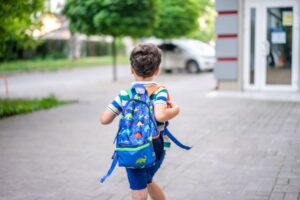
In the wake of Ohio House Bill 250, which required schools throughout Ohio to create and enforce formal cell phone policies, digitally connected parents were left with a conundrum: How can you track students at school if cell phones are required to be powered down?
The “old-school” mindset — once you put them on the bus in the morning, they are safe and sound at school until they return home in the afternoon — is adopted by many of us that made it safely through our school years under those conditions. However, this is the digital age and parents enjoy the peace of mind that comes with knowing their kids’ real-time location. There are many reasons why that knowledge is pertinent, ranging from ensuring a student isn’t skipping class to human trafficking prevention.
Since the HB250 mandate took effect, Toledo-area schools have complied in various ways. Toledo Public Schools high schools have employed magnetically locking Yondr pouches to make phones physically inaccessible until the final bell, while the TPS K-8 buildings use morning lockboxes for student phones to make phones unavailable. Perrysburg Schools and Anthony Wayne Schools have taken an “out of sight and powered down” approach where phones must be turned off and stored in lockers or backpacks throughout the day.
With restrictions in place, parents yearning for a digital connection are scrambling to find ways to track their students, while still following the rules. Smartwatches seemed like the obvious workaround, but unfortunately – because they have screens and are not inherently silent – they fall under the same rules as cell phones.
Technology offers an option
Rewind to 2014: a startup called Tile released a small electronic device that connected to your cell phone via Bluetooth. This device could be attached to items prone to go missing — like keys, backpacks and luggage — tracked with an app.
These inexpensive devices have seen huge advancements over the past decade. Tile is still around (now owned by Life360), but most major phone manufacturers have their own versions, most notably Apple AirTags and Samsung SmartTags. Though functionally similar, these trackers are now much more reliable and, more importantly, precise. Even with your student’s cell phone powered off, these tracking devices provide a real-time location.
Parents can also opt for true GPS tracking devices like Jiobit or AngelSense. These devices connect directly to cellular networks, completely independent of a cell phone. Historically, these devices were reserved for those with special needs, the elderly, or — with Jiobit — pets. However, with 26 States mandating some form of restriction on cell phones in K-12 schools, these devices are quickly gaining traction across the country.
Ultimately, Ohio’s new law wasn’t meant to create a safety issue; it was aimed at reducing distractions caused by cell phones in schools. And it seems to be working. School administrators across Northwest Ohio have been celebrating the return of verbal socialization. Many districts report noticeably louder lunchrooms and hallways as schools return to a more analog experience.
But for parents who don’t want to cut that digital umbilical cord, these small, silent trackers offer a reliable way to maintain peace of mind while still following the rules.

