
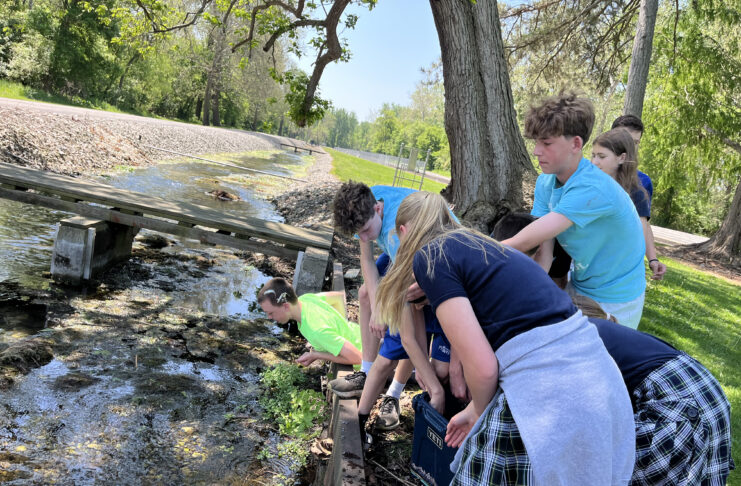
The seventh and eighth graders at St. Rose Catholic School in Perrysburg have the usual textbooks, videos, and classroom instruction as part of their overall education in science.
But for some of these junior high students, it goes well beyond that traditional approach. They learn about water quality, stream environments, the diet of certain wildlife, and they are introduced to a set of skills these young people might utilize for the rest of their lives.
“Trout in the Classroom” is an elective at St. Rose, and a very popular one. The students get to raise rainbow trout from eggs to a size where the fish can be safely released in a spring-fed stream near the Blue Hole in Castalia, right before the end of the school year.
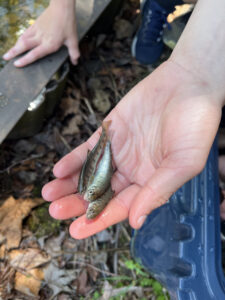 Throughout the spring semester, the students feed the trout, test and clean the tanks where the fish are raised, monitor the water’s chemical profile, and learn about the life cycle of rainbow trout, one of the most-prized gamefish in the country. The kids witness firsthand the changes as the young trout mature from fertilized eggs to minuscule alevins with the yolk sacs attached, and then grow into free-swimming fry about an inch long before reaching two or three inches in length by the time they are released.
The eggs come from a state fish hatchery, while the knowledge and instruction come from Dr. Bryon Borgelt, the principal at St. Rose, where the “Trout in the Classroom” program has been a part of the curriculum for nearly a decade.
“They gain a lot from the experience,” Dr. Borgelt said. “They do special projects learning all about trout, the habitat they require to thrive, the importance of having cold, oxygenated water for trout, and how pollution and invasive species can threaten trout populations.”
RELATED: Perrysburg’s Summer Treasure Hunt Promises Adventure, Discovery and Community Fun
Borgelt said he expects the class will produce more environmentally aware young people, as well as a group that develops a new-found affinity for rainbow trout.
“By seeing what it takes to steadily care for those fish and raise them from eggs to a size where they will have a chance to survive and grow into adult rainbow trout – the kids seem to really love the experience,” he said. “We want them to know what it takes to not only care for the fish, but also care for the environment those fish will live in.”
The large aquifer housed in the rock under the Castalia area sends a steady stream of 48-degree water into Cold Creek, where the St. Rose-raised trout will be released. The class starts with 80-100 fertilized trout eggs, and has about a 90 percent survival rate.
“This has been a great experience for the students,” said Borgelt, who feeds the trout on the weekends when the students are not in school.
“They have all learned the science side of raising these trout, monitoring the water temperature, the pH, changing out the water to keep the fish in a healthy environment, and what to feed them, and how often, and how much. It’s science, but it’s a lot more than textbooks and lessons,” he said, adding that he includes instruction in fly tying and fly casting during the course.
The program is sponsored by the Trout Unlimited organization, and similar Trout in the Classroom or Salmon in the Classroom courses are found at schools in most states.

