
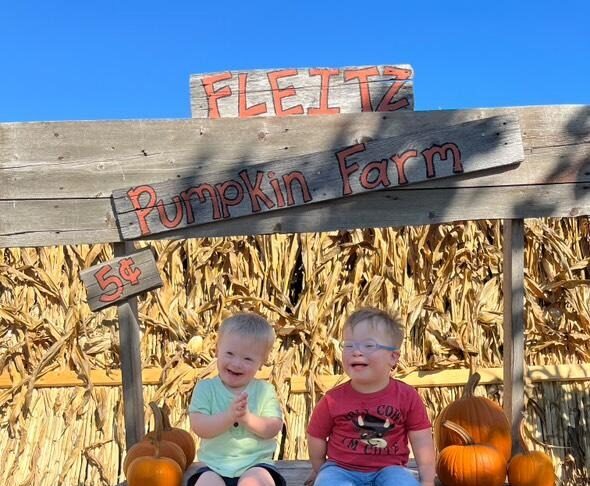
If you know and care for someone who has Down Syndrome, there’s a fantastic resource in the Toledo Area for parents and caregivers: the Down Syndrome Association of Greater Toledo (DSAGT) serves 17 counties in northwest Ohio, along with a few counties in southeastern Michigan.

Executive director, Krista Jensen, has always been drawn to the Down Syndrome community. She followed a number of families on Instagram who had children with Down Syndrome and shared openly about the struggles and the joys. When she met the former director of DSAGT at a local networking event, they hit it off and Jenson joined the board of directors for several years. She then applied for the role of executive director when it opened up due to the former director relocating.
“The organization started in the 80s as a parent group,” says Jensen. “Parents felt there wasn’t enough support for their children. In the 80s, it wasn’t all that long ago when parents who had babies with Down Syndrome weren’t encouraged to take those babies home. So many ended up institutionalized.”
Misconceptions about Down Syndrome
Jensen runs into a lot of misconceptions, noticing they do not always understand what a person with Down Syndrome’s life can be like and all they can be capable of.
When parents first get a diagnosis, often they are asked directly if they would like to terminate the pregnancy. Jensen finds that many parents are understandably concerned about what their child’s quality of life will be like.
“At one point,” said Jensen, “a Down Syndrome person’s life expectancy was only 20 years. A lot of that was medically related, but secondly, they weren’t being included in society or schools–they weren’t even being taken home. They didn’t have a lot to live for.”
More societal inclusivity
With organizations like DSAGT, and more societal inclusivity, people with Down Syndrome now lead thriving lives: going to school, making friends, working or going to college. There are many more opportunities.
“A national Down Syndrome organization did a study a few years ago,” said Jensen, “and 99% of the survey recipients with Down Syndrome agreed they were happy with their life. And the same was true of the parents. Parents stated they would not change who their child is.”
Another misconception is the assumption that people with Down Syndrome are perpetually happy. “Yes, they may have a more positive outlook on life,” said Jensen, “but just like everybody else, they have days where they struggle with depression, anxiety and sadness.” Lauren Stout, a mother of a 4y/o, Miles, with Down Syndrome, relates, “People with Down Syndrome have every emotion that we do,” she said. “They might be happy a lot, but I believe that’s because they see the good in everything. When you see the good in everything, there’s not much that’s gonna bring you down. My son will get mad that he can’t always eat what he wants, or go outside—just a normal toddler tantrum. But he is genuinely happy to be around people he loves and to do things he enjoys.”
Jensen, shockingly, was once asked by a reporter if people with Down Syndrome can talk. “We always encourage people to have high expectations for their kids, while also meeting them where they’re at. They’re more capable than anyone really realizes,” Jensen said.
Connecting with community
Stout received Miles’ diagnosis when she was 20 weeks pregnant. After the diagnosis, she spent countless hours online doing research and ended up getting connected to another local mom of a Down Syndrome child on Instagram, who connected Stout with DSAGT.
“I went to my first event and got sucked into the community,” Stout said with a laugh. “It’s been the greatest thing I could have ever imagined–the friendships, assistance, seeing what’s ahead.”
For a family that has just received a Down Syndrome diagnosis, Stout said it is totally normal to grieve what a family thought their child’s life would be like. In some ways, Down Syndrome children are very typical: they love to watch Toy Story, play outside, be with friends, and eat cookies and pizza. But they also have to work a lot harder to achieve typical developmental milestones.
Stout sees society as too focused on a person’s life being “perfect,” and that’s just not realistic. “I’ll see this a lot in the medical field,” she said. “They want to keep digging, asking, what’s wrong? They see the negative before they see the positive. You have to step back and look at it a different way. When you have a child with Down Syndrome, your view on life changes drastically.”
DSAGT programing for parents and children
“When parents first get a diagnosis and reach out to us,” said Stout, “we’ll offer to send them a new parent welcome bag that includes items for the baby, Down Syndrome and DSAGT resources, a book for the parents— it’s pretty popular. It’s a nice warm welcome, because a lot of parents, at that point, haven’t gotten a lot of congratulations. But this should be exciting—you’re welcoming a baby into your life! That should be celebrated.”
Events hosted to provide introductions
The DSAGT hosts a new parent breakfast annually. The Toledo Buddy Walk each October is often the first event a new family comes to. The Little Learners program teaches parents how children with Down Syndrome best learn and retain info, and tackle behaviors and potty training and IEPs– all things they may face in the school system. While children rotate between stations learning reading, math, fine motor skills, and more.
DSAGT features IEP assistance, where they attend meetings and help support families. They present school lessons with engaging presentations to help students and teachers learn more about Down Syndrome. For teens and young adults, they have OpenSpot Theater, where teens enjoy singing, dancing, and acting. Society 21 is for people aged 16 and up with Down Syndrome to enjoy organized activities while building friendships.
But the most important thing, Stout said, for new families is to connect with other families. The DSAGT has a closed parent support group on Facebook and a What’s App group as well. To learn more about the DSAGT, visit dsagt.org.

