
Most parents today don’t really know about measles. They may have heard stories about their parents having the disease when they were kids. They’ve probably seen photos of the dotted rashes on the scalps and backs of children, but don’t really know what it all means—or how serious it can be.

Forty years ago, Dr. R. W. Mills’s medical school mentor chastised him for his lack of understanding about eradicated diseases. “He said, ‘Out of sight, out of mind’ about them,” Dr. Mills, Chief Medical Officer of Nationwide Children’s Hospital in Toledo, explained. “What a lesson I learned! We have been so overwhelmingly successful in containing measles, that many parents figure that they can risk not having their children vaccinated.”
The scary facts about measles
Before the 1960s, it was estimated that 3 to 4 million people had the measles every year. But after the vaccine’s introduction in 1963, everyone was vaccinated against measles, explained ProMedica’s Mary Ellen Pizza, M.D. By 2000, measles were declared eliminated in the U.S.

But recent reductions in children being immunized has caused the infection numbers to rise. According to the National Foundation for Infectious Diseases, more than 1,290 cases were confirmed in 2019. More recently, in 2025 there were 2,144 cases confirmed. And as of April 2026, 1,814 confirmed measles cases have been reported in 36 U.S. states. Of those cases, 92 percent were among people who were unvaccinated or whose vaccination status was unknown. “These numbers are likely massively under-reported,” said Mills. “Especially in the areas of outbreaks, parents aren’t getting their kids tested.” “Measles is a viral illness that is highly contagious,” said Pizza. “And there is no treatment. The virus, which lives in the nose and throat, spreads easily through breathing, coughing and sneezing. It can live up to 2 hours on surfaces and in the air.”
Symptoms & complications
Dr. Pizza relates the “three Cs” of measles symptoms:
• Cough (usually a dry cough accompanied by feeling generally bad)
• Coryza (a runny nose)
• Conjunctivitis (inflamed, watery, red eyes)
These symptoms are usually accompanied by a high fever. Next are the Koplik Spots—tiny, white-blue spots with a red, halo-like background found inside the cheeks, in the mouth. Pizza said these spots usually appear 1-2 days after the fever (in the pre-eruptive stage of the disease) and disappear in a couple days. After the spots are gone the rash begins. This most contagious part of the disease typically begins on the head, and spreads to the extremities in the next 3-4 days. Complications from measles can be wide-ranging, from ear infections or diarrhea to more severe issues like pneumonia and encephalitis (inflammation or swelling in the brain).
Complications can also be long-lasting or return years later. And of 1,000 children who contract measles, 1 or 2 will die.
Education, support
“We want children to go to school in a safe environment,” explained Mills. “Immunization protects the entire community, especially the kids who cannot get the immunization (babies under 12 months old, pregnant women and those who are immune-compromised). The single most important factor in immunization is a family’s relationship with their medical provider.”
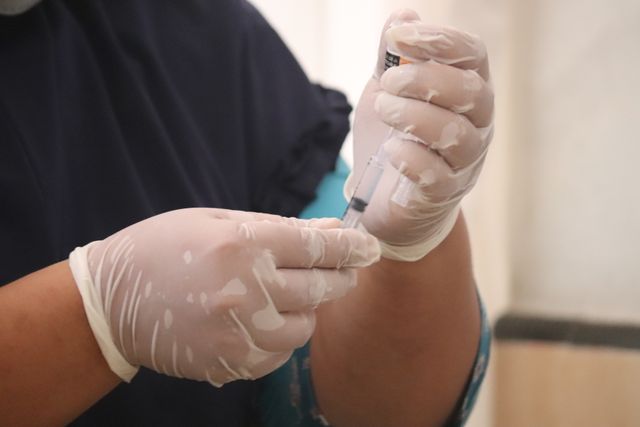
Most pediatricians in the northwest Ohio region begin with the assumption that children will be immunized (the two-dosed measles, mumps, rubella (MMR) vaccine). Then if parents have questions, their physician can explain the benefits of immunization.
“Parents are confused,” Dr. Mills said. “We’re seeing more vaccine-curious families and believers in natural immunity. We listen to these concerns and go through the pros and cons of vaccinations.” A child will build a 93 percent immunity after the first vaccine and a 97 percent immunity after the second. “We’ve had a long, long stretch of incredible success with immunization,” explained Mills. “We have to educate families to get back to full immunity.”

